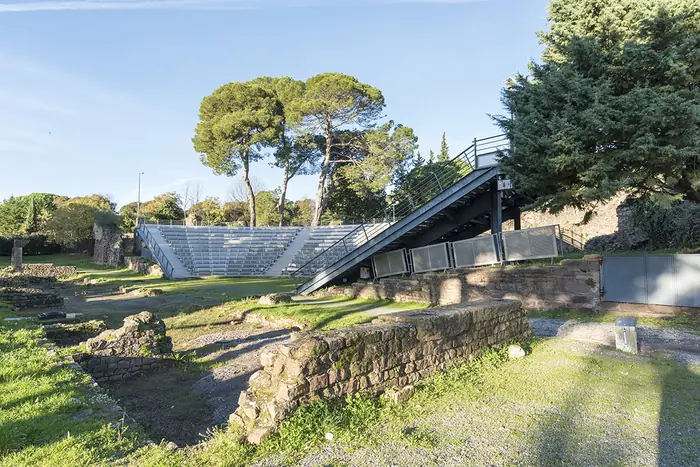
There is a particular quality of light in Fréjus at dusk — the kind that turns limestone the colour of old honey and makes the shadows between stones look almost liquid. Standing at the foot of the curved cavea of the Théâtre romain Philippe Léotard, with the last warmth of a June evening settling on your shoulders, it is not difficult to understand why the Romans chose this hillside in the first place.
On 13 and 14 June 2026, the theatre opens its ancient stone tiers for a programme of popular performance combining music, song, and dance. The venue is the Théâtre romain Philippe Léotard, at 175 Avenue du Théâtre Romain — a name that requires no further translation.
Forum Iulii, Then and Now
Fréjus was founded as Forum Iulii — Julius Caesar's market town, later expanded under Augustus into a significant naval base and colonial city. The theatre itself was built during the first century of the common era, positioned in the north-eastern quarter of the city, close to what was then the Porte de Rome. Its plan follows the classical Greco-Roman model: a hemicycle of tiered seating fanning outward to face the stage, with a solid rear wall — the scaenae frons — that once carried sculpted decoration and provided a monumental backdrop for the actors.
What survives today is more than a ruin in the conventional sense. The standing remains are substantial enough to make the building's overall structure legible — you can read the logic of the space, follow the geometry of the seating banks, and begin to reconstruct in your mind the scale and ceremony of the original structure. This is not a site where imagination must do all the heavy lifting.
'Les vestiges encore en élévation rendent lisible la structure globale du bâtiment et laissent imaginer les dimensions et le décor d'apparat de cet édifice monumental.'
The theatre takes its modern name from Philippe Léotard, the French actor and singer born in Fréjus in 1940, whose career ranged across film, theatre, and chanson. The dedication is fitting: a performing arts space named for a native son who spent his life in the service of exactly the arts it now hosts.
What to Expect on the Night
The programming at the Théâtre Philippe Léotard has historically favoured work with broad appeal — performances that draw together different disciplines rather than presenting any single form in isolation. The June 2026 dates continue this approach, with evenings that mix music, song, and dance. Specific acts and scheduling details are available through the city of Fréjus's cultural programme at ville-frejus.fr.
The experience of attending is shaped as much by the setting as by whatever appears on stage. Ancient theatres impose their own dramaturgy. The semicircular cavea means that even in a large gathering, the sightlines are intimate; the acoustics, designed two millennia ago without electronic assistance, carry sound with a directness that modern venues rarely replicate. Arriving before the performance begins — while the sky above the stage wall is still pale blue and the stone is still holding the warmth of the afternoon — is not incidental to the evening. It is part of it.
For those combining the event with a wider visit, Fréjus rewards time. The old town holds one of the most complete ensembles of Roman infrastructure in France: an amphitheatre, aqueduct remains, the Lanterne d'Auguste at the edge of what was the harbour, and the archaeological museum. The Cathedral quarter, with its early Christian baptistery dating to the fifth century, adds another layer entirely. The Var coast — Sainte-Maxime visible across the gulf, the Massif de l'Estérel rising red to the west — provides the kind of backdrop that reminds you why people have been building cities on this shoreline for a very long time.
Two evenings in June, then, at a theatre that has been waiting almost two thousand years for the audience to return. The stones, at least, are patient.