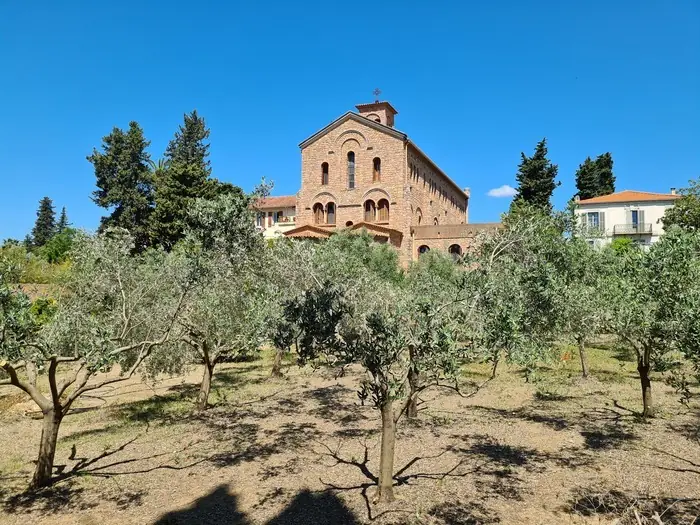
On the edge of the old town of Hyères — France's oldest winter resort, favoured by Queen Victoria and Robert Louis Stevenson alike — there is a garden that most visitors never see. It sits behind a convent wall on Rue Victor Hugo, shaded and unhurried, belonging to a world that moves at its own pace. On the evening of Friday 5 June, that wall opens.
The Jardin du Couvent Sainte-Marie des Anges is the setting for a visite théâtralisée — a guided theatrical visit — organised through the city's Heritage Service. The event begins at 17h00 and takes place at the convent at 5 Rue Victor Hugo, in the heart of Hyères. It is, by design, something between a tour and a performance: the heritage guide leads, but the residents of the site join in, lending the visit a quality that no conventional guided walk can manufacture.
A Convent Turned Residence
The building itself was constructed in 1930 — relatively recent by the standards of a town whose medieval quarter dates to the twelfth century, yet old enough to carry its own particular atmosphere. Today it operates as the Ensoleillado residence, part of the Umane group, which means the convent's cloistered life has given way to something more open: a community of residents who have made these sun-warmed walls their home. That continuity — from religious community to civilian one — gives the place a layered quality that a purely historic site would lack.
Hyères has always attracted people who wished to stay longer than a holiday allows. The Var coast's microclimate, sheltered by the Massif des Maures and warmed by the Mediterranean, made it a destination for convalescents and aristocrats throughout the nineteenth century. Palms were planted along its avenues before they appeared anywhere else on the French Riviera. The town's relationship with gardens is old and considered: the Villa Noailles, just uphill, remains one of the most celebrated modernist gardens in the south of France. Sainte-Marie des Anges belongs to a different register — quieter, more domestic — but it shares that Hyèrois instinct for cultivated beauty.
What the Visit Offers
The theatrical format matters here. Rather than a recitation of dates and architectural features, the visit is shaped by the presence of the residents themselves, who bring the space alive in a way that a guide alone cannot. The Heritage Service of Hyères has developed this kind of participatory approach as a way of making patrimony feel inhabited rather than preserved under glass.
What a visitor can expect:
- A walk through the convent garden, with its 1930s architectural context explained by the heritage guide
- Contributions from residents who know the site as a place of daily life
- A late-afternoon light that, in early June on the Var coast, is reliably golden and long
No ticket price is listed for the event, and visitors are advised to confirm conditions directly with the organisers before attending.
There is something quietly radical about this kind of visit. The garden is not a museum exhibit — it is someone's home, and the people who live there are not performers in a strict sense, but witnesses. Their presence transforms the tour into something more like a conversation across time: between the building's 1930s origins, its religious past, its present as a residence, and the city that has grown around it.
Hyères in early June sits at the precise moment before the summer crowds arrive in earnest. The markets are full, the mimosa has long finished and the bougainvillea is taking over, and the old town's stone streets hold the warmth of the day well into the evening. A 17h00 start means you arrive in the heat of the afternoon and leave, likely, in the softer light of early evening — which is, on the Côte des Maures, a very good time to be anywhere at all.
For those who find the standard Riviera itinerary — beaches, rosé, the motorway west toward Cannes — insufficient, Hyères consistently rewards a slower approach. This garden, on this evening, is an invitation to look at the town from the inside out.