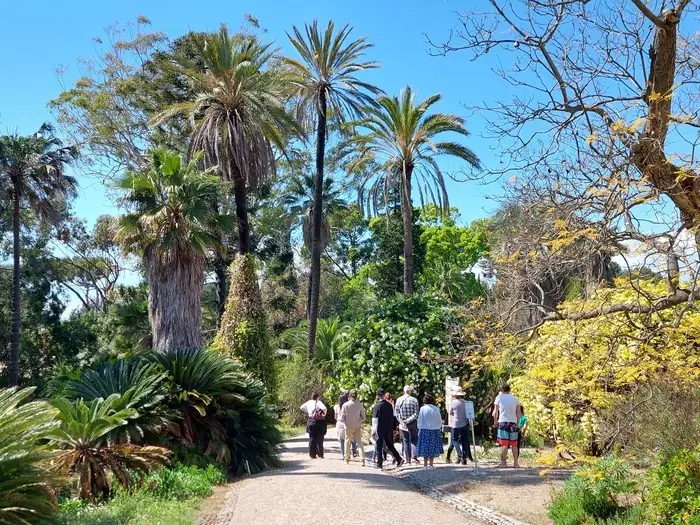
There is a particular quality of light in Antibes on a Sunday afternoon in early June — the kind that turns limestone walls the colour of old parchment and makes the shadows of umbrella pines fall long and deliberate across gravel paths. On the Chemin Raymond, a quiet lane that most visitors to the city never find, a wrought-iron gate marks the entrance to the Jardin Botanique de la Villa Thuret. Step through it and the sound of the Côte d'Azur — its traffic, its tourist-season chatter — recedes almost immediately.
The garden occupies 3.5 hectares of paysager parkland, conceived in the romantic tradition of the nineteenth century: sweeping, unhurried, with planting that suggests discovery rather than display. It is not a garden designed to impress at a glance. It rewards patience, and it rewards return visits. Which is precisely why, on Sunday 7 June 2026, INRAE — France's national research institute for agriculture, food and the environment — is opening the Thuret to guided visits for the afternoon.
A Living Laboratory on the Cap d'Antibes
The Jardin Thuret is not merely decorative. It is administered by the Unité de Recherche Expérimentale Villa Thuret of INRAE PACA, which means that what looks, at first glance, like an exceptionally beautiful park is in fact a working scientific collection. The trees and shrubs gathered here — many of them exotic species in various stages of acclimatisation — represent decades of patient horticultural and botanical research. The garden sits within a broader French tradition of acclimatisation gardens that flourished along the Mediterranean coast from the mid-nineteenth century onward, when the mild winters of the Riviera made the region a natural testing ground for plants arriving from North Africa, the Levant, the Americas and the Far East.
This particular garden carries the name of Gustave Thuret, the nineteenth-century French botanist and algologist who established the property. The romantic landscaping style he favoured — loose, naturalistic, with specimen trees positioned to be read individually against open lawn — is still legible in the garden today, even as the scientific mission has evolved considerably around it.
'Des techniciens INRAE en expérimentation et production végétales commenteront votre visite à la découverte des magnifiques collections originales du jardin et de leurs secrets.'
What the Afternoon Holds
The format is deliberately accessible. Two separate guided tours depart on the afternoon of 7 June: one at 14h30, a second at 15h00. No advance registration is required — visitors simply arrive and join whichever departure suits them. The guides are not professional tour leaders but INRAE technicians specialising in plant experimentation and production: people who work in this garden, who know its specimens not as labels on stakes but as subjects of ongoing study. That distinction matters. The commentary they offer will be grounded in the actual research conducted on site, which lends the visit a texture that a conventional horticultural tour rarely achieves.
For those arriving from Antibes town centre, the address — 90 Chemin Raymond, 06160 Antibes — is most easily reached by car or taxi; the garden sits on the Cap d'Antibes, removed from the main tourist circuits. Allow time before the tour to walk the outer perimeter of the garden if the gate permits early entry, or to find a shaded spot on the lane where the stone walls are already warm by early afternoon.
What a visitor is likely to encounter inside: exotic tree species at various stages of acclimatisation, the layered canopy of a mature paysager park, and the particular silence of a place that has been tended, with scientific seriousness, for well over a century. The Thuret is not a garden that announces itself. It accumulates — slowly, visit by visit — and an afternoon spent here in the company of people who understand it deeply is, by any measure, time well used.
Further information is available at the garden's official site: jardin-thuret.hub.inrae.fr. The tours are free to join; no ticket, no reservation, no agenda beyond curiosity.