There is a particular quality of light on the Suquet in early September. The summer crowds have begun to thin, the mimosa is still weeks away, and the stone lanes that climb toward the old watchtower hold the morning cool a little longer than the seafront below. It is precisely the right moment to arrive with empty hands and no particular agenda — which is, of course, the only correct way to attend a vide-grenier.
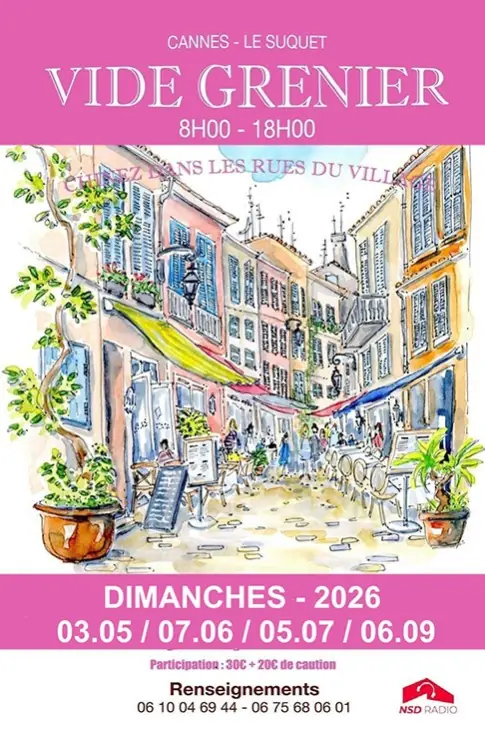
On Sunday, 6 September 2026, the Association Village du Suquet takes over the Place du Suquet and the surrounding streets — Rue Saint-Dizier, Rue du Pré, Rue Coste Corail and Rue Perrissol — for its annual neighbourhood clear-out. The event runs from eight in the morning until six in the evening, and admission for visitors is free.
A Neighbourhood With Something to Say
The Suquet is the oldest part of Cannes, a compact hill of ochre and pale limestone that predates the resort city by several centuries. While the Croisette below was still marshland, fishermen and merchants were already navigating these same lanes. The watchtower — the Tour du Suquet — dates to the eleventh century; the church of Notre-Dame d'Espérance, which anchors the summit, was begun in the sixteenth. To walk here on an ordinary afternoon is already to feel the city at a different register. To walk here when its residents have carried their surplus lives out onto the cobblestones is something else entirely.
The vide-grenier — literally, 'attic emptying' — is a French institution that sits somewhere between a car-boot sale, a brocante and a neighbourhood social event. It is less curated than an antique fair and more personal than a market. The objects on offer tend to carry a domestic history: a lamp that stood in someone's salon, a pair of shoes worn twice, a paperback with a previous owner's name pencilled inside the cover.
What You Will Find
The Association Village du Suquet describes the range of goods broadly, which is accurate — this is not a specialist fair. Expect:
- Decorative objects and small furniture
- Clothing, shoes and accessories
- Toys, books and vinyl records
That last category deserves a moment's attention. French households of a certain generation accumulated record collections of real substance, and a Sunday morning spent flipping through crates on a Provençal hillside, with the bay of Cannes visible between the rooftops, is a particular pleasure that no streaming service has yet managed to replicate.
Stall holders — private individuals rather than professional dealers — pay a participation fee of €30 plus a €20 deposit to exhibit. The relatively modest cost tends to attract genuine locals clearing out genuine clutter, which keeps the atmosphere neighbourly rather than commercial.
'On y trouve des objets de décoration, meubles, vêtements, chaussures, accessoires, jouets, livres et disques.' — Association Village du Suquet
Arrive early if you are serious about the hunt. By nine o'clock the serious browsers are already at work, and the better pieces — a mid-century ceramic, a silk scarf in a pattern that no longer exists, a complete set of Pléiade editions — will not wait until noon. That said, there is a different, quieter pleasure in arriving at eleven, when the initial rush has passed, the vendors have settled into their chairs and the conversations become longer and more digressive.
Practical Matters
The Suquet sits a short walk from the Palais des Festivals and the old port. The streets involved are narrow and largely pedestrianised on event days, which makes the whole thing feel more like a village fête than a civic market. Wear shoes you can walk in — the cobblestones are uneven — and bring cash. Not every stall will accept a card payment, and there is something faintly absurd about negotiating over a €3 paperback with a contactless terminal.
September in Cannes still carries warmth, but the light by late afternoon turns amber and long, falling across the limestone facades at an angle that makes everything look slightly more valuable than it is. That, perhaps, is the final argument for staying until six: not the objects themselves, but the particular atmosphere of a working neighbourhood at the end of a long, pleasant, unhurried day.