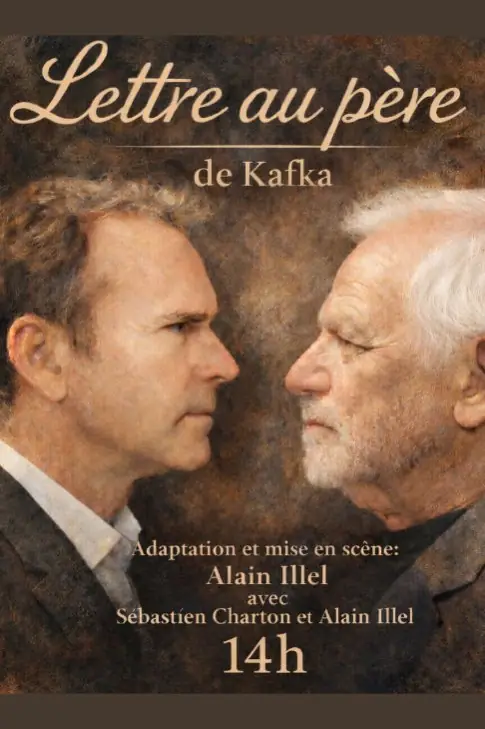
There is a particular quality to Saturday afternoons in Cannes when the season has not yet reached its full roar — the light is sharp off the Croisette, the terraces are filling slowly, and the city holds a moment of stillness before the evening begins. It is in this pause, on 20 June 2026 at 2 p.m., that the theatre space C'Picaud on avenue du Docteur Raymond Picaud will offer something quietly extraordinary: a stage adaptation of Franz Kafka's letter to his father.
The letter itself — written in November 1919, never delivered, running to nearly a hundred handwritten pages — is one of the most raw documents in twentieth-century literature. Kafka addressed it to Hermann Kafka, a self-made Prague merchant of formidable presence and impatient temperament, attempting to articulate decades of fear, inadequacy, and unspoken love. Hermann never read it. The letter was passed to Kafka's mother, who returned it unread to her son. Kafka died in 1924. The text was published posthumously in 1952, and it has haunted readers ever since — not because it is the work of the man who wrote The Trial and The Metamorphosis, but because it reads like something anyone might have written and never dared to send.
Words That Could Not Be Spoken
The adaptation brought to C'Picaud is directed by Alain Illel, who also appears on stage alongside Sébastien Charton. The production runs one hour and ten minutes — long enough to honour the weight of the material, short enough that nothing is allowed to settle into abstraction. Two performers, one text, the architecture of a failed conversation between a son and a father who never quite inhabited the same emotional language.
What makes this kind of theatrical work particularly demanding — and, when it succeeds, particularly arresting — is the absence of plot in the conventional sense. There is no narrative arc to follow, no resolution to anticipate. The tension lives entirely in the words themselves and in the physical presence of the actors who carry them. Kafka's prose, even in translation, has a precise, almost legal clarity; it catalogues grievances and confessions with the same cool attention he brought to his fiction. On stage, that precision becomes something else entirely.
'I was always hiding something from you, in my room, in my books, in my friends — because I could not bear to be seen clearly by you.'
C'Picaud and the Cannes You Don't Always See
The venue itself is worth noting. C'Picaud sits in the residential hills above the old port, away from the festival palaces and the jewellery windows of the Croisette. It is a cultural space that belongs to the everyday life of the city — the Cannes of schoolchildren, local theatre companies, and Saturday afternoon audiences who arrive on foot. Coming here from the seafront involves a short climb through streets of pale stone and flowering bougainvillea; the shift in register is part of the experience.
Admission is 10 euros. There are no tiers, no premium options. The simplicity is appropriate: this is theatre in the oldest sense, a small room, a few lights, language doing the work.
For those spending time on the Côte d'Azur in mid-June — between the end of the film festival and the peak of the summer season — an afternoon at C'Picaud offers something the coast does not always provide: interiority. Cannes is a city of surfaces, of spectacle and display, and there is pleasure in that. But Kafka wrote his letter precisely because the surface had become unbearable. Watching two actors inhabit that unbearability, in a quiet room on a bright Saturday afternoon, is an experience that stays with you longer than the view from the Palais.