The road to Gilette climbs in tight switchbacks through the Estéron valley, leaving the coast's noise behind with each bend. By the time the village appears — pale stone against the limestone ridge, the valley floor a long way down — you feel the particular quietness that the arrière-pays does better than anywhere on the Riviera. It is not emptiness. It is age, accumulated slowly, unhurried.
It is into this context that Pierre-Guy Martelly has built something that resists easy categorisation. He is a ferronnière d'art — a decorative ironworker — and a sculptor, and over the years he has transformed the grounds of the Musée Lou Ferouil, at 3250 Route de Gilette, into an open-air village: not a theme park, not a heritage centre in the institutional sense, but a personal reconstruction of a world he believes is worth keeping. On 27 and 28 June 2026, the museum opens its doors for guided visits — by reservation — to anyone willing to make the drive into the hills.
A Village Within a Village
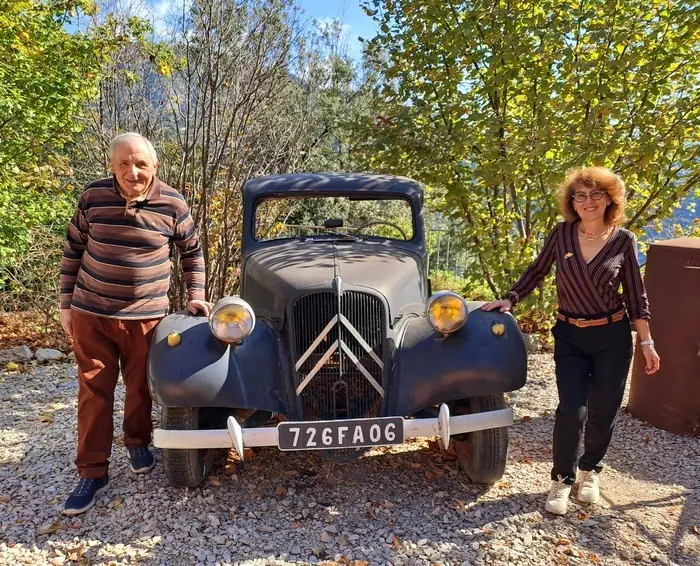
The layout follows the logic of a real Provençal settlement. Streets lead to squares; squares open onto workshops. Along the way, Martelly has assembled the tools, the furniture, the signage and the working equipment of trades that have largely vanished from the region: the cobbler, the cooper, the wheelwright. Vintage vehicles occupy the spaces where carts once stood. The staging is meticulous without being sterile — this is not a museum of glass cases but of open doors, each échoppe arranged as though its owner has just stepped away.
The scale shifts as the route continues. Towards the end of the walk, the scene narrows into something more intimate: a miniature Provençal village, a reconstruction in small of Gilette as it once was. There is something quietly affecting about it — the way compression can make memory more legible. Martelly describes his project in terms that recall Marcel Pagnol's Provence: a world of anecdote, of craft, of particular light and particular smells, preserved not in amber but in iron and stone.
'Ici, chaque rue raconte un métier, chaque échoppe raconte une histoire.'
The Forge at the Centre of It All
The itinerary ends — or rather, finds its point of gravity — at Martelly's traditional forge. This is where the museum stops being a collection and becomes a practice. The forge is in use. The tools are not decorative. Visitors can see the work of ferronnerie d'art as a living discipline: the heat, the rhythm, the particular smell of iron on stone, the way a piece of metal changes under sustained attention.
The Alpes-Maritimes has a long tradition of ironwork — the region's hilltop villages required gates, bells, hinges, balustrades, all produced by local smiths working within constraints of material and terrain. That tradition has largely been absorbed into industrial production. Lou Ferouil is one of the places where it has not.
Gilette itself repays the detour. The village sits at around 400 metres, with views across the Var valley that on clear days reach the coast. The medieval church, the narrow lanes, the washing lines strung between ochre walls — it is, in the plainest sense, a beautiful place to spend a morning. The museum visit, which runs across both days of the weekend, is by reservation only; practical details are best confirmed directly with the venue before arrival.
For those travelling from Nice, the drive takes roughly 45 minutes via the D2209 along the Var. There is no railway. The road itself, once you leave the valley floor, is part of the experience — the gradual withdrawal from the Mediterranean's edge, the olive groves giving way to scrub oak, the air cooling by a degree or two with each kilometre gained. Arrive early enough and you will have the village largely to yourself, the light still at an angle, the stone still cool from the night.