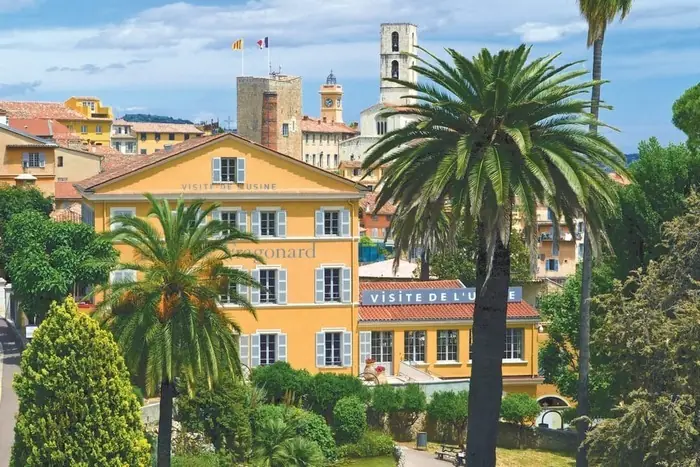
There is a particular quality of air in Grasse that visitors notice before they notice anything else. It arrives before the terracotta rooftops come into view, before the Provençal light flattens everything into gold — a layered, warm complexity that is neither flower nor chemical but something between the two. The town has been producing perfume since the sixteenth century, and the craft is embedded in its stones, its narrow streets, its sense of civic identity. To walk through the old quarter here is to understand, in a bodily way, why this hillside above the Mediterranean became the capital of world perfumery.
On 5, 6 and 7 June 2026, the Parfumerie Fragonard opens its Usine Historique at 20 boulevard Fragonard for guided visits that move through the full arc of production — from the raw materials and their transformation to the finished, labelled object. The factory is not a reconstruction or a heritage attraction assembled after the fact. It is a working facility, and that distinction matters.
A Factory That Predates the Revolution
The building itself was established in 1782 — four years before Mozart composed Don Giovanni, seven years before the storming of the Bastille. In 1926, the house was renamed Fragonard in tribute to Jean-Honoré Fragonard, the Rococo painter born in Grasse in 1732, whose canvases of pastoral pleasure now hang in the Frick Collection in New York and the Louvre. The name was an act of local pride as much as a branding decision, and it stuck. Nearly a century later, Parfumerie Fragonard remains one of the oldest continuously operating perfume houses in the city.
The guided tour follows the logic of the manufacturing process rather than any theatrical sequence. Visitors pass through the perfumer's laboratory — the organ, as it is known in the trade, a tiered structure holding hundreds of raw materials arranged by olfactory family — and into the distillery, where heat and steam coax essential oils from plant matter. The maceration and filtration workshop comes next, then the enfleurage rooms, a cold-process technique that was once the primary method for capturing the scent of delicate flowers like jasmine and tuberose that cannot withstand heat. The conditioning ateliers and the soap manufactory complete the circuit.
"Venez parcourir en notre compagnie le laboratoire du parfumeur et son orgue, le distilloir, l'atelier de macération et de filtrage, ainsi que les salles d'enfleurage, les ateliers de conditionnement et notre savonnerie." — Parfumerie Fragonard
Three Thousand Years in a Single Room
The visit concludes in the house's private museum, where the narrative stretches back three millennia. Perfume as a practice predates the Roman Empire — the word itself derives from the Latin per fumum, through smoke — and the collection traces that long arc through objects, vessels, texts and trade routes. It is the kind of museum that rewards slowness: the cases are dense, the chronology is ambitious, and the connections between ancient ritual and contemporary luxury are made without condescension.
Grasse's position in this history is not incidental. The region's microclimate — warm, sheltered, irrigated by mountain streams — proved ideal for cultivating the flowers that perfumery requires: Centifolia rose, jasmine, mimosa, violet. By the eighteenth century, the town had developed an industrial infrastructure to support the trade, and families like the Chirisses and the Galimards had turned craft into commerce. Fragonard arrived relatively late to that story, but it has outlasted many of its contemporaries.
For a visitor arriving from Nice or Cannes — forty minutes by road, longer by the winding departmental routes that are more rewarding to drive — the Usine Historique offers something that the perfume counters of the Croisette cannot: process made legible. The sequence of rooms, each dedicated to a distinct stage of production, gives the finished bottle a biography. What had been a consumer object becomes, briefly, an industrial and agricultural one, connected to fields and seasons and human labour.
June is well chosen for this. The jasmine harvest in Grasse traditionally begins in late summer, but by early June the landscape around the town is already flowering, the air already carrying the particular density that defines the place at its most itself. To visit a working perfume factory in this moment — windows open, the town outside doing what it has always done — is to catch the industry and its setting in a kind of alignment that the colder months do not offer. Come with time to walk the old quarter afterward. The boulevard Fragonard leads directly into streets that have changed very little since the factory was founded.