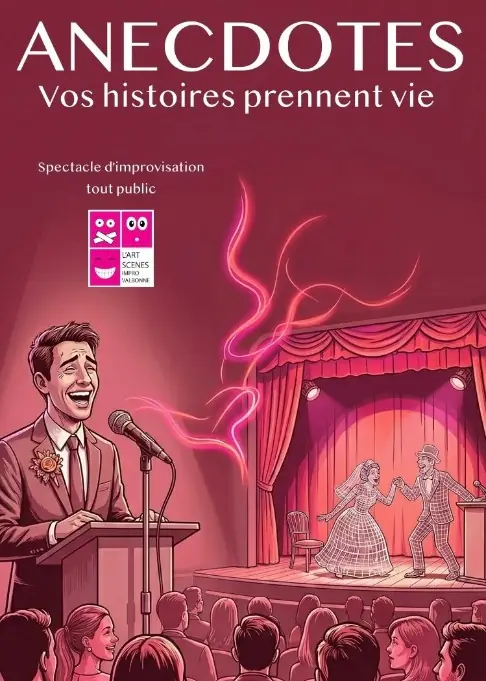
There is a particular pleasure in sitting inside a small theatre knowing that no one — not the performers, not the director, not the couple at the altar — has any idea what is about to happen. That pleasure is the entire premise of Anecdotes, a new interactive improvisation show arriving at the Salle Le Raimu on Friday, 6 November 2026 at 20h30.
The setting is a wedding reception. Julie and Antoine have just said their vows, and now the witnesses are taking the floor — one by one — to share an anecdote. The catch: every story is drawn from the audience. Each confession, memory or mischief offered up by the room is immediately seized upon by the improvisers of the troupe Art Scènes and played out live on stage. Some revelations will be affectionate. Others, the description promises, will be croustillantes — a French word that sits somewhere between 'spicy' and 'crunchy', and is rarely used to describe anything dull. Each one, in its own way, puts the newlyweds' love to the test.
Theatre That Writes Itself
Improvisation theatre has deep roots in French popular culture, from the café-théâtre tradition of the 1960s to the Ligue d'improvisation formats that spread across francophone stages in the 1980s. What distinguishes the form at its best is the contract it makes with the audience: you are not spectators, you are co-authors. Anecdotes takes that contract seriously. The public is described as complice de l'imprévu — an accomplice to whatever unfolds — which is rather more interesting than simply being asked to clap.
The troupe responsible is Art Scènes, whose performers work within the structured chaos of a fictional wedding banquet. The frame is clever: a wedding is already a ceremony built on stories, on the gap between the official version of a couple and the memories held by everyone else in the room. Handing that gap to an audience and a group of improvisers is, in theatrical terms, a sound structural gamble.
'Croustillante, nostalgique ou émouvante' — the show's own description of what each anecdote might become, which covers, more or less, the full range of human experience.
The Venue, the Neighbourhood, the Evening
The Salle Le Raimu sits at Chemin de la Borde in Cannes La Bocca, the western quarter of the city that stretches towards the Estérel massif and has long been a more residential, less festival-circuit corner of greater Cannes. The hall takes its name from Jules Muraire — known universally as Raimu — the Toulon-born actor whose work with Marcel Pagnol gave French cinema some of its most enduring comic and emotional registers. There is a quiet aptness to staging an evening of improvised storytelling in a room that bears the name of a man who made ordinary people's speech sound like literature.
Tickets are priced accessibly: 15 € for the general public, 9 € for MJC Ranguin members and for under-14s, with a Pass Culture Ville de Cannes option at 16 €. The show is listed as tout public, meaning it is conceived to work across ages — a consideration worth noting if you are travelling with family, or simply prefer an evening that does not require advance knowledge of any particular theatrical tradition.
November on the Côte d'Azur is a different proposition from July. The Croisette empties of its summer crowd; the light turns lower and more golden in the late afternoons; restaurants become easier to book. It is, for those who know the region outside its festival season, often the more rewarding time to be here. An evening at a neighbourhood theatre watching performers navigate the chaos of a fictional wedding — armed only with whatever the audience chooses to confess — fits the mood of the month rather well.
The Salle Le Raimu can be found at Chemin de la Borde, 06150 Cannes La Bocca. Full details and booking are available via the Cannes city agenda at cannes.com.