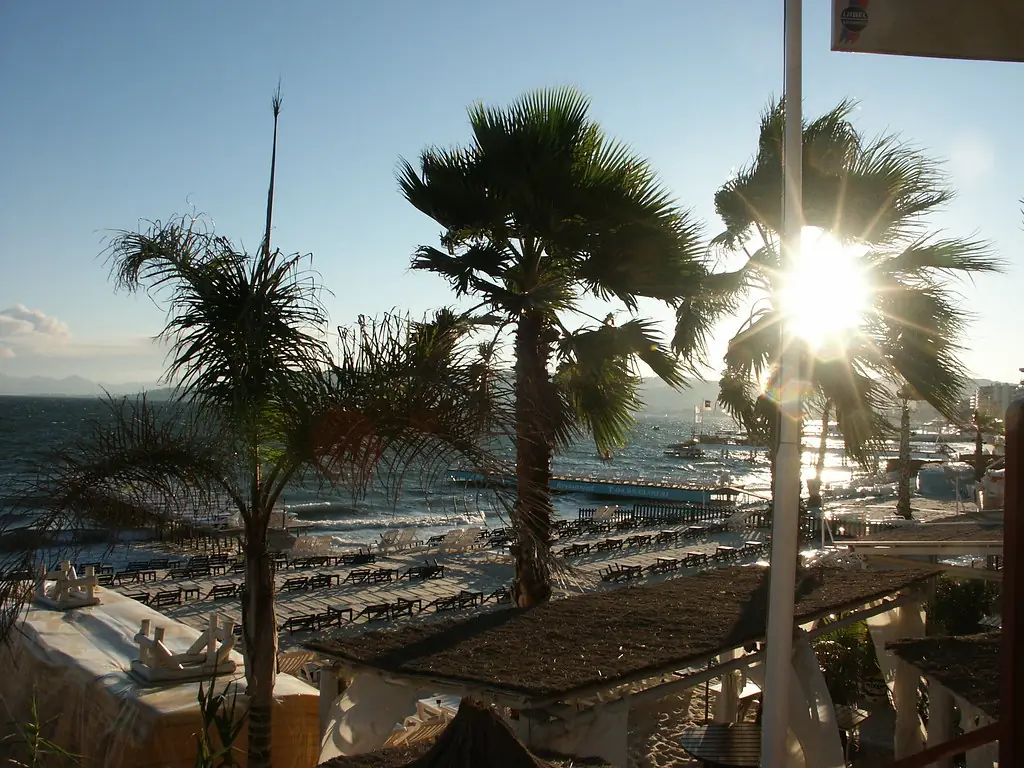
There is a particular quality to music heard outdoors on the Côte d'Azur in summer — the way the last of the evening light lingers over the Mediterranean, the faint salt in the air, the stone pines holding the sound close before releasing it skyward. At the Petite Pinède in Antibes, that combination has been a reliable pleasure for decades. On 10 July 2026, it belongs to Who Parked the Car?
The name alone earns a second glance. It carries the casual irreverence of a band that knows exactly what it is doing — a seven-piece ensemble whose very configuration signals ambition: keyboards and lead vocals from Thomas Salvatore, twin saxophones in the hands of Sebastián Muñoz and Félix Reneault, César Aouillé on guitar, Ludovic Prieur on bass, Malo Ropers on percussion, and Alejandro Dixon behind the drum kit. That is a lot of musicians sharing a stage, and a lot of musical conversation to manage. The brass alone — two saxophonists working in concert or counterpoint — gives the group a richness that smaller combos simply cannot summon.
The Petite Pinède and Its Place in the Jazz Calendar
The venue sits on the boulevard Edouard Baudoin, tucked into the greenery at the edge of Antibes Juan-les-Pins, a town whose relationship with jazz is neither decorative nor recent. Juan-les-Pins has hosted one of Europe's most storied outdoor jazz festivals since 1960, and the Petite Pinède — its intimate pine-shaded stage — has seen artists of every generation pass through. The larger Pinède Gould nearby carries the marquee names; the Petite Pinède tends to reward those willing to show up early and sit close.
For a septet like Who Parked the Car?, that intimacy is an asset. Seven musicians in a tight acoustic space means every textural decision is audible: the moment a second saxophone drops into harmony, the way a percussionist colours the edge of a phrase, the interplay between a Rhodes or organ voicing and a walking bass line. Nothing hides.
'Two saxophones, a full rhythm section, and a vocalist-keyboardist — the instrumentation alone maps a lineage from soul-jazz through funk and into something harder to name.'
The Jammin Summer Session series, of which this concert is a part, takes place under the broader umbrella of the Jazz à Juan festival — a programme that has historically drawn both established international names and emerging ensembles to the same stretch of coastline. Being placed within that context is not a small thing for a young group.
What to Expect on the Night
With a septet of this makeup, a few things tend to follow naturally:
- Extended ensemble passages** where the two saxophones trade or layer lines above the rhythm section
- Vocal contributions from Salvatore at the keyboards, anchoring the harmonic centre while the horns move around him
- The kind of rhythmic density that comes from having both a percussionist and a drummer — Dixon and Ropers together create a foundation with more colour and elasticity than a single kit player could manage alone
The Petite Pinède is an open-air setting, which means the atmosphere shifts with the hour. Concerts here typically begin in the warmth of the early evening and end under a sky that has gone from orange to deep blue. Bring something light to wear once the temperature drops, and arrive early enough to find a good position — the venue's scale rewards proximity.
Antibes itself, a walled old town on a headland between Nice and Cannes, offers no shortage of ways to spend the hours before the music starts. The covered market on the cours Masséna, the ramparts looking out toward the Îles de Lérins, the Picasso Museum housed in the Château Grimaldi where the artist worked in the autumn of 1946 — the town earns its evening unhurriedly. A concert at the Petite Pinède fits naturally at the end of a day spent moving slowly through it.
Who Parked the Car? is a question that may never be answered. What happens on 10 July at the Petite Pinède almost certainly will be.