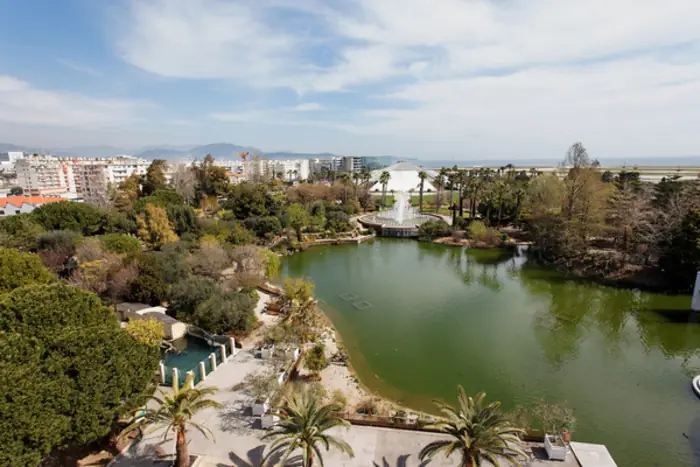
There is a particular quality of light on the Promenade des Anglais in early June — the Mediterranean sun still carrying a certain restraint before the full heat of summer arrives, the air laced with salt and something greener, harder to name. At the western end of that famous seafront, where the road curves toward the airport, Parc Phoenix sits behind its gates like a held breath: seven hectares of cultivated wilderness that most visitors to Nice walk straight past on their way to somewhere else.
On the morning of Friday 6 June 2026, the park invites a small group — limited to twenty people — to slow down considerably. The Parcours sensoriel is a guided discovery walk centred on the plants of Parc Phoenix, approached not through labels and taxonomy but through the five senses: touch, smell, sight, sound, the occasional taste. The session begins at 10h00. Admission and booking details are available at parc-phoenix.org.
A Garden Built for Curiosity
Parc Phoenix opened in 1990, taking its name from the Phoenix palm — arguably the most planted genus along the entire Côte d'Azur, its silhouette as synonymous with this coastline as the limestone cliffs above Èze or the terracotta rooftops of the old town. The park's centrepiece is the Diamant vert, a pyramidal greenhouse among the largest of its kind in Europe under a single span, where tropical and subtropical species grow in carefully staged exuberance. An iguana moves through the pandanus with its stilt roots; pink flamingos animate a small lake. Outside, some twenty themed gardens unfold around a larger lake edged with Mediterranean terraces and a cascade.
The palm collection alone rewards close attention: butyagrus from Brazil, fishtail palms, Afghan palms — a living record of what this climate can sustain and, increasingly, what it might sustain in a warmer future. The park has been quietly planting tree species selected for their potential resilience to drought and climate shift, a long experiment conducted in plain sight. A Provençal garden sits beside a traditional kitchen garden and a plantation of œillet niçois, the carnation that once defined the region's cut-flower trade. A collection of salvias complements the holdings of Nice's botanical garden. The Île des temps révolus — Island of Bygone Times — gathers cycads and swamp cypresses, species that predate the dinosaurs, beside planted craters shaded by pergolas.
What the Walk Offers
The Parcours sensoriel asks participants to engage with this landscape differently from the usual garden visit. The programme, as described by the park, is a discovery of the different senses through plants — which in practice means pausing at a leaf to register its texture, leaning into a flower to understand what the nose knows before the eye does, listening to what a garden actually sounds like when you stop moving through it.
Because the group is capped at twenty, the experience has an intimacy that larger guided tours rarely achieve. There is room to linger, to ask questions, to let the guide's knowledge settle rather than rush past it. The format suits the park well: Parc Phoenix is not a place that rewards speed.
"Parcours sensoriel, découverte des différents sens à travers les plantes" — the event's own description, spare and precise, leaves the imagination room to work.
For visitors already in Nice for the early summer — before the Riviera's July crowds compress the coastline into something less itself — the morning fits naturally into the rhythm of the city. The park is at 405 promenade des Anglais, reachable on foot from the city centre or by tram. Afterward, the Promenade stretches east toward the Vieux-Nice and the Cours Saleya market, which by late morning will still have vendors and the particular smell of cut flowers that has defined this city's mornings for centuries.
Nice has always been a city that understands pleasure as something requiring attention — the right table, the right light, the right moment. A morning spent learning to read a garden through your hands and your nose rather than your eyes is, in that sense, entirely in keeping with where you are.