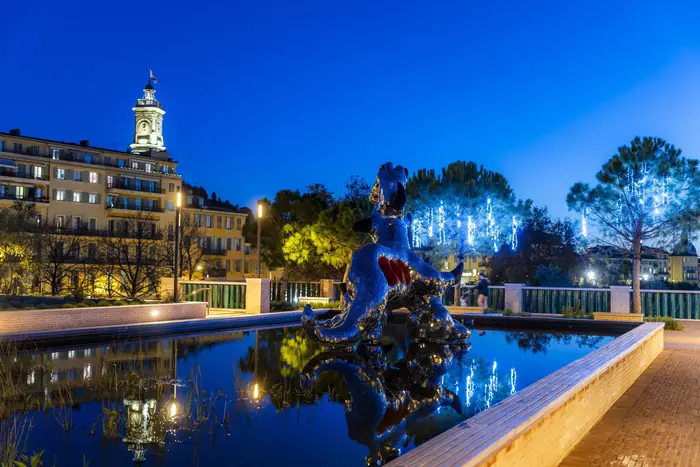
On a June morning in Nice, the esplanade de la Bourgada sits at an odd threshold. Behind you, the angular concrete facade of MAMAC — the city's museum of modern and contemporary art — casts a clean geometric shadow. Ahead, the long green ribbon of the Promenade du Paillon stretches south toward the sea, its lawns and fountains so composed, so deliberately civic, that it takes a moment to remember what lies beneath: a river. The Paillon, channelled and covered over the course of the twentieth century, runs under this entire promenade, invisible but present, shaping the ground you walk on.
This is precisely the starting point — literally and conceptually — for La Promenade du Paillon, Saison 2, a guided walking tour offered on Saturday, 6 June 2026, with sessions at 10h00 and 15h00. The meeting point is the esplanade de la Bourgada, at the top of the staircase leading up to MAMAC, at 10 Boulevard Jean Jaurès. The tour is organised by the Direction des Patrimoines de Nice, in partnership with the Muséum d'Histoire Naturelle, and led jointly by guides from the city's Ville d'Art et d'Histoire service and mediators from the Muséum's own education team.
Two Voices, One Landscape
What distinguishes this tour from a standard heritage walk is its dual structure. The format — visite à deux voix, a visit in two voices — pairs the architectural and historical perspective of a Ville d'Art et d'Histoire guide with the natural and scientific lens of a Muséum d'Histoire Naturelle mediator. The result is a layered reading of a single urban corridor: the same stretch of ground examined for its built heritage, its historical memory, its ecological logic, and its geological character simultaneously.
Nice has held the Ville d'Art et d'Histoire label since 2002, a national designation that recognises cities with an active commitment to architectural and heritage education. The guides who carry that accreditation are trained to read a city's fabric closely — not just monuments, but streetscapes, urban planning decisions, the evidence of successive eras written into stone and concrete. Alongside them, the Muséum d'Histoire Naturelle brings a different kind of attention: to soils, to water systems, to the plant life that colonises urban edges, to the natural history that underlies any human settlement.
The River Beneath the City
The Paillon itself is the quiet protagonist of the walk. For centuries it was the eastern boundary of old Nice, a torrent that flooded unpredictably and defined the city's limits as firmly as any wall. The gradual decision to cover it — a process that unfolded across decades of the twentieth century — transformed the riverbed into one of Nice's most significant public spaces: first the Jardin Albert Ier, then the esplanade du Général de Gaulle, and eventually the full Promenade du Paillon, inaugurated in its current form in 2013. The promenade runs nearly a kilometre from the Théâtre National Nice to the sea, threading between the old town and the newer city.
"The Paillon is not absent — it is simply below the surface, still moving, still shaping the ground above it."
To walk this corridor with guides trained in both heritage interpretation and natural history is to read the city in a way that a solitary stroll cannot offer. The fountains and play areas and planted terraces of the modern promenade sit on top of a hydrological reality that the tour makes legible. The sediment layers, the flood histories, the engineering decisions — these are the kinds of details that require someone who knows where to look.
No ticket price is listed for the event, and prospective visitors should verify conditions and booking requirements directly with the organisers ahead of the date. The two time slots — morning and afternoon — allow for some flexibility depending on how you have arranged the rest of a June day in Nice.
June on the Côte d'Azur is a particular kind of month: the summer crowds are building but have not yet peaked, the light is long and clear, and the city still belongs, at least partially, to people who live in it. The Promenade du Paillon on a Saturday morning, before the heat settles in, is a place where locals walk dogs and children run through the misting fountains. It is, in other words, a good moment to look more carefully at what the city has made of its buried river — and to understand why it matters.