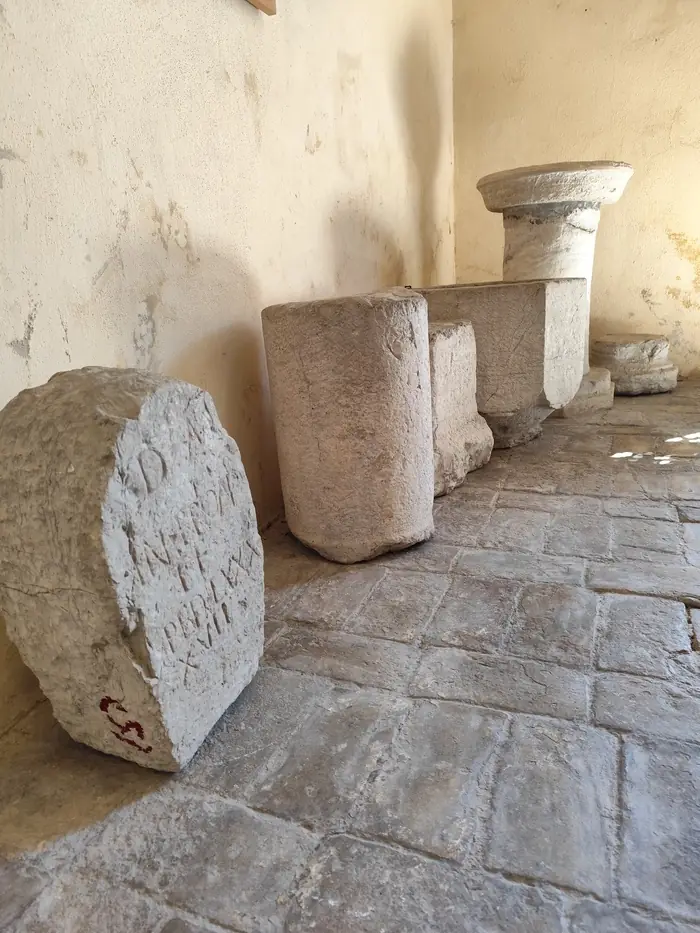
There is a particular quality of light in Vence on a Saturday morning in June — slanted, warm, arriving early over the limestone ridges of the Préalpes d'Azur before the heat has settled in for the day. On the Boulevard Emmanuel Maurel, the Chapelle Sainte-Anne sits with the quiet self-possession of a building that has been here long enough to stop explaining itself. Most visitors pass it without pausing. Those who do pause rarely suspect that the stones in its walls have something to say — and that, given the right guide, they will say it in Latin.
Vintium Beneath the Surface
Vence is not a Roman city in the obvious sense. It does not have a forum you can walk across or an amphitheatre you can photograph from the surrounding hills. What it has is something more intimate: fragments of the ancient city of Vintium embedded in the fabric of later buildings, repurposed and half-forgotten, waiting to be read. The Chapelle Sainte-Anne is one of the best places in the town to encounter this layering. Its walls preserve Latin inscriptions — epigraphic remnants of a settlement that was, two millennia ago, a functioning Roman civitas in the province of Alpes-Maritimae.
Epigraphy — the study of inscriptions carved into stone — is one of the quieter disciplines of classical archaeology, but it rewards attention disproportionate to the effort. A few lines of chiselled text can record a name, a dedication, a date, a civic honour. Collectively, across a site, they build a portrait of who lived there, what they valued, and how they wished to be remembered.
'Parcourez les inscriptions latines de la chapelle Sainte-Anne, souvenirs de l'antique cité romaine de Vintium.'
What the Tour Offers
On Saturday 13 June 2026 at 10:30, the Chapelle Sainte-Anne hosts a guided tour as part of the Journées Européennes de l'Archéologie — the European Archaeology Days, an annual programme that opens archaeological sites and collections across France and neighbouring countries to the general public. The title of the tour, loosely translated, is an invitation to 'find your Latin again at the Chapelle Sainte-Anne': a gentle jest that assumes you once had some, and a reassurance that you do not strictly need it.
The meeting point is in front of the chapel itself, on the Boulevard Emmanuel Maurel in Vence. The tour is free and open to all, but places must be reserved in advance by calling 04 93 58 06 38.
What the tour covers, precisely, follows the inscriptions preserved in the chapel — stone by stone, line by line. For those with no Latin at all, it is an introduction to a script and a language that shaped the legal, religious and civic vocabulary of Europe for more than a thousand years after Rome itself had ceased to function. For those with a schoolroom memory of declensions and ablatives, it is something more pleasurable: the moment when dead grammar meets living stone, and the two suddenly make sense of each other.
Vence itself is worth arriving early for. The old town — the cité médiévale enclosed within its near-complete ring of ramparts — is one of the best-preserved in the Alpes-Maritimes. The cathedral, built on the site of a Roman temple, contains a mosaic by Marc Chagall, installed in 1979 in memory of a friend. The market on Place du Grand Jardin runs on Tuesday and Friday mornings. The drive up from the coast, through the Gorges du Loup or along the Route de la Corniche, takes roughly forty minutes from Nice and rather less from Antibes, and repays the detour even without a destination in mind.
The Journées Européennes de l'Archéologie take place across a single weekend each June, coordinated by the Institut National de Recherches Archéologiques Préventives. The programme spans hundreds of events across France alone — excavation site visits, museum openings, workshops, lectures — but the smaller, locally rooted tours like this one tend to offer something the larger events cannot: proximity, specificity, and the sense that the person talking to you has spent years thinking about this particular wall, in this particular town.
Bring comfortable shoes, a hat if the sun is already strong by half past ten — in June in Vence, it may well be — and perhaps a notebook. The inscriptions do not move, but the details, once pointed out, have a way of staying with you long after you have driven back down to the coast.