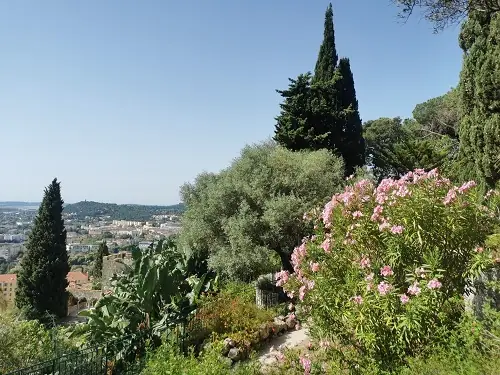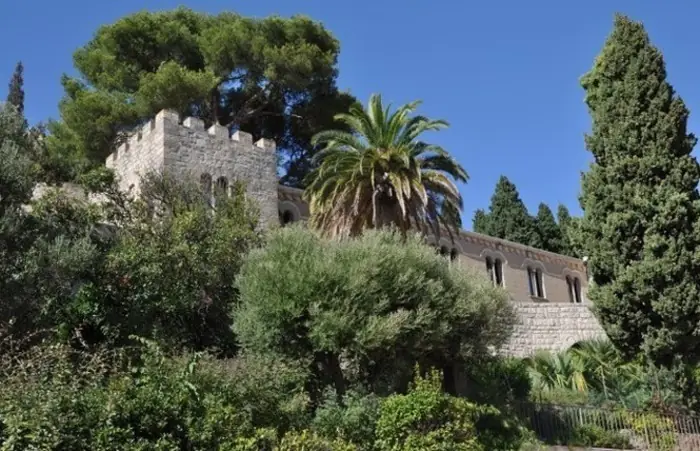
There is a particular quality of light in Hyères on a June morning — slanted, still warm at the edges, carrying the faint salt of the Mediterranean before the mistral has had a chance to complicate things. It arrives early over the old town and settles first on the terraced hillside gardens of the Parc Sainte-Claire, where stone walls hold the heat of Bormes limestone and the fronds of a dragon tree cast shadows that barely move. This is the setting for a photography workshop on Sunday 7 June 2026, beginning at 9 a.m. — an hour chosen, one suspects, with some understanding of what the light does here.
The workshop is led by Virgil Prudhomme and takes place within the grounds of Parc Sainte-Claire, at 7 Avenue Édith Wharton, Hyères. Participants are invited to bring a smartphone or camera — no specific equipment is required — along with water and sun protection. The session combines technical instruction (framing, subject selection, photographic technique) with hands-on artistic practice in the field: composition, planes of depth, light, colour. It is, in the best sense, a working session in an extraordinary outdoor classroom.
The Garden Behind the Name
The address itself is a quiet provocation. Édith Wharton — Pulitzer Prize-winning novelist, author of The Age of Innocence, chronicler of a certain gilded American world — arrived at the Castel Sainte-Claire in 1920 and purchased it outright in 1927. She spent her final decade here, restructuring the terraced garden with the same disciplined intelligence she brought to her prose. She introduced fragrant plants, exotic species, and among them the Strelitzia reginae — the bird of paradise — which still flowers on these slopes. The villa itself was built after 1849 on the site of a former Franciscan convent, commissioned by Olivier Voutier, the naval officer and archaeologist credited with the discovery of the Venus de Milo on the island of Milos in 1820. The layers of history compressed into this single hillside are not incidental to the experience of photographing here.
Since 1960 the property has belonged to the City of Hyères and now houses the administrative offices of the Port-Cros National Park. The garden — maintained as a public space — climbs in terraces toward the château hill, offering views across the rooftops of the old town and out toward the sea. Its plant collection reads like a catalogue of subtropical ambition: Brachychiton rupestris from Queensland, Araucaria, Dracaena draco, Cycas, the flame-flowered Erythrina caffra from South Africa. For a photographer working with colour and form, it is not a neutral backdrop.
"Apporter smartphone ou appareil photo / Prévoir eau et protection solaire" — the only equipment list that matters here is a simple one.
What the Morning Offers
Virgin Prudhomme's approach, as described, moves between the technical and the artistic without treating them as separate disciplines. Participants can expect:
- Explanation of framing choices and the relationship between subject and background
- Practical work on composition — foreground, middle ground, distance — within the garden's natural layering
- Attention to light and colour as active elements rather than conditions to be corrected
The garden's own structure does much of the pedagogical work. Terraced spaces create natural frames. The contrast between dense subtropical foliage and the pale stone of the retaining walls produces the kind of tonal range that rewards deliberate exposure decisions. And the views — when a gap opens between a Lonicera and the edge of a terrace — shift the subject entirely, from botanical close-up to panoramic seascape in a single step.
Hyères occupies an unusual position on the Côte d'Azur: less frequented than Cannes or Saint-Tropez, historically significant as one of the earliest wintering destinations for northern Europeans, and possessed of a microclimate that allowed Wharton and her predecessors to cultivate plants that have no business surviving this far north. The town also hosts the Festival International de Mode, de Photographie et d'Accessoires de Mode each spring — photography, here, is not an afterthought.
A Sunday morning in this garden, camera in hand, with instruction on how to see rather than simply to record — that is the specific offer on 7 June. Those who come will find the light already waiting.