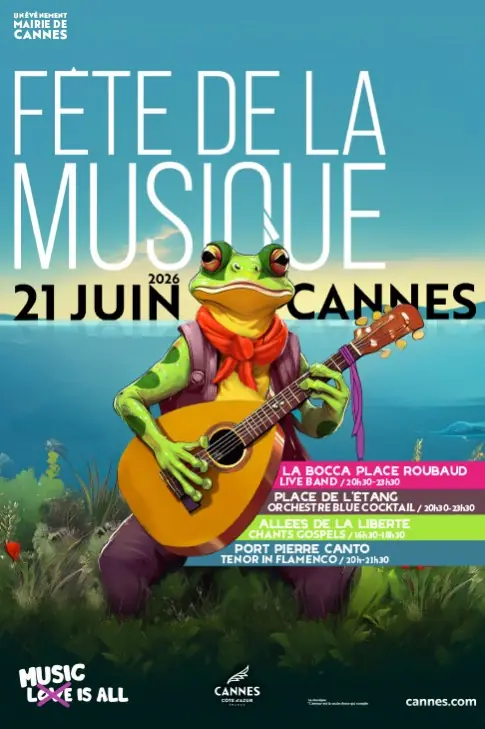
There is a particular quality to Cannes on a Sunday in late June — the light arriving at a low, honeyed angle off the Esterel, the Croisette already warm underfoot before nine. On the 21st of June 2026, that Sunday will carry a soundtrack. Every year on the summer solstice, France's Fête de la Musique turns public spaces into stages, and in Cannes the tradition runs through the city's bones rather than merely across its surface.
The premise is disarmingly simple: free concerts at six locations across the city, from mid-morning into the evening, with no wristband, no ticket queue, no hierarchy of access. Swing and soul at the Allées de la Liberté — the plane-tree-lined esplanade where the daily flower market gives way, on this particular day, to music drifting between the stalls. Gospel voices and choreography out at Cannes La Bocca, the western quarter that rarely features in the glossy itineraries. DJ sets and live acts at Place de l'Étang and Marché Forville, where the covered market's iron framework catches sound in a way that rewards lingering.
A Jazz Session With a Painting as Its Occasion
The most layered moment of the day happens indoors — or rather, at the threshold of indoors. The Centre d'art La Malmaison, a Belle Époque exhibition hall facing the sea on La Croisette, will host a jazz jam session led by the quintet of Mathias Lévy. The concert coincides with the finissage — the closing day — of an exhibition by French painter Carole Benzaken, which means the music arrives as a kind of farewell to the work on the walls. There is something precise and unrepeatable about that overlap: sound filling a room as the paintings prepare to leave it.
La Malmaison has a long habit of this sort of cultural layering. Built in the early twentieth century as a casino annex, it has since been restored as one of the Riviera's more intimate contemporary art spaces, its proportions human-scaled in a city that can tend toward the monumental.
'Programme sous réserve de modifications' — the city notes that details may change, which is worth keeping in mind when planning an evening around a specific set.
Flamenco by the Water
At the Esplanade Grand Large — the open plaza beside Port Pierre Canto, south of the Croisette — the programme turns to Tenor in Flamenco, a format that places operatic voice inside the flamenco tradition. It is an unusual pairing, and the setting amplifies the drama: the esplanade sits at the edge of the sea, with the Lérins Islands visible on clear days, and the kind of natural acoustics that outdoor architects spend careers trying to replicate.
Flamenco has a longer presence on the Côte d'Azur than is sometimes remembered. The region's Spanish community, established through waves of twentieth-century migration, brought the form here and kept it alive in small clubs and family gatherings long before it became a festival staple. A performance of this scale, in a public waterfront space, carries that history forward without necessarily announcing it.
What the day asks of you is really just a willingness to move. The six venues are spread across the city — from the port area and the Croisette arts centre to the Forville market quarter and the western neighbourhood of La Bocca — which means the Fête de la Musique in Cannes is also, quietly, a walking tour. Between sets, there are side streets that most visitors never take, a bakery near Forville that opens early, a view of the Suquet hill that reveals itself between buildings when you are not looking for it.
The solstice light will last until nearly ten in the evening. The music is free. The city, for one Sunday, belongs to whoever is in it.