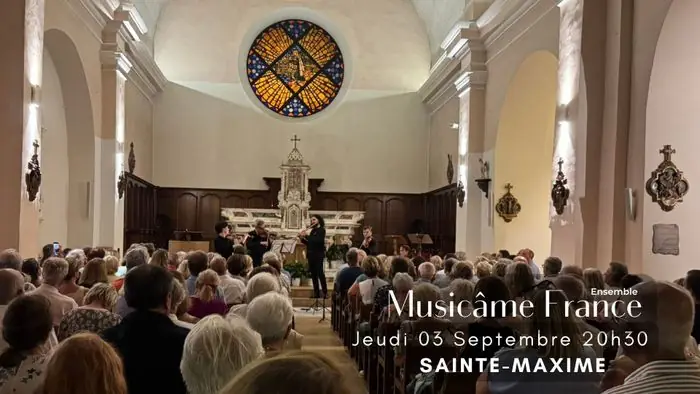
There is a particular quality to the light in Sainte-Maxime on an early September evening — the hard glare of August finally softened, the bay of Saint-Tropez settling into something quieter across the water. The terrace cafés along the port are still full, but there is a different kind of gathering forming a few streets back, around the stone steps of the Église Sainte-Maxime on Place Mireille de Germond. People arrive unhurried, programme in hand. The doors are open. Inside, the candles and the old vaulted ceiling do what they have always done.
On Thursday 3 September at 20h30, the five musicians of Ensemble Musicâme France will take the floor of this eighteenth-century parish church for a concert that spans four centuries of Western and Ottoman classical music. Tickets are priced between 20 and 30 euros.
A Programme That Refuses to Stay in One Place
The evening opens and closes with Ravel — Boléro at the start, Tzigane at the end — which is either a provocation or a statement of confidence, possibly both. Between those two poles, the programme moves with considerable range. C.P.E. Bach's Flute Concerto in G major gives way to the final movement of Vivaldi's 'Summer' from the Four Seasons, a piece so familiar it demands exceptional playing to be heard freshly. Then comes the most unusual entry on the list: Dimitrie Cantemir's Pesrev Muhayer, a work from the Ottoman classical tradition. Cantemir — eighteenth-century Moldavian prince, Ottoman court musician, and one of the earliest systematic theorists of Ottoman music — is rarely heard in French concert programmes. His presence here is not decorative; it shifts the evening's axis.
Rachmaninov's Vocalise No. 14 follows, a wordless song originally for voice and piano that translates with quiet authority to strings. Then Mozart's Symphony No. 40 in G minor — specifically its first-movement Allegro — before a version of J.S. Bach's Double Violin Concerto in D minor arranged in a jazz idiom by guitarist Django Reinhardt. Puccini's fantasy on La Bohème and Saint-Saëns' 'The Swan' from The Carnival of the Animals round out the central portion before Ravel's Tzigane, a concert rhapsody of near-virtuosic demands, closes the programme.
'Présent dans plus de 100 villes à travers le monde, l'Ensemble Musicâme France défend une musique qui touche le cœur et élève l'esprit au-delà des frontières.'
Five Players, One Collective
Ensemble Musicâme France describes itself not as a conventional chamber orchestra but as a collective — a structural distinction that shapes how the group rehearses and performs. The five musicians appearing in Sainte-Maxime are: Issam Garfi on flute, Da-Min Kim as violin soloist, Matei Ioan on second violin, Brice Duval on viola, and Emilie Rose on cello. They come from major international ensembles and have performed in more than a hundred cities worldwide. In a church that seats perhaps a few hundred at most, that kind of résumé produces an intimacy that larger venues cannot replicate.
The Église Sainte-Maxime itself is worth arriving early to appreciate. The town — a fishing village turned discreet Riviera resort, never quite as conspicuous as its neighbour across the gulf — has kept its parish church at the centre of civic life since the early eighteenth century. The acoustics are forgiving without being blurry; strings carry well, and the flute will be heard clearly from the last row.
For visitors spending the first days of September on the Var coast, the timing is well-considered. The summer crowds are thinning without the town having yet closed itself down for autumn. The port restaurants are still operating at full stretch, the market still runs, and the sea temperature remains warm enough for a morning swim before an evening of Rachmaninov. A concert like this one — ten works, five players, one hour and a half of music — fits the mood of the season: not a farewell exactly, but an acknowledgement that something is ending, and that it deserves a proper send-off.