The old town of Menton does not ease you in gently. It rises from the seafront in a vertical rush of ochre and terracotta, its narrow carruggi climbing past shuttered doorways and sun-bleached plaster until the rooftops meet the sky somewhere above the Baroque campanile of Saint-Michel. From the promenade de la mer below, the silhouette reads almost unchanged from engravings made two centuries ago. Almost. Look closer, and the questions begin.
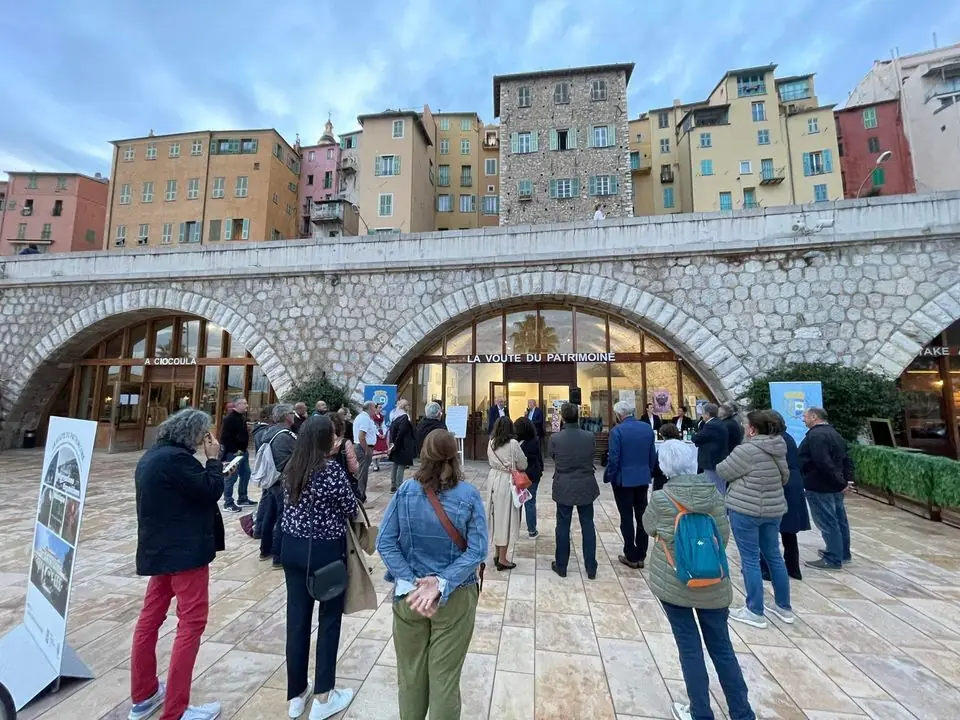
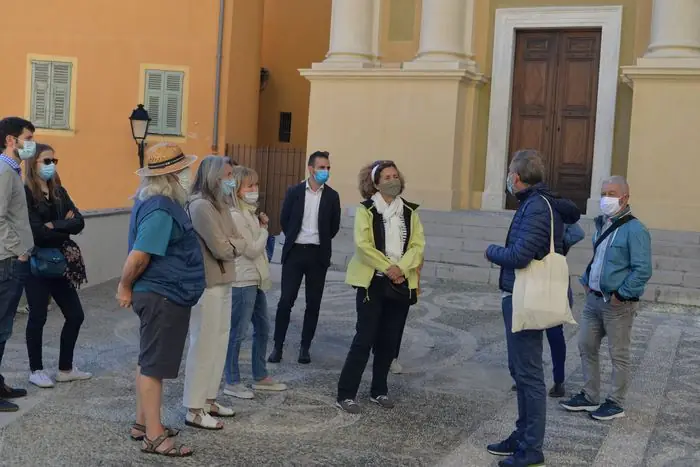
On Saturday 17 October 2026, those questions will be asked aloud — and answered, at least in part — during a guided walk through the vieille ville led jointly by an architect and the project manager of Menton's Ville d'art et d'histoire programme. The tour departs at 10:00 and begins at the Voûte du Patrimoine, a historic vaulted space tucked into the esplanade des Sablettes at the foot of the old town, with the bay of Garavan opening out behind it. Tickets are available through the Menton Riviera Merveilles booking portal.
Two Voices, One Hill
The format — two guides, two disciplines — is deliberate. An architect reads a building differently from a heritage administrator: one sees load-bearing logic and the ghost of an original cornice; the other weighs legal designation, community use, the slow arithmetic of public funding. Together, they frame the tour around the Site Patrimonial Remarquable, the French statutory classification that covers Menton's historic centre and sets the terms for what can be altered, restored, or rebuilt. The walk is billed not as a celebration of the past but as a live interrogation of it: what must be protected at all costs, and how far can reconstruction legitimately go before it becomes something else entirely?
These are not abstract questions in Menton. The town's architectural identity is unusually layered — medieval street patterns overlaid with Baroque civic ambition, then transformed again in the nineteenth century when the arrival of the railway and a fashionable English clientele produced a rash of grand hotels and winter villas. The Hôtel Pretti, the Astoria, the painted façades that line the old port: each represents a different moment of construction and a different idea of what the city should look like. Deciding which layers to preserve, and in what condition, is the kind of problem that keeps heritage professionals employed and occasionally at odds with one another.
'Que faut-il protéger à tout prix et jusqu'où peut-on reconstruire?' — the question the tour is built around, and one that has no easy answer.
The Voûte du Patrimoine, where the walk originates, is itself a useful prologue. The space holds scale models of the old town and several of its landmark buildings, along with a permanent exhibition on Menton in the seventeenth century — the period when much of the current urban fabric was laid down. Menton has held Ville d'art et d'histoire status for twenty-five years, a national label awarded by the Ministry of Culture to towns that demonstrate sustained commitment to heritage education and public engagement. The Voûte is the programme's public face, and it is eventually earmarked to become a full Centre d'interprétation de l'Architecture et du Patrimoine — a more formal institution for the kind of thinking this walk sets in motion.
What the Walk Asks of You
This is not a tour that requires specialist knowledge, but it rewards curiosity. Participants should expect to move through steep, uneven streets — sensible shoes matter more than a guidebook — and to spend two hours in genuine dialogue rather than passive reception. The dual-guide format opens space for disagreement as well as explanation, which tends to produce a more honest account of how cities actually change.
For visitors who know Menton primarily as a lemon festival and a winter sun destination, the tour offers a different register entirely: the town as a working heritage problem, its beauty inseparable from the effort required to sustain it. The walk covers the Site Patrimonial Remarquable designation in practical terms — what it protects, what it permits, where the current debates lie — and uses specific buildings and streetscapes as evidence rather than illustration.
Menton sits at the eastern edge of the French Riviera, a few minutes from the Italian border, and its position has always made it slightly apart from the larger resort towns to the west. That separateness is part of what the old town preserves: a texture of everyday Mediterranean urbanism that predates the Côte d'Azur's reinvention as a leisure destination. The walk on 17 October is a chance to read that texture with people who have spent years learning its grammar — and to come away with a sharper sense of what is genuinely at stake when a city decides what it wants to keep.