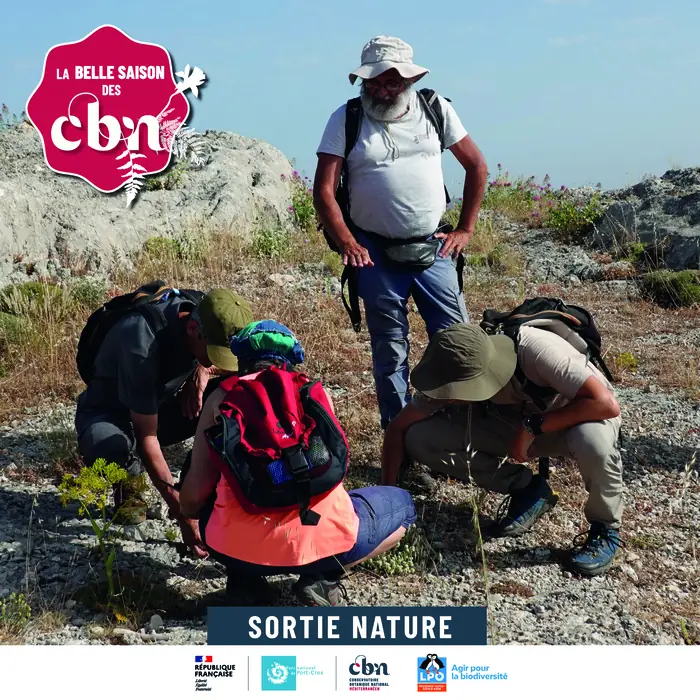
By six-thirty in the morning, the light over the Var coast already carries weight. It arrives flat and silver across the salt flats, cutting through the reed beds before the heat of the day has had time to blur the horizon. This is the hour when the Vieux Salins of Hyères belong to the birds — the stilts picking through shallow brine, the warblers threading the tamarisk scrub — and to anyone patient enough to arrive before the mistral stirs.
A Walk Between Land and Sea
On Wednesday 3 June 2026, a three-hour guided nature walk sets off at 8h30 from 321 rue de la Rascasse, at the entrance to the Espace Nature des Vieux Salins in Hyères. The walk is free of charge and open to all, with equipment provided on site. Reservations can be made by telephone at 04 94 01 09 77, or in person at the Espace Nature welcome desk. The outing forms part of La Belle Saison des CBN, a programme running from 12 May to 12 June across France's conservatoire botanical network — further details at fcbn.fr.
Hyères sits at the southeastern edge of the Var, sheltered by the Maures massif and facing the Îles d'Or. Its salt marshes are among the last working and semi-wild coastal wetlands between the Camargue and the Italian border — a landscape shaped less by human intention than by the three forces that govern it: salt, wind, and sun. The conditions are, by any biological measure, severe. Salinity fluctuates with the tides and the season; the ground alternates between waterlogged and cracked; shade is almost nonexistent. And yet life here is neither sparse nor simple.
Two Guides, Two Disciplines
The walk will be led by Henri Michaud, botanist and doctor in Mediterranean ecology at the Conservatoire Botanique Méditerranéen, and Sarah Bagnis, a nature guide on the Salins d'Hyères for the LPO PACA — the regional branch of France's leading ornithological society. The pairing is deliberate. Michaud's specialism is the flora of southern France, and the Salins offer a concentrated study in halophytic adaptation: sea purslane anchoring the margins, glasswort turning scarlet in autumn, sea lavender flowering in the cracks of dried mud. Bagnis brings the birds into focus — the species that depend on this coastal corridor for nesting, feeding, or rest during migration.
Throughout the three hours, the route includes dedicated observation stops, with equipment made available so that participants can follow the guides' attention rather than simply walking past it. The approach is less lecture than shared looking — the kind of field session where a botanist crouches beside a samphire plant and a birder raises binoculars at the same moment, and the two observations turn out to be connected.
The broader context is worth holding in mind. The Mediterranean basin is one of the world's recognised biodiversity hotspots, yet its coastal wetlands have contracted sharply over the past century under pressure from development and drainage. The Salins d'Hyères represent a habitat that has become genuinely rare: a place where the ecological logic of the salt marsh — its cycles of flood and desiccation, its specialist communities of plant and bird — remains legible to anyone willing to read it slowly.
For visitors to the Côte d'Azur who have spent time in the resort towns to the east, the Vieux Salins can feel like a different country: quieter, less finished, more contingent. The walk asks nothing more than an early start, sensible shoes, and the willingness to let two people who know this ground very well show you what you would otherwise walk straight past.
"Ces contraintes font de ce milieu une véritable richesse écologique" — the very harshness of the environment is what makes it remarkable.
The morning ends, presumably, with the heat beginning to rise off the flats and the birds retreating to shade. What remains is harder to schedule: a revised sense of what the coastline contains, and what it quietly asks of the things that live there.