There is a particular quality of light in the Cimiez hill district of Nice — filtered through umbrella pines, falling across Roman stonework — that makes the past feel unusually close. The arena here is not a ruin so much as a presence: two thousand years of Mediterranean life compressed into a single terraced hillside above the city. It is a fitting address, then, for a gathering of the people whose professional lives are spent prising that past loose from the earth.
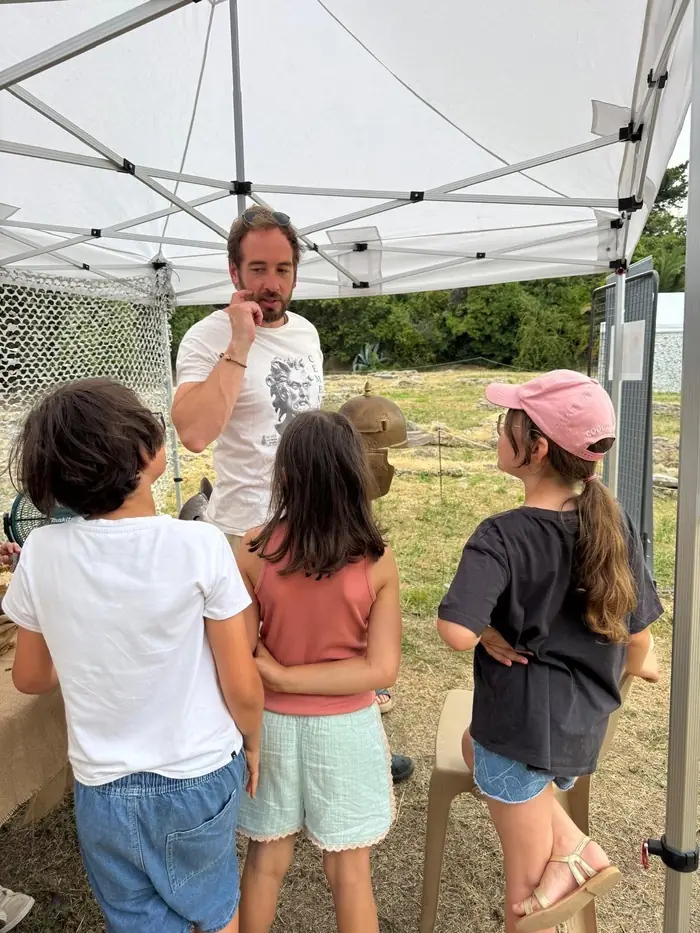
On 13 and 14 June 2026, the Musée archéologique de Cimiez opens its doors to a meeting between the public and the working archaeologists of the Alpes-Maritimes. The format is direct: come and talk to the specialists themselves, learn what their disciplines actually involve, and hear what is currently being found and studied across the region. The address — 160 avenue des Arènes de Cimiez — places the event at the very site where systematic excavations between 1950 and 1969 uncovered the objects now held in the museum's collections.
A Region Layered in Time
The collections at Cimiez centre on Cemenelum, the Roman capital of the province of Alpes Maritimae, and the artefacts recovered from those mid-century digs: official documents and private objects alike, the administrative and the intimate side by side. But the museum's reach extends further — pieces from across the wider region are represented, including objects salvaged from the wreck of the Fourmigue C, discovered off the coast of Golfe-Juan. A Roman shipwreck lying on the seabed of the Côte d'Azur is, in its way, as eloquent as any inscription.
The Alpes-Maritimes is one of those territories where geological and human time scales collide with unusual force. The same département that contains Nice's Baroque churches and Belle Époque promenades also holds Terra Amata, a site on the city's eastern shore where evidence of human occupation dates back some 400,000 years. Archaeology here is not a single discipline but a chorus.
'Rencontrez les différents acteurs de l'archéologie des Alpes-Maritimes pour découvrir leurs métiers et l'actualité de leurs recherches.'
Who Will Be in the Room
The gathering brings together practitioners from several distinct institutions and research contexts:
- Archaeologists from the Métropole Nice Côte d'Azur
- Researchers from the CEPAM laboratory (Cultures – Environnements. Préhistoire, Antiquité, Moyen Âge), a CNRS-affiliated unit working across prehistory, antiquity and the medieval period
- Agents from INRAP, the national institute for preventive archaeological research, whose fieldwork is triggered by construction and development projects across France
- Mediators and specialist guides from both the Musée d'archéologie de Nice / Cimiez and the Musée de préhistoire de Terra Amata
- Members of the Institut de paléontologie humaine de Nice
The breadth of that list is itself informative. Archaeology in this region is not a single institution's concern but a distributed effort — university researchers, state agencies, municipal museums and palaeontologists working in parallel, occasionally overlapping, each with a different relationship to the same terrain.
For a visitor, the value of two days structured around direct conversation rather than guided tours is the chance to ask the questions that exhibition labels rarely answer. What does a week on a dig in the Maritime Alps actually look like? How does preventive archaeology — the kind triggered when a developer breaks ground — differ from a planned research excavation? What is currently being studied, and what remains unresolved? These are not rhetorical questions here; the people who can answer them will be in the room.
The Musée archéologique de Cimiez sits within a wider site that includes the Roman baths, the arena, and the Franciscan monastery and gardens — a concentration of layered history that gives even an unhurried afternoon a particular weight. The June timing places the event in the long Riviera evening light, when the stone of the arena holds the warmth of the day and the pines above the hill go still. It is the kind of setting that makes a conversation about the deep past feel less like a lecture and more like a continuation.