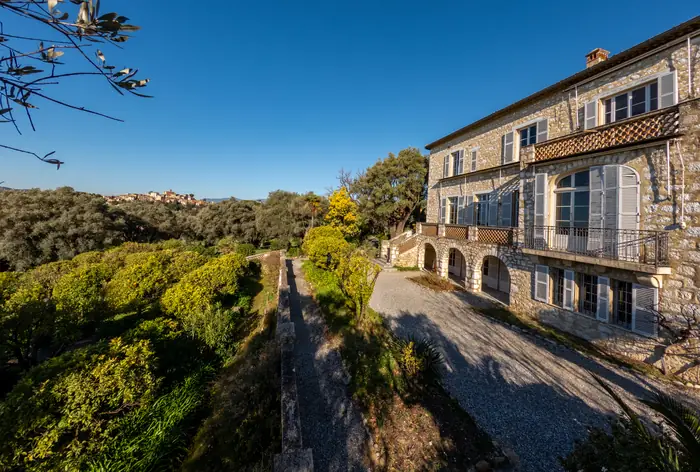
There is a particular quality to the light at Les Collettes in early June — low enough in the morning to cast long shadows between the olive trunks, warm enough by mid-morning to bleach the limestone paths almost white. Pierre-Auguste Renoir found it in 1907, when he came south in search of relief for his arthritis and stayed, essentially, for the rest of his life. He called it his light. Standing beneath the same trees today, it is not difficult to understand why.
On Saturday 6 June 2026, the Musée Renoir at 19 Chemin des Collettes opens its gardens for a morning that brings together botany and painting in a format that is deliberately unhurried. From 10 a.m., visitors are invited to explore the estate's principal Mediterranean species at their own pace — the ancient olive groves, the aromatic scrub, the cultivated kitchen garden that the city of Cagnes-sur-Mer has restored behind the Ferme des Collettes. Scattered through this landscape, painters will be working in the open air, their canvases turned toward the same panorama Renoir faced: the medieval hilltop village of Haut-de-Cagnes to the north, the glittering line of the sea to the south, and the rolling hills of the arrière-pays filling the distance between.
The Estate Itself
The Domaine des Collettes is, by any measure, an extraordinary piece of ground. The garden carries the 'Refuge LPO' designation — a French conservation label awarded by the Ligue pour la Protection des Oiseaux — with 36 bird species recorded within the estate. The olive trees are centuries old, their trunks twisted into shapes that predate the painter, the museum, and the modern town below. Renoir planted some of the garden himself; the restored potager behind the farmhouse follows plans drawn from the period of his residence. The house where he lived and worked, now the museum, remains largely as he left it.
'Cette lumière qui baigne des oliviers séculaires illumine encore et pour toujours ses toiles dans le monde entier.'
The museum's own framing of the estate captures something true: the light that fell on these trees when Renoir was painting here is, in any meaningful sense, the same light that now falls on his canvases in collections from Paris to Philadelphia. The continuity is not sentimental — it is optical, verifiable, and quietly extraordinary.
What the Morning Offers
The programme is structured around two simple pleasures, combined:
- A self-guided botanical walk through the estate's Mediterranean plantings, at whatever pace suits the visitor
- The chance to observe painters at work and to speak with them — an exchange described in the event's own terms as sharing 'the emotion and the light that inspired Renoir among his olive trees'
This is not a guided tour in the conventional sense. There are no fixed departure times, no groups to keep up with. The format rewards the visitor who lingers — who stops to identify a maritime pine or a carob, then drifts toward a painter's easel to look over a shoulder at how the same view is being translated into pigment. It is, in other words, a morning that asks you to look carefully at the same landscape twice: once as a naturalist, once as a viewer of art.
Cagnes-sur-Mer itself sits between Nice and Antibes along the Côte d'Azur — well connected by rail and road, but without the density of its neighbours. The old village above the museum retains the scale and stone of a medieval hill town; the lower town and marina have the comfortable practicality of a place where people actually live. The Musée Renoir, halfway up the hill on Chemin des Collettes, occupies a position between the two — close enough to the coast to feel the sea air, high enough to see it clearly.
Admission conditions and pricing are not specified in the museum's published information for this event; visitors should consult the museum directly at ville.cagnes.fr/musee-renoir before planning their visit. The event runs on Saturday morning from 10 a.m., and given the informal, self-paced nature of the programme, arriving early will give you the gardens at their quietest and the light at its most directional — which is, after all, what brought Renoir here in the first place.