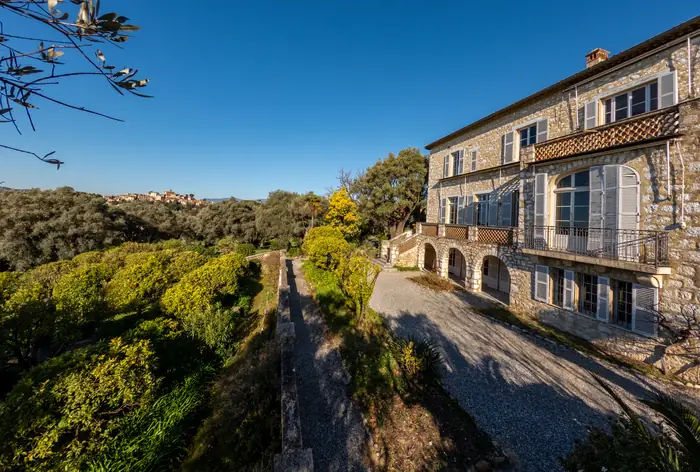
The olives have been here longer than the paintings. Some of the trees in the Domaine des Collettes are centuries old — gnarled, silver-leafed, indifferent to the art world's opinion of them — and on a June afternoon their shadows fall across the same ground that once caught Pierre-Auguste Renoir's eye and refused to let go. He came to the Côte d'Azur in search of a particular quality of light, and he found it here, above Cagnes-sur-Mer, where the hills drop toward the sea and the medieval village crowns the ridge to the north. He stayed until he died.
On 6 and 7 June 2026, the Musée Renoir opens this domain to guided visits under the title 'Renoir et la nature dans ses œuvres' — an explored reading of the intimate relationship between the painter and the natural world that shaped his late career. The meeting point is the museum reception at 19 Chemin des Collettes; places are allocated according to available capacity, so arriving early is simply good sense. The Sunday visit, at 14:00, will be conducted in English.
The Garden as Studio
Renoir was, from the beginning, a painter of the outdoors. With his Impressionist contemporaries he had learned to work en plein air — to chase light rather than reconstruct it, to treat a landscape as a living argument rather than a composed backdrop. By the time he settled at Les Collettes in the early twentieth century, his hands were already compromised by arthritis, yet the olive grove around him continued to feed his imagination in ways that four walls never could. The trees appear in his canvases not as incidental scenery but as presences — their silvery foliage catching the Provençal light in the same restless, broken way that water does.
The guided visit draws precisely on this continuity between place and work, inviting guests to read the paintings differently once they have stood among the trees that appear in them. The estate's garden has been designated a 'Refuge LPO' — a protected bird sanctuary — with 36 recorded species, and the city has recreated Renoir's kitchen garden behind the Ferme des Collettes. The panorama from the grounds takes in the sea, the surrounding hills, and the silhouette of the old village above: the same view, more or less, that Renoir looked at every day.
'Cette lumière qui baigne des oliviers séculaires illumine encore et pour toujours ses toiles dans le monde entier.'
What the Visit Offers
The Musée Renoir itself occupies the house Renoir built on the property — his last home and studio, preserved with a quality of stillness that larger institutions rarely manage. The guided commentary on these two June days places the works in direct dialogue with the landscape outside: the nature that Renoir painted is not abstracted here into art-historical argument but remains physically present, at arm's length.
For visitors making a weekend of it, Cagnes-sur-Mer sits between Nice and Antibes on the coast, easily reached by train. The Haut-de-Cagnes quarter — the medieval village visible from the garden — rewards an hour's walk before or after the visit, with its narrow lanes and the Château-Musée Grimaldi at the summit. June on the Riviera is warm and long-lit; the olives will be in full leaf.
The English-language session on Sunday 7 June at 14:00 makes the visit genuinely accessible to international travellers passing through the region. For anyone who has stood in front of a late Renoir in a museum elsewhere in the world and wondered about the source of that particular luminosity — the way his colour seems to come from within rather than from above — the answer, it turns out, is here, in the grove, in the afternoon light of early summer.