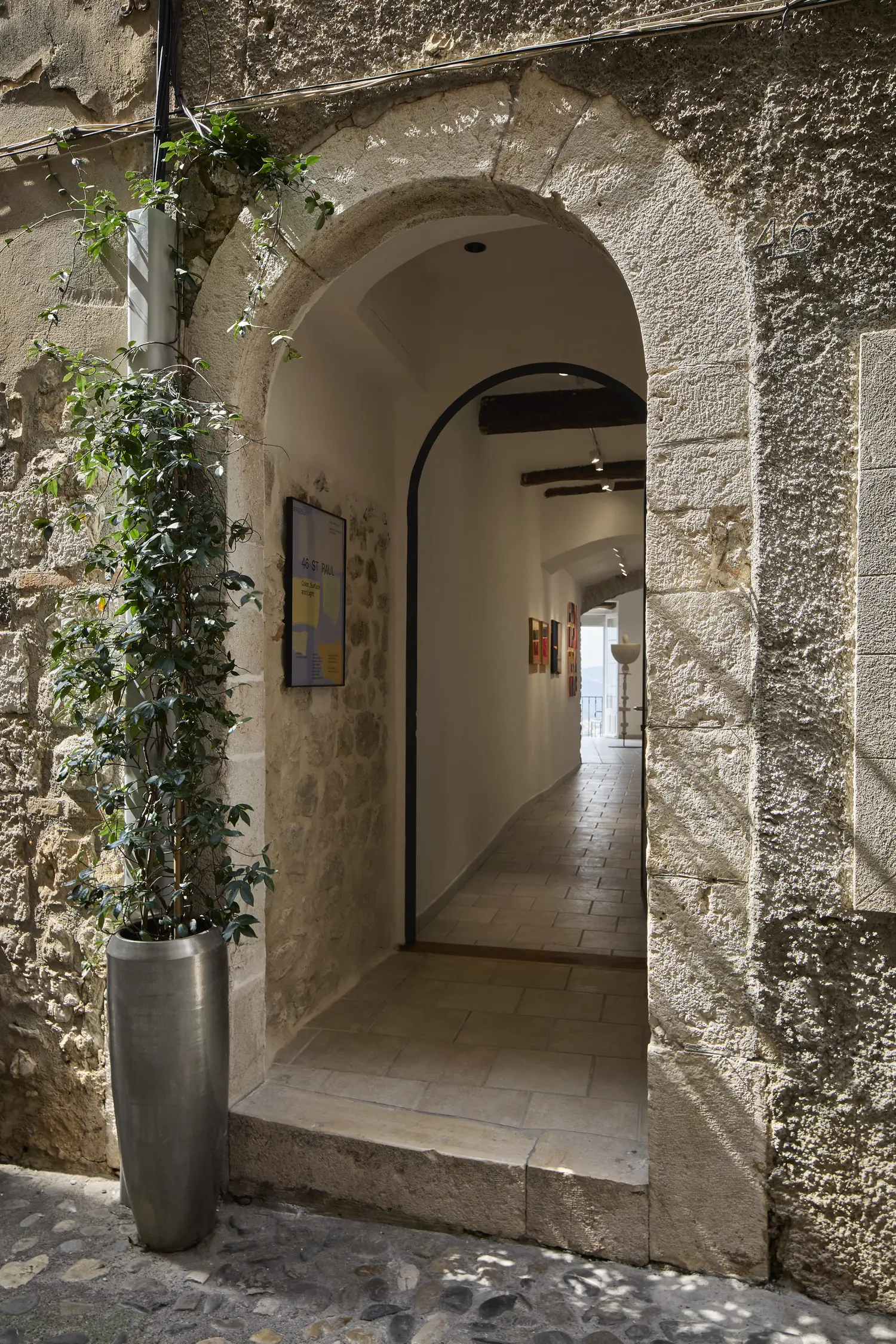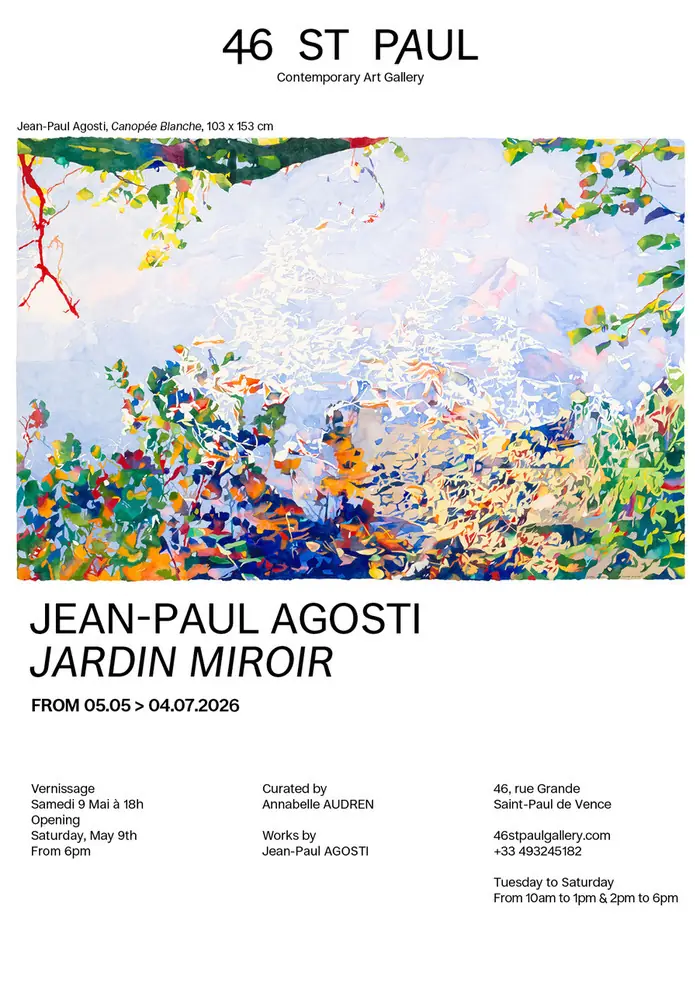
There is a particular quality of stillness that settles over Saint-Paul-de-Vence in early June — the tourists of high summer not yet arrived, the light already long and honeyed, the stone lanes of the Grande Rue cool in the morning before the heat builds. It is the kind of place that has absorbed artists for a century, and continues, quietly, to do so. On 5 and 6 June 2026, the 46 St Paul Gallery at 46 rue Grande opens its doors to Jardin Miroir, a retrospective dedicated to Jean-Paul Agosti — one of the more singular, and perhaps undersung, figures in contemporary French painting.
Agosti was born in Paris in 1948 into a family for whom art was not aspiration but atmosphere. His father, Paul Facchetti, was a photographer and gallerist whose circle encompassed Max Ernst, Alberto Giacometti, Jean Dubuffet, Henri Michaux, the psychoanalyst Jacques Lacan, and the architect Carlo Scarpa. Growing up in that company is, one imagines, either overwhelming or quietly formative. For Agosti, it appears to have been the latter. He trained at the École nationale supérieure des Beaux-Arts in Paris, then deepened his thinking through studies in the philosophy of science at the Sorbonne — an unusual pairing that would prove central to everything he made thereafter.
A Garden as a System of Thought
By the 1970s, Agosti had committed fully to painting. The decisive shift came when he took up residence within the enclosure of a former abbey at Gif-sur-Yvette, south of Paris, and began to paint the garden surrounding him. That garden — its rhythms, its layered depths, its negotiation between wildness and structure — became the founding motif of an oeuvre now spanning more than fifty years. It is not the garden as pastoral escape, nor as botanical record. For Agosti, the garden is a symbolic territory: a form of living architecture in which order and chaos, the visible and the invisible, are perpetually in correspondence.
The medium he returned to most insistently was watercolour — a choice that carries its own logic. Watercolour resists revision; it requires the painter to trust the first movement of the hand, to allow transparency to do its work. In Agosti's practice, this translucency becomes a way of holding multiple levels of reality simultaneously on a single surface, inviting the eye to move not across but into the image. His thinking draws on nature, science, and spirituality as parallel registers — not competing explanations of the world, but overlapping vocabularies for the same underlying complexity.
"Le jardin devient pour lui un territoire symbolique : un espace d'architecture vivante où s'entrelacent maîtrise et foisonnement, ordre et chaos, visible et invisible."
The Gallery and Its Village
The 46 St Paul Gallery occupies a 100-square-metre space, entirely renovated, in the heart of the village. Its programme focuses on plastic and poetic research that extends and reimagines the major movements of twentieth-century art — abstraction, figuration, minimalism, the French Support-Surfaces tendency, American Color Field painting — while remaining alert to what younger generations are doing with those inheritances. Light, colour, and texture are the gallery's consistent preoccupations; its artists work across painting, photography, mixed media, and material experimentation. The themes that recur — memory, landscape, time, the sensory traces left by lived experience — sit in natural dialogue with Agosti's half-century of looking at a garden.
Saint-Paul-de-Vence itself carries no shortage of art history. The Fondation Maeght, opened in 1964 on the hill above the village, remains one of the finest purpose-built spaces for modern art in Europe. The village has lodged, at various points, Picasso, Matisse, Chagall, Calder. That inheritance can weigh on a place, turning it into a kind of open-air museum of its own mythology. What galleries like 46 St Paul offer is something more immediate: work being shown now, in conversation with that history but not paralysed by it.
Jardin Miroir runs across two days only — 5 and 6 June 2026. For visitors already planning time on the Côte d'Azur in early summer, Saint-Paul-de-Vence is forty minutes from Nice, reachable by bus along roads that wind through the hills of the Alpes-Maritimes. The village is at its most navigable in the morning, before the day's warmth peaks. Arrive early, walk the Grande Rue at your own pace, and let Agosti's watercolours — their layered transparencies, their argument that a garden contains everything worth knowing — offer their own, unhurried argument.