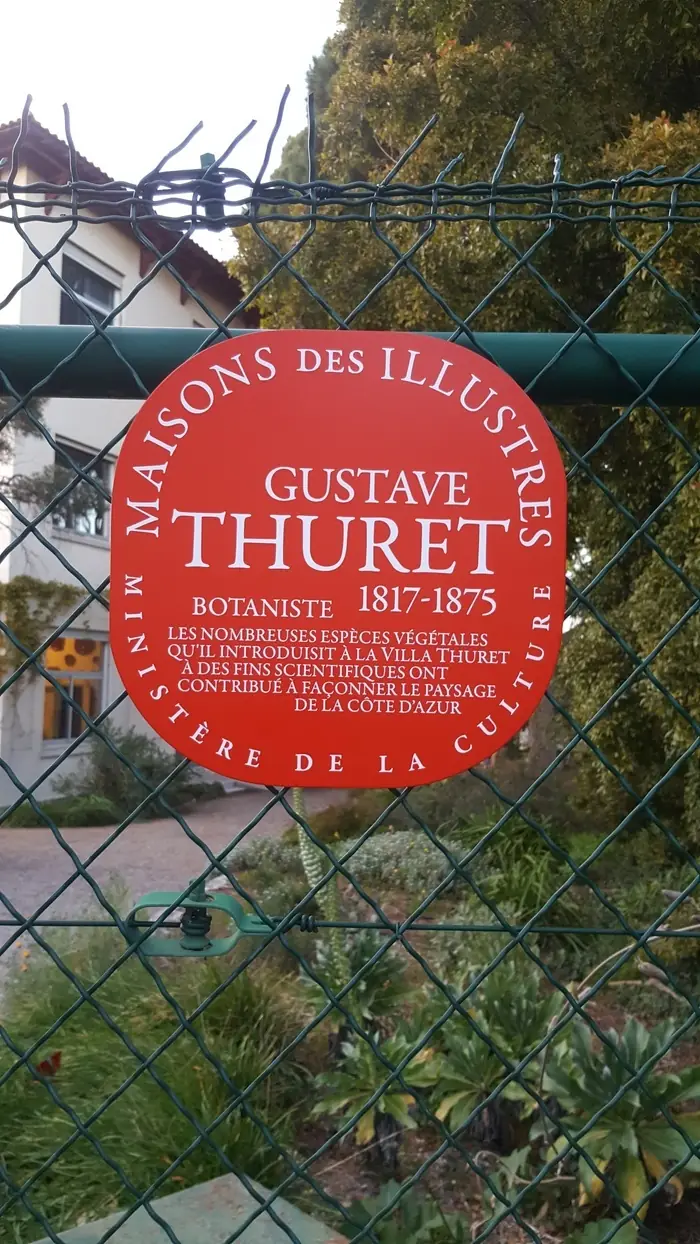
There is a particular quality of light on the Cap d'Antibes in early June — salt-bright, filtered through canopies of cedar and Aleppo pine — that makes the rest of the Riviera feel slightly overexposed by comparison. The Jardin botanique de la Villa Thuret sits at 90 Chemin Raymond, set back from the coast's theatre of yachts and terraces, and it rewards those who seek it out with something the shoreline rarely offers: stillness, and the slow accumulation of botanical time.
On Sunday 7 June 2026, the garden opens its doors to guided visits of its newly arranged museum room — the salle muséale — dedicated to Gustave Thuret and the succession of figures who shaped this place over generations. Two sessions are planned: one in the morning, one in the afternoon. Groups are assembled on site, which lends the occasion an unhurried, walk-in quality rather than the choreography of a ticketed event.
A Garden Built on Curiosity
Gustave Thuret was a nineteenth-century French botanist whose passion for algae and marine plant life brought him south, to this sliver of land between the Mediterranean and the pines. The garden he established here — 3.5 hectares in the paysager tradition, with winding paths and a collector's instinct for the rare and the foreign — became, in time, a working scientific station. Today it is managed by the Unité de recherche expérimentale Villa Thuret, part of INRAE Paca, France's national research institute for agriculture, food and environment. The romantic garden and the research laboratory coexist here without apparent contradiction, which is perhaps the most French thing about the place.
The collection leans heavily toward trees and shrubs in the process of acclimatisation — species from warmer or more distant climates being tested, quietly, against the microclimate of the Cap. Walking the paths, you encounter specimens from the Southern Hemisphere alongside Mediterranean natives, the whole arranged in the soft, asymmetric style that nineteenth-century landscape design borrowed from the English and then made thoroughly its own.
'L'histoire de la Villa Thuret et des personnages qui ont participé à son évolution' — it is that human thread, as much as the botanical one, that the museum room sets out to trace.
What the Museum Room Holds
The salle muséale was conceived as a tribute to Thuret and his successors — the scientists, gardeners and administrators who carried the project forward after his death. Guided commentary accompanies each visit, giving visitors the kind of contextual depth that a self-directed wander through the garden cannot. The format is deliberately intimate: groups formed on the spot, no pre-registration implied, the pace set by those who turn up.
For the visitor arriving from Nice or Cannes — a thirty-minute drive along the coast — this is the sort of morning that earns its keep precisely because it asks little in advance and returns something considered. The garden itself is worth the journey on its own terms:
- A working botanical collection of exotic trees and shrubs under long-term acclimatisation study
- A landscape in the romantic nineteenth-century tradition, designed for contemplative movement
- An institutional history connecting private patronage to public scientific research
The event is free of charge, and the morning session means you can be back on the Antibes ramparts in time for lunch, looking out over the same sea that once drew Thuret south in the first place.
The Côte d'Azur has always attracted people who came for the light and stayed for something they hadn't anticipated. Thuret came for the Mediterranean flora and ended up building an institution. The garden he left behind is, in its understated way, one of the more honest monuments on this stretch of coast — less polished than the villa museums of the Cap, more alive than a historic house. A Sunday morning spent inside its story feels, at this distance from the beach crowds of high summer, like the right kind of discovery.