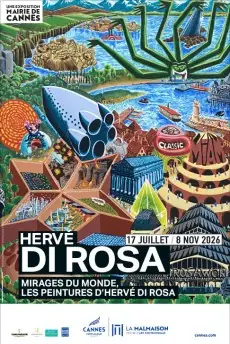
The boulevard de la Croisette in late July belongs, in most people's imagination, to the festival crowds and the yacht-watchers. But at number 47, set back from the promenade in the pale stone villa known as La Malmaison, another kind of spectacle has been running since mid-July — one that asks you to slow down, look closely, and follow someone who knows exactly where to look.
On Wednesday, 29 July 2026 at 17:00, the Centre d'art contemporain La Malmaison opens its current exhibition to a guided visit led by the show's own curator. The event is tied to Mirages du monde, les peintures d'Hervé Di Rosa, an exhibition running at La Malmaison from 17 July through 8 November 2026. The format is deliberately intimate: one hour, one guide, the works themselves.
A Painter Who Collects Worlds
Hervé Di Rosa is one of the central figures of the Figuration Libre movement that emerged in France in the early 1980s — a generation that pushed back against abstraction with colour, popular culture, cartoon-inflected forms, and an unabashed appetite for kitsch as raw material. Alongside Robert Combas, Di Rosa helped define a visual language that felt simultaneously naïve and knowing, drawing on street imagery, comic strips, folk art, and the visual vernacular of global popular culture.
What has distinguished Di Rosa's practice over the decades is a restless geographical curiosity. He has worked with artisans and artists across Mexico, Senegal, India, China, and beyond — absorbing local visual traditions not as a tourist collecting souvenirs, but as a painter genuinely renegotiating his own idiom in each new context. The title Mirages du monde — roughly, 'mirages of the world' — carries that tension well: visions that shimmer between the real and the imagined, between the place you arrive at and the one you thought you were going to.
What the Curator Unlocks
A visit to a contemporary art exhibition without context can feel like arriving at a conversation that started before you walked in. That is precisely what this guided hour is designed to address. The curator leads visitors through the works on display, offering what the organisers describe as clés de lecture — keys to reading — as well as a look behind the scenes at how the exhibition was conceived and assembled.
This kind of access is rarer than it sounds. Exhibition curators are the people who spent months in correspondence with the artist, who argued over hang and light and sequence, who know which work almost didn't make it into the room and why. Walking with one through a show is less a lecture than a conversation with someone who has thought harder about these paintings than almost anyone else alive.
'Cette visite offre des clés de lecture pour découvrir les œuvres présentées ainsi que les coulisses de l'exposition.' — La Malmaison, on the visit's purpose.
La Malmaison itself is worth a moment's consideration. The building, a late nineteenth-century villa that has served as Cannes's contemporary art centre since 1990, occupies one of the most commercially pressured stretches of real estate on the French Riviera. That it continues to present serious contemporary art — free of the white-cube anonymity of purpose-built institutions — gives visits here a particular texture. The mouldings and proportions of the original architecture remain in quiet dialogue with whatever work is currently on the walls.
Tickets are priced at 8,50 € full rate, 5,50 € for visitors aged 18 to 25, Cannes Pass Culture holders, and Cannes Seniors Le Club members. Entry is 2 € for under-18s, students, job-seekers, and visitors with a disability card and their accompanying person.
The exhibition itself continues through 8 November 2026, so there will be other chances to see the paintings. But the curator's walk on 29 July is a specific thing — a single afternoon when the person who shaped the show walks you through it. On the Croisette, that kind of conversation is not something you find by accident.