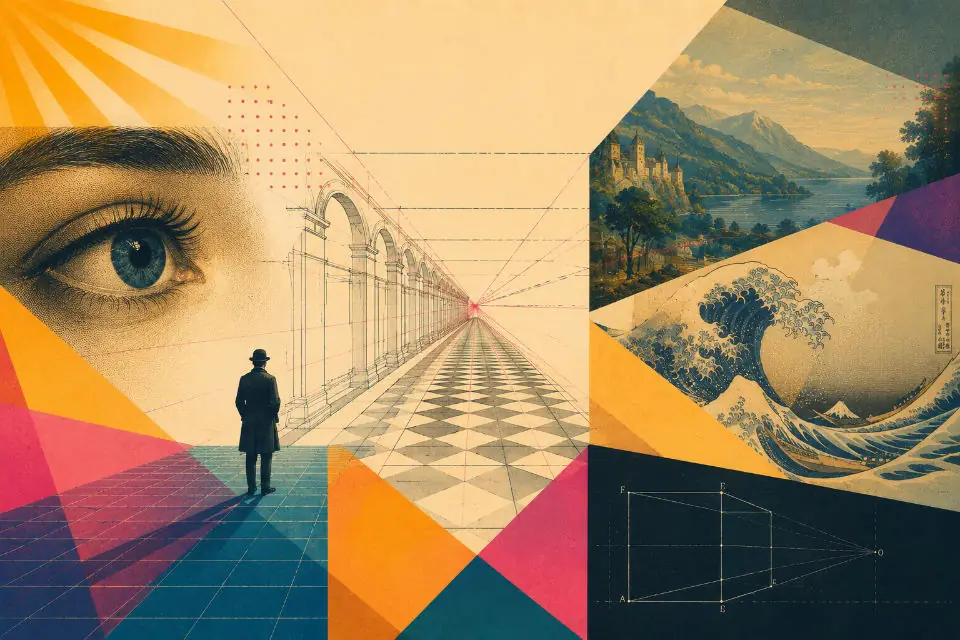
There is a moment, standing before a painting or watching a film, when your eye moves without being asked. It drifts left, then settles on a face, then traces the diagonal of a shadow — and you had no say in any of it. That invisible choreography is the subject of a one-hour lecture at the Micro-Folie Espaces Mimont in Cannes on Saturday, 11 July 2026, at 14h30. It is free to attend, with reservation required.
The talk takes its title from a deceptively simple question: what makes an image work? Not beautiful, not striking — but work, in the structural sense. The answer, it turns out, lies in a set of principles that painters codified centuries ago and that cinematographers have been borrowing ever since.
The Invisible Architecture of a Frame
The lecture moves through the foundational tools of visual composition: lines of force that pull the gaze across a surface, the rule of thirds that keeps a composition from feeling inert, the balance of visual mass, and the productive tension between elements that creates meaning rather than mere decoration. These are not rules so much as a shared grammar — one that operates below the threshold of conscious attention.
'La composition constitue le premier langage silencieux de l'image.' — the premise of the talk, and a useful way to think about why some images stay with you and others simply don't.
What makes the approach here particularly lucid is the range of its examples. The lecture draws on classical painting and cinema in the same breath, tracing how the same compositional logic travels across centuries and media. A Baroque altarpiece and a shot from a mid-century film may seem to have little in common; the lecture argues otherwise.
Cannes as a Setting for This Conversation
It would be hard to find a more fitting city for a discussion of the moving image. Cannes has hosted the world's most scrutinised film festival for decades, and the town's relationship with cinema is woven into its architecture, its seasonal rhythms, and the particular self-consciousness of its cultural life. The Micro-Folie Espaces Mimont is part of a national network of cultural spaces conceived to bring museum-quality programming to neighbourhood scale — a digital museum, a fabrication lab, a place where the distance between art and daily life is deliberately compressed.
For a visitor spending a Saturday afternoon in Cannes, the timing is well-judged. July on the Côte d'Azur can be relentless — the heat peaks, the Croisette fills, the sea glitters with a brightness that is almost aggressive. Stepping inside for an hour to think carefully about how images are constructed is not a retreat from the place so much as a different way of seeing it. You may find yourself walking out and noticing, for the first time, exactly where your eye goes when you look at the bay.
The lecture asks no prior knowledge of art history or film theory. It is designed to be accessible — a conversation about perception that anyone who looks at things, which is to say everyone, can follow. That said, it rewards those who come with a question already forming: why does this image feel balanced when that one feels wrong? Why does a certain photograph hold the eye while another, technically similar, does not?
Admission is free, but places must be reserved in advance through the Cannes cultural agenda. The event runs for one hour and takes place at the Micro-Folie Espaces Mimont. No further sessions on this date are listed in the source materials.
There is something quietly ambitious about a lecture like this — not a retrospective, not an exhibition, but an hour spent learning to see. The Côte d'Azur has always attracted people who look carefully at light. This is an invitation to understand what happens after the looking begins.