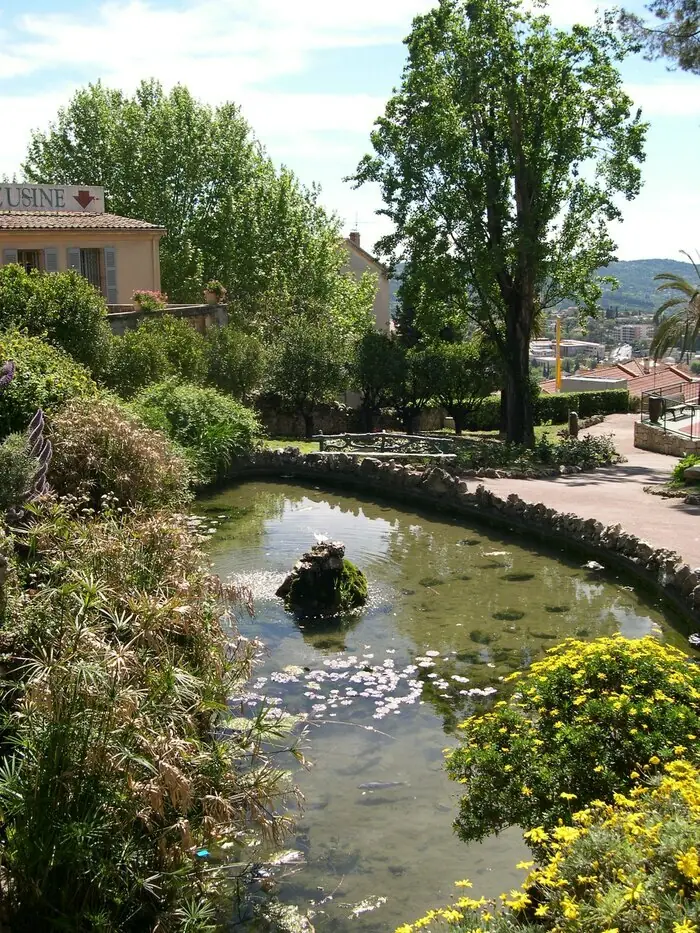
There is a particular quality of light in Grasse on a June afternoon — heavy with warmth, filtered through canopies that have been growing, in some cases, since the nineteenth century. The town is known, of course, for its perfume industry, but the terraced hills behind the old centre conceal another kind of sensory archive: gardens that were never meant for public eyes. On Saturday, 6 June 2026, at 15:00, a guided visit opens access to three of them, all within the historic core, all free of charge.
The meeting point is the Jardin du Musée d'Art et d'Histoire de Provence, at 2 rue Mirabeau — itself a garden worth arriving early for. It belongs to the category of the hôtel particulier, the grand private townhouse of the Provençal bourgeoisie, and every element is calibrated to that tradition: parterres edged in clipped box, a fountain with a mossy rock basin, Italian cypresses standing like dark exclamation marks against the limestone façade. A wisteria winds around the balcony pillars; a persimmon and a magnolia anchor the corners. The palms were planted in the nineteenth century. In 2010, landscape architect Jean Mus redesigned the space, and the result sits comfortably between historical fidelity and contemporary clarity.
Three Gardens, Three Histories
The visit takes in what the organisers describe as les trois trésors cachés du centre historique — the three hidden treasures of the historic centre. They represent distinct typologies: the jardin d'hôtel particulier (the private townhouse garden), the jardin de bastide (the country-house garden brought within city limits as Grasse expanded), and the jardin de loisir (the pleasure garden, conceived for leisure rather than production). Each carries its own grammar of design, planting logic, and social history.
The conversation will range across several themes: the evolution of garden design in the region, the practical functions these spaces served — kitchen production, water management, shade — and the engineering behind their irrigation. Provence's relationship with water has always been complicated, and the question of how historic gardens were fed from cisterns, channels, and natural springs is as much an infrastructural story as a horticultural one. The visit will also address how plants adapted, over generations, to the specific microclimate of Grasse's hillside position, and — a detail that tends to surprise visitors — the small fauna that inhabit these enclosed green spaces.
'Jardins d'hôtels particuliers, de bastides ou de loisir' — three distinct garden types, three different ways of understanding how a city keeps its private green spaces alive.
What Grasse Grows Beneath the Surface
Grasse sits at roughly 330 metres above sea level, facing south towards the Esterel and the coast. Its altitude moderates the summer heat just enough to allow plants that struggle on the littoral — magnolias, certain roses, wisteria — to thrive with unusual vigour. The historic centre, with its narrow streets and high walls, creates a further set of microclimates within microclimates: pockets of shade and retained moisture that make enclosed gardens feel almost improbably lush against the bleached stonework surrounding them.
The town's association with botanical culture runs deep. The perfume industry's centuries-long demand for jasmine, rose de mai, and tuberose created a sophisticated local understanding of how to cultivate fragile plants at scale — knowledge that filtered, in quieter ways, into the private gardens of the families who profited from the trade. To walk through one of these spaces is to move through a layered record of that history, even if the garden itself makes no explicit claim to it.
Entry is free, and no booking details are provided in the event information — arriving at the garden on rue Mirabeau at 15:00 on 6 June appears to be the straightforward instruction. The visit is conducted in French. For those whose French runs to garden vocabulary and architectural history, the afternoon offers an unusually direct encounter with a city that tends to keep its finest things just out of sight — behind walls, above staircases, through gates that are, on this particular Saturday, left open.