There is a particular quality of light in Fréjus in early June — dry, direct, flattening shadows before the summer haze arrives. It is the kind of light that archaeologists prefer: it strips away distraction. And it is precisely this quality of revelation — the stripping away of the surface to expose what lies beneath — that animates the new exhibition opening at the Espace Patrimoine on Place Clemenceau.
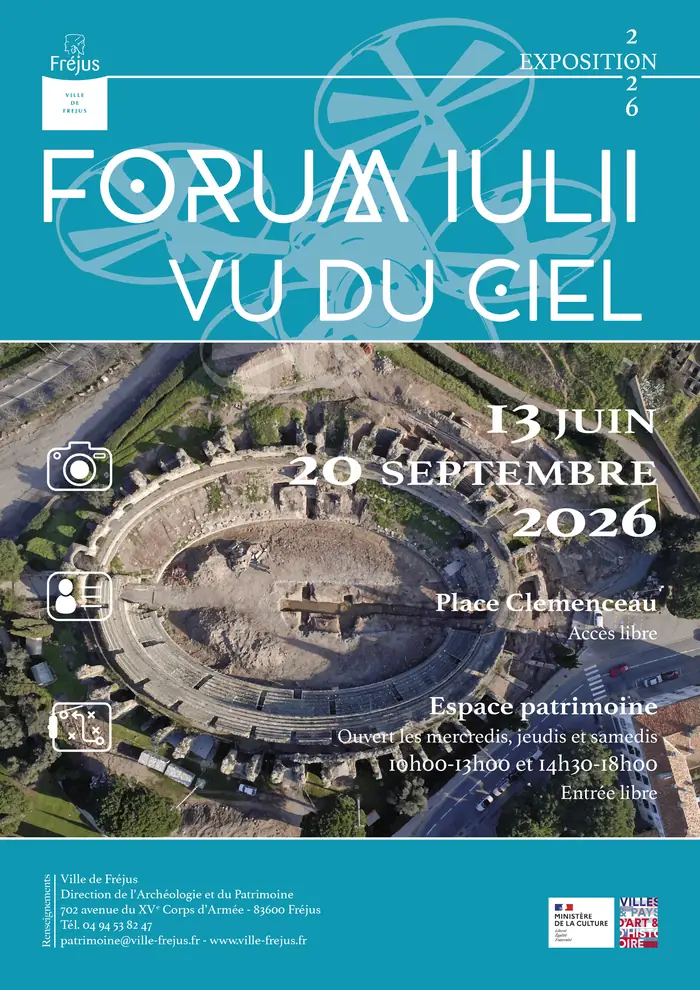
The show is called Forum Iulii vu du ciel — Forum Iulii, Seen From the Sky — and it does exactly what the title promises. Through aerial photography and the accumulated evidence of years of municipal excavation, it presents the Roman city of Forum Iulii, the ancient predecessor of modern Fréjus, as it has never quite been seen before: from altitude, in plan, its geometry suddenly legible against the contemporary streetscape below.
A City Built on a City
Fréjus was founded by Julius Caesar around 49 BC as a naval base and subsequently developed by Augustus into one of the most significant Roman ports on the Ligurian coast. The name Forum Iulii — Julius's Forum — has clung to the place across two millennia. What makes the site unusual, even by the standards of Provence's richly layered archaeology, is the sheer density of Roman infrastructure that survives: an amphitheatre, an aqueduct, the remains of a theatre, city walls, and traces of the harbour basin that once sheltered the fleet that defeated Mark Antony and Cleopatra at the Battle of Actium. Much of this is visible at ground level. But much more is not.
That is where the aerial perspective becomes something close to argument. When excavation photographs and drone imagery are assembled into an exhibition, the buried street grid, the footprint of vanished insulae, the alignment of ancient roads beneath modern ones — all of it snaps into focus in a way that no ground-level visit can quite achieve. The exhibition draws directly on fieldwork carried out by the city over many years, presenting those findings as visual evidence rather than academic report.
'L'empreinte archéologique sur le territoire de Fréjus est immense et se constate davantage en prenant de la hauteur.'
The Exhibition and Its Setting
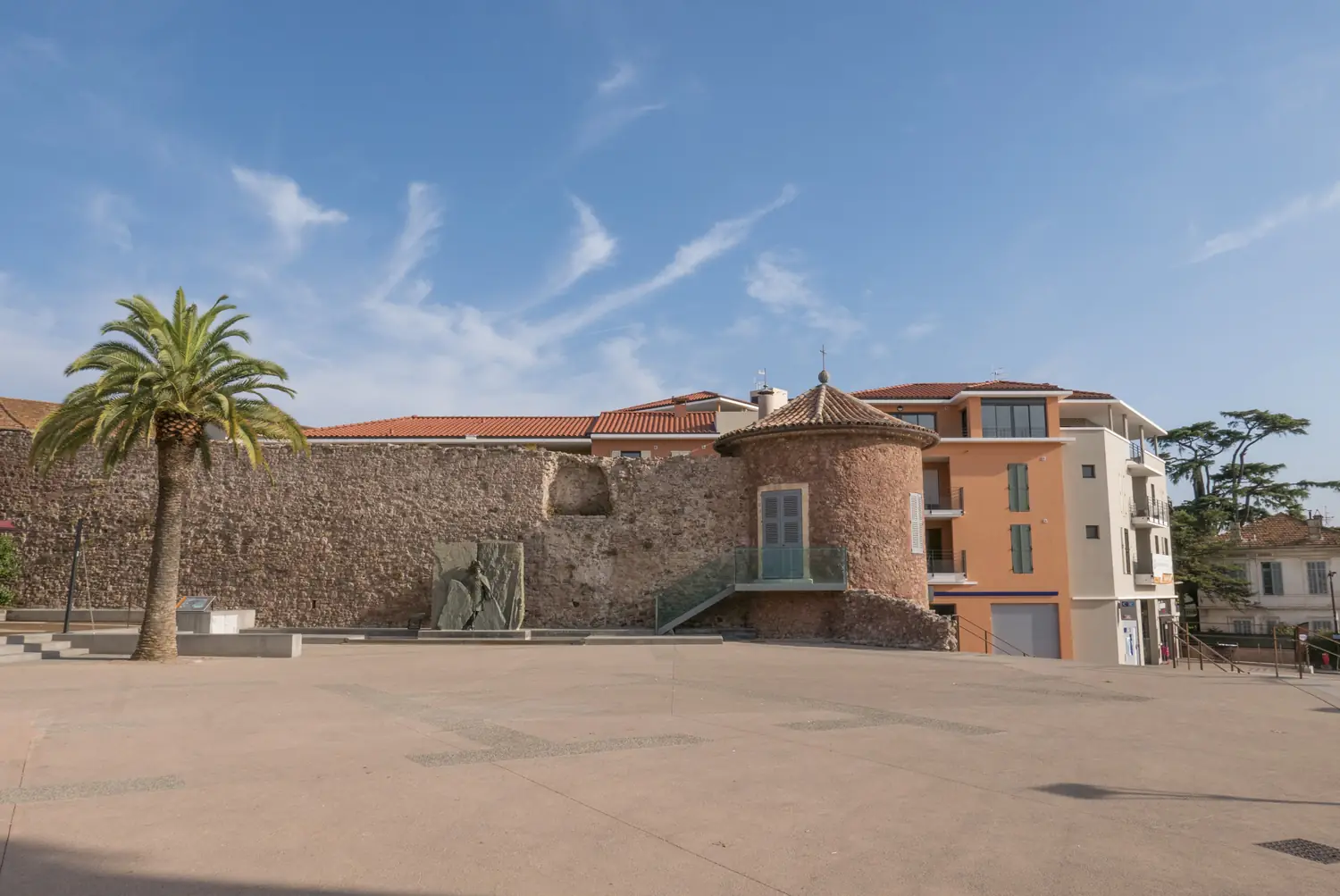
The venue itself is worth noting. The Espace Patrimoine occupies a 16th-century circular tower — one of the surviving elements of Fréjus's medieval ramparts — set directly on Place Clemenceau at the entrance to the old town. The building is, in its own way, a palimpsest: Renaissance military architecture sitting above Roman foundations, now repurposed as a space dedicated to the city's ongoing conversation with its own past. Each year the Espace Patrimoine mounts a new exhibition tied to current research or restoration work — archaeological digs, conservation projects on classified monuments, the findings of scientific study. Forum Iulii vu du ciel follows in that tradition.
The exhibition opens with a private inauguration on Friday the 12th of June at 17h00, with public access running across the weekend of 13 and 14 June 2026. No admission details have been announced at the time of writing; the city's heritage office at ville-frejus.fr is the appropriate point of contact for practical information.
For a visitor already in the region — perhaps based in Saint-Raphaël or further along the coast toward Cannes — Fréjus rewards more than a passing hour. The Roman amphitheatre, a short walk from Place Clemenceau, still hosts summer concerts; the cathedral complex in the old town contains one of the earliest baptisteries in France, dating to the 5th century. The town has the unhurried character of a place that knows its own worth and does not particularly need to announce it.
What the exhibition at the Espace Patrimoine offers, finally, is a shift in perspective that is more than metaphorical. To see a city from above — to watch its ancient bones emerge from the noise of the present — is to understand that the ground beneath any Mediterranean town is not simply ground. It is time, compressed. Fréjus, more than most, has the evidence to prove it.