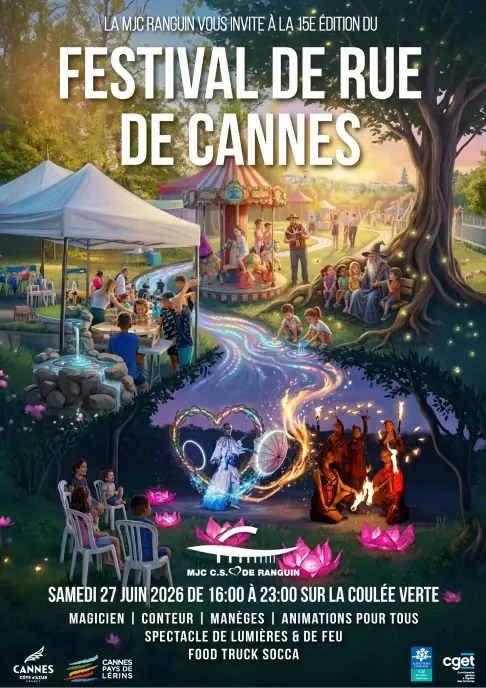
There is a Cannes that exists entirely outside the frame of the Croisette — no velvet ropes, no festival badges, no particular interest in being photographed. It runs west along the coast toward La Bocca, a working neighbourhood where the Lérins Islands sit low on the horizon and the evening light comes in at the same angle it always has, indifferent to the calendar of glamour two kilometres away. On Saturday, 27 June 2026, that neighbourhood becomes the setting for something considerably less choreographed and considerably more alive.
The Festival de Rue takes place on the coulée verte of Cannes La Bocca — a green corridor behind the MJC Ranguin community centre — from 16:00 until 23:00. Entry is free. The programme, as stated by the organisers, includes fire performance, magic, storytelling, fairground rides, and animations for all audiences. Seven hours, a long summer evening, and no ticket required.
The Green Corridor and What It Means
The coulée verte is the kind of urban space that cities tend to underestimate. A ribbon of greenery threaded through a residential quarter, it is the sort of place where children cycle after school and older residents walk slowly with purpose. On most June Saturdays it is pleasantly unremarkable. The festival turns it into a stage — not a formal one, but the kind that street performance has always preferred: a path, a crowd gathered loosely on both sides, and the understanding that something is about to happen.
Street arts in France carry a particular lineage. From the medieval jongleurs who worked market squares to the nouvelles formes of the 1970s and 1980s — companies like Royal de Luxe and Archaos, who dragged fire and mechanical spectacle into public space and refused to apologise for the scale of it — French arts de la rue have long operated on the principle that theatre belongs outside, where it cannot be avoided. A fire show on a green corridor in La Bocca is, in its way, part of that continuum.
'The street is the oldest stage there is — no fourth wall, no programme notes, no permission needed to leave.'
What the Evening Holds
The programme moves across disciplines rather than following a single narrative. Fire performance — which in the context of street festivals typically means juggling, breathing, and choreographed work with torches, poi, or staff — is visually direct in the way that few art forms are. It works on children and adults in exactly the same register: the light, the heat at the edge of the crowd, the slight collective intake of breath.
Magic and storytelling occupy a different register — quieter, more intimate, the kind of performance that requires a smaller circle and a willingness to be fooled or held. Fairground rides and general animations round out the programme, giving the event the texture of a neighbourhood celebration rather than a curated arts presentation. The distinction matters: this is an event designed for the people who live here.
The hours are well chosen. Arriving at 16:00 means the early acts play in full afternoon sun, the coulée verte still warm underfoot. By 20:00 the light will have shifted into that particular Mediterranean gold that makes even ordinary things look considered. By the time the fire performers take the space in the later hours, the sky will be dark enough to make the flames count.
Cannes La Bocca sits at the western edge of the city, easily reachable by bus from the centre or by foot along the coastal path. The MJC Ranguin — the Maison des Jeunes et de la Culture — is a familiar landmark to local families, which tells you something about the intended audience. This is not a satellite event of the Cannes Film Festival, which will have concluded weeks earlier. It is its own thing, on its own terms.
Some evenings in the south of France justify themselves simply by existing: warm air, a place to sit or stand, something worth watching. 27 June on the coulée verte asks very little of you in return — only that you show up.