There is something quietly subversive about placing a children's art workshop inside one of the most recognisable addresses on the Côte d'Azur. La Malmaison sits at 47 boulevard de la Croisette — the same long seafront promenade where film stars are photographed, yachts idle in the October light, and the palm trees bend with practiced indifference toward the Mediterranean. Yet behind its pale neoclassical façade, the Centre d'art contemporain has always insisted on a different kind of spectacle: art that asks you to look slowly, and think afterwards.
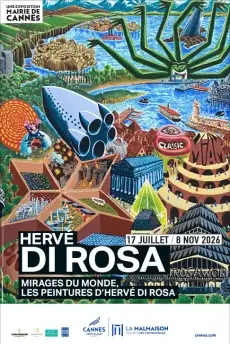
On Wednesday 21 October 2026 at 3 p.m., the centre opens its doors to a younger audience for a one-hour drawing workshop built around the work of Hervé Di Rosa — one of France's most distinctive figures in contemporary painting, and a co-founder of the Figuration Libre movement that emerged in the early 1980s alongside Robert Combas. Di Rosa's visual world is populated by flat, cartoon-inflected characters rendered in bold, saturated colour: figures that borrow from comic strips, popular mythology, and the visual cultures of countries he has spent decades travelling through. His is not an art of restraint.
Into the World of Di Rosa
The workshop takes place in the context of Mirages du monde, les peintures d'Hervé Di Rosa, the exhibition running at La Malmaison from 17 July to 8 November 2026. That exhibition title — 'mirages of the world' — points directly at the heart of Di Rosa's practice: a lifelong fascination with the imagery and craft traditions of cultures far from his native Sète, absorbed and transformed into a personal visual language that is immediately legible and, on closer inspection, surprisingly layered.
For the workshop, participants are invited to enter that language themselves — not as observers but as makers. The exercise is straightforward in the best sense: draw your own character, in Di Rosa's manner. Which means grappling with his particular grammar: the simplified silhouette, the expressive outline, the flat fills of colour, the slightly manic energy that runs through even the most static of his figures. It is the kind of brief that sounds easy to a child and reveals itself, pencil in hand, to be genuinely absorbing.
'Créer leur propre personnage à la manière de l'artiste' — the workshop's stated aim, and a more ambitious one than it first appears.
What to Expect
The session runs for one hour, which is well-judged for younger attention spans without feeling rushed. Admission is priced at 6 € for Cannes residents and 8 € for visitors from outside the city; accompanying adults enter free of charge. The format is designed for children, though the exhibition itself is open to all ages and well worth the time before or after the workshop.
October is, by any measure, a fine moment to be in Cannes. The summer crowds have thinned, the light has softened to that particular amber that photographers come back for, and the Croisette returns to something closer to its everyday self — a working boulevard rather than a stage set. La Malmaison, a short walk from the Palais des Festivals, is easy to reach on foot from most of the town centre.
For families already spending the school holiday week on the coast, the combination of the workshop and the broader Di Rosa exhibition offers a morning or afternoon with genuine substance. The centre's programme has long understood that contemporary art and accessible programming are not in opposition — that a child who spends an hour drawing a flat, bright, slightly strange character in the manner of a living French painter has encountered something that may well stay with them longer than the view from the beach.
The Croisette will still be there when you come out. The light on the water will be doing what it always does in late October. But the drawing — that, the child takes home.