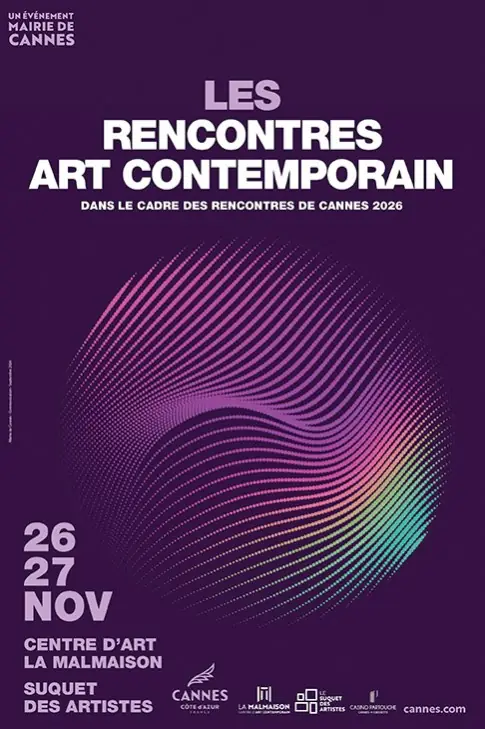
There is a particular kind of November light on the Croisette — low, silver, stripped of the summer crowds — that makes Cannes feel, briefly, like a town that belongs to itself. The grand hotels still hold their positions along the waterfront, but the pace has slowed, and the city's quieter cultural life comes forward. It is in this mood that the Rencontres d'art contemporain arrive: two consecutive evenings, two distinct venues, free admission, and a frank acknowledgement built into the very title that contemporary art can feel bewildering.
The programme runs on Thursday 26 and Friday 27 November 2026, each session beginning at 18h and lasting one hour. Both events are free to attend.
An Honest Question, Asked in Public
The first evening takes place at the Centre d'art La Malmaison, at 47 boulevard de la Croisette. The building itself carries a certain weight — a 19th-century villa turned exhibition space, set directly on the seafront promenade that the world associates with red carpets and film festival choreography. On the 26th, the context is rather different: Hanna Baudet, Director of Cannes' Contemporary Art Division, leads a conference titled 'L'art contemporain, on n'y comprend rien' — which translates, without apology, as 'Contemporary art: nobody understands it.' The session is pitched as an accessible set of interpretive tools for anyone who has stood in front of a work and felt, quietly, at a loss. That Baudet frames the evening this way — not as an introduction to a canon, but as permission to ask the obvious question — is itself a form of curatorial generosity.
The Malmaison has long served as Cannes' primary space for temporary exhibitions, and its position on the Croisette gives it an unusual double identity: a serious art venue that happens to share its address with the most photographed boulevard on the Côte d'Azur. Coming here in late November, when the plane trees along the promenade have shed most of their leaves and the light off the Lérins Islands is flat and clear, is a different experience from arriving in May. The building is easier to read. So, perhaps, is the art.
A Painter Talks About Her Work
The second evening moves inland, up toward the old town. The Suquet des Artistes, at 7 rue Saint-Dizier, sits in the historic quarter known as Le Suquet — the hill above the port where Cannes began, long before the Croisette existed, long before the festival. The venue hosts a meeting with the painter Marion Charlet on the occasion of her solo exhibition Felicità. On the 27th at 18h, Charlet will speak with the audience about her pictorial world, her sources of inspiration, and her creative process.
Charlet's work is rooted in painting — a medium that rewards slow attention and resists easy summary — and an exhibition titled Felicità (the Italian word for happiness, or felicity) suggests a sensibility oriented toward warmth and light rather than provocation. A one-to-one conversation between an artist and a public audience, held in the space where the work is shown, is among the more direct ways to understand what a painter is actually doing. There are no intermediaries, no wall texts doing the heavy lifting.
'L'art contemporain, on n'y comprend rien' — a conference title that turns the usual anxiety about contemporary art into the starting point.
What the two evenings share is a commitment to accessibility — not in the sense of simplification, but of genuine openness. No ticket, no reservation implied in the facts provided, no specialist vocabulary required at the door. The Rencontres d'art contemporain are organised by the city of Cannes, and they reflect a strand of French cultural policy that treats public engagement with living art as a civic matter, not a luxury.
For a visitor in Cannes at the end of November, the rhythm of the two evenings fits naturally into the quieter tempo of the autumn coast. An hour at La Malmaison on the Thursday, the sea visible through the windows; an hour up at Le Suquet on the Friday, the port lights beginning to show below. The programme asks very little of you, and offers, in return, a conversation about what it means to look.