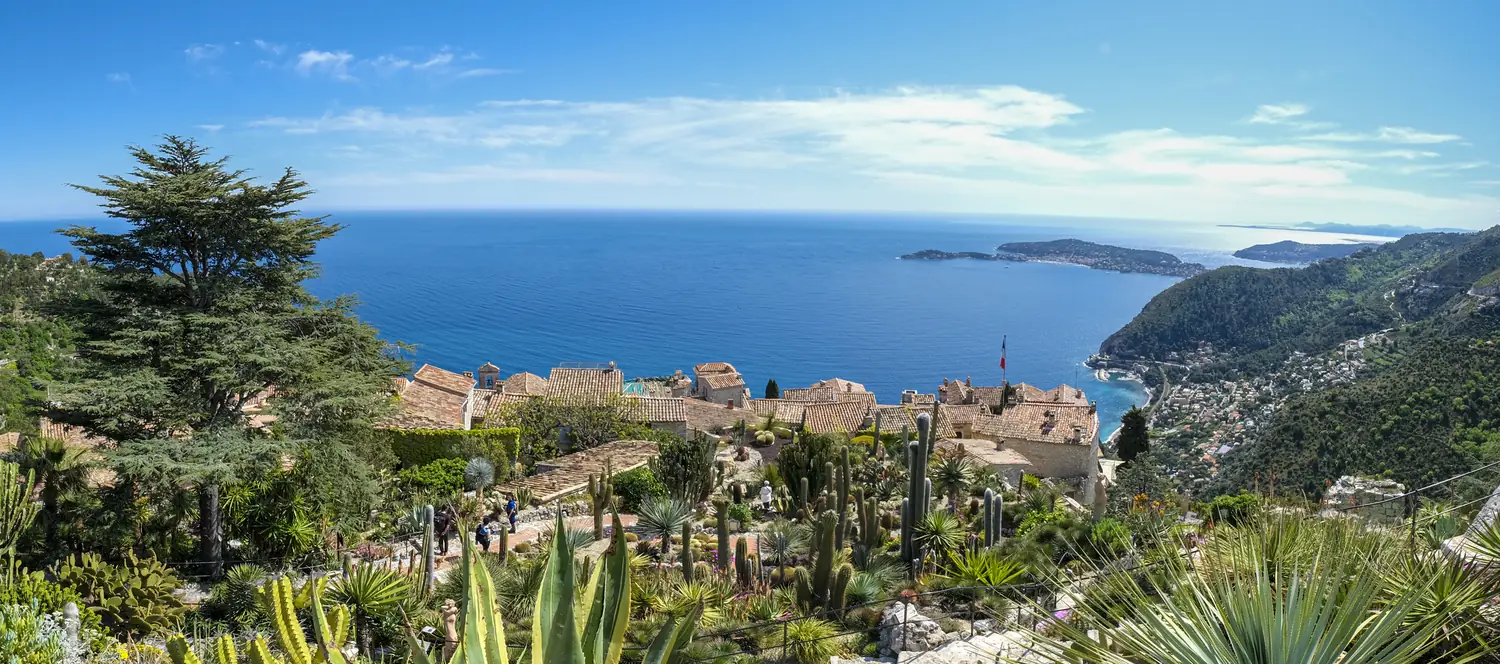
There is a particular quality of light on the Côte d'Azur in early June — not yet the searing white of July, but already warm enough to draw colour from stone and leaf alike. At the summit of Eze, where the medieval village clings to a limestone peak some four hundred metres above the Mediterranean, that light falls on one of the most quietly extraordinary gardens on the French Riviera. The Jardin Exotique d'Eze is not a grand botanical institution. It is something more personal than that: a terraced collection of succulents and cacti arranged along the ruins of a hilltop fortress, with the sea glittering far below and, on a clear day, the coastline curving all the way toward Italy.
On Saturday, 6 June 2026, the garden opens its paths to a guided visit with a specific and genuinely curious focus — the pigmentation of succulent plants. Two sessions are available: one at 10h30, another at 14h30. Each is limited to 25 people, which makes for an intimate exchange rather than a crowd moving in formation. The guided visit itself is free of charge; standard garden admission applies. Reservation is advised.
Beyond Green: The Chromatic Life of Succulents
The premise of the visit is deceptively simple. If chlorophyll accounts for the green we instinctively associate with plant life, what explains the reds, the yellows, the deep burgundies and the silvery blues that appear so frequently among succulents? That question — what function or functions do these colours serve? — is the thread the guide will pull throughout the visit. It is the kind of question that sounds elementary until you realise you have never properly thought about it.
Succulents produce pigments such as anthocyanins and carotenoids for reasons that remain an active area of botanical inquiry. These compounds may act as a form of sunscreen, protecting photosynthetic tissue from intense UV radiation — a relevant adaptation for plants that evolved in exposed, high-altitude or arid environments not unlike the terraced limestone of the Eze promontory itself. Some researchers suggest the colouration also plays a role in deterring herbivores or attracting specific pollinators. The garden, in other words, becomes a living laboratory for a question that sits at the intersection of ecology, chemistry and visual perception.
'Si le vert vient de la chlorophyle, il y a aussi des rouges, et des jaunes. Quelle est la fonction ou les fonctions de ces coloris?'
A Garden With Altitude
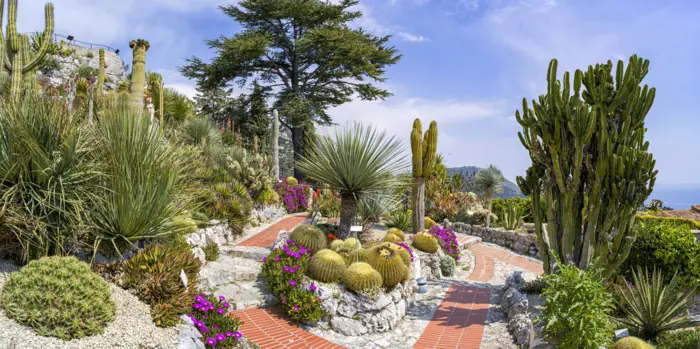
The Jardin Exotique d'Eze has the particular atmosphere of a place that earns its beauty through effort. The village of Eze itself demands a climb — narrow cobbled lanes, stone archways, the smell of lavender and warm rock — before the garden opens at the very top. The site of a former Saracen fortification and later a castle demolished on the orders of Louis XIV, the summit has been a garden since the early twentieth century. The collection leans heavily on species from arid and semi-arid climates: agaves, aloes, euphorbias, echeverias in rosettes of grey-green and dusty rose.
What a visitor finds here is not a manicured parterre but something wilder and more considered — plants chosen for their resilience and their strangeness, arranged so that the eye moves between form and colour and, always, the vast blue distance beyond.
For the 6 June visit, guests would do well to consider the following:
- The 10h30 session offers softer morning light, which tends to bring out the more subtle tonal variations in pale-coloured succulents.
- The 14h30 session catches the afternoon sun at an angle that intensifies reds and oranges — potentially more dramatic for anyone with a photographer's eye.
- Comfortable shoes are essential; the garden paths are uneven and the terrain is steep in places.
Eze is accessible by car — parking is available in the lower village — or by bus from Nice and Monaco. The village itself warrants time before or after: a handful of craft ateliers, a perfumery, and the kind of lunch terrace where the view does most of the work.
There is something fitting about examining colour theory in a place where the landscape itself seems almost too saturated to be real — the particular blue of the Ligurian Sea, the silver-green of olive groves on the slopes below, the ochre of old stone. The garden on the summit of Eze has always had this quality: it makes you look more carefully. A guided visit that asks you to think about why a plant turns red in full sun is simply a more structured version of what the place has always invited.