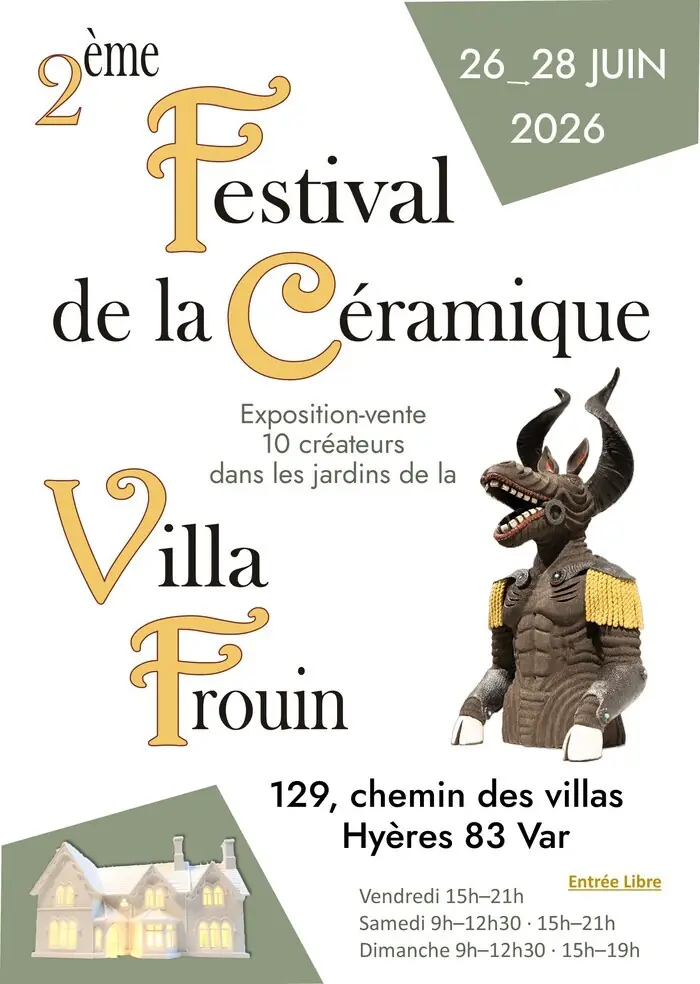
There is a particular quality of light in Costebelle in late June — filtered through stone pines, warm without being punishing, the kind that makes terracotta glow as though lit from within. It is the right light for ceramics. And it is the light that will fall across the gardens of Villa Frouin from 26 to 28 June 2026, when the property at 129 chemin des Villas opens its grounds and interior rooms for the second edition of its Festival de la Céramique.
The first edition drew close to 950 visitors. That number, for a private villa in a residential quarter of Hyères, is not modest. It suggests something beyond curiosity — a genuine appetite for this kind of encounter, intimate in scale yet serious in ambition.
A House, a Garden, Ten Makers
The festival is organised under the stewardship of Nadège and Étienne Frouin, whose villa provides both the setting and the spirit of the event. Ten contemporary ceramicists have been invited to occupy the garden and the interior spaces — each bringing a distinct visual language, each present in person throughout the three days. The works span a considered range: porcelain informed by the marine world, sculptural pieces with an almost inhabited quality, bold formal experiments, and objects of daily use reimagined with care. There is no single aesthetic thesis being argued here. What unites the selection is a commitment to what the French call écriture personnelle — a legible, embodied individual voice.
The artists are available to speak with visitors directly. This is not incidental to the event; it is the point. A visitor can stand beside a piece, ask about the firing temperature, the source of a glaze colour, the number of failed attempts before this particular form resolved itself. That kind of exchange is rarer than it should be, and it changes the way one looks at the object.
'Les artistes sont présents, disponibles, prêts à partager leurs gestes, leurs inspirations et les secrets de leur pratique.' — Villa Frouin festival description
Hyères, Quietly
Hyères occupies an unusual position on the Côte d'Azur. It is the oldest winter resort on the French Riviera, favoured in the nineteenth century by British and Russian aristocracy precisely because it offered warmth without the noise that would later define Cannes or Nice. Robert Louis Stevenson wrote part of Treasure Island here. Queen Victoria visited. The old town climbs a hill above the modern city; the Costebelle neighbourhood, where the Villa Frouin stands, retains the unhurried residential character of that earlier era — wide lanes, mature gardens, stone walls trailing with vegetation.
Ceramics, as a medium, has its own long presence in the Var. The region's soil and its proximity to the sea have sustained pottery traditions for centuries, and the contemporary scene in Provence draws practitioners from across France and beyond. A festival sited in a private garden rather than a municipal exhibition hall makes a particular argument about where art belongs — in lived spaces, in dialogue with architecture and landscape rather than quarantined behind white walls.
Admission to the festival is free. The layout is designed to allow unhurried movement through both the garden and the interior rooms, with a flow that accommodates a first-time visitor as readily as a collector with specific intentions. Works are available for purchase, and the presence of the artists means that acquisition, when it happens, carries the weight of a conversation rather than a transaction.
For those spending time in the Var that weekend, the villa is straightforwardly reached from central Hyères. The surrounding neighbourhood rewards a longer walk — past gardens that have been accumulating their present form for well over a century, toward the sea that remains, as it always has, the region's true organising principle.
The festival runs across three afternoons and evenings, beginning each day at 13:00. It asks nothing of its visitors except attention — and perhaps enough restraint not to leave empty-handed.