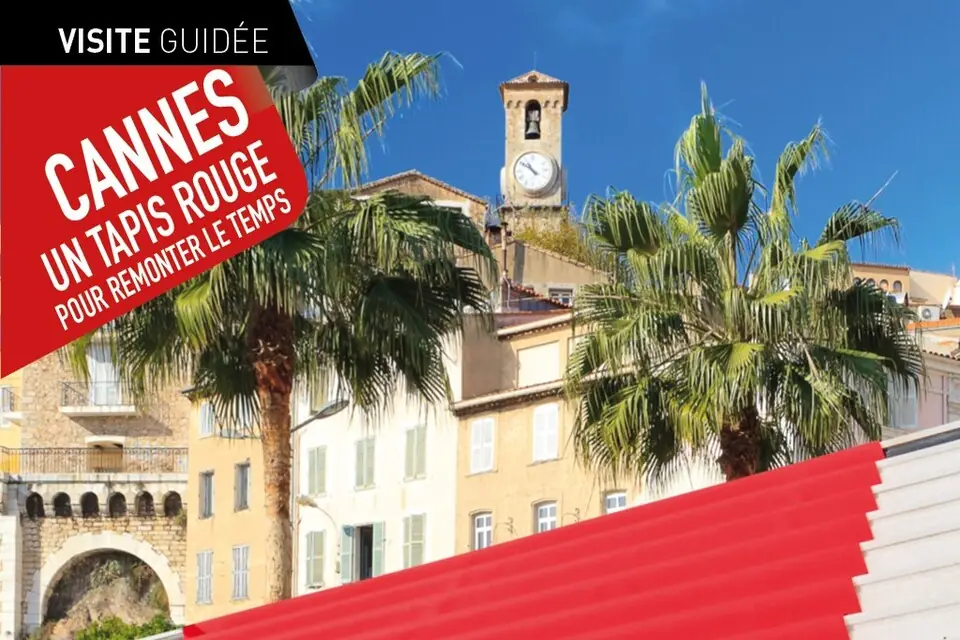
There is a version of Cannes that exists only in photographs: the spray of flashbulbs on the Palais steps, the yacht-lined Croisette, the annual theatre of fame that arrives each May and departs just as swiftly. But step one street back from the boulevard, and the city changes register entirely. The limestone is older. The light falls differently. The noise of the port gives way to something quieter and more considered — the kind of place that has been lived in, not merely visited.
It is precisely this Cannes — the one beneath the gloss — that a guided walk departing from the Office de Tourisme at the Palais des Festivals et des Congrès sets out to explore. The tour runs on Thursday, 22 October 2026, starting at 15h, lasts 90 minutes, and is conducted in French. Booking in advance through the Office de Tourisme is required. Admission is 6 € for adults, 3 € for holders of the Carte Mobilité Inclusion, and free for children under 12.
A City With More Than One Story
Cannes was a modest fishing village until the 1830s, when a chance encounter — Lord Brougham, the former British Lord Chancellor, stranded here by a cholera quarantine at the Var border — changed the course of its history. He built a villa, returned every winter for decades, and the English aristocracy followed. The mild climate, the quality of the light, the protected bay: word spread, and Cannes began its long transformation into a destination of international consequence. The film festival, which launched in 1946, was simply the most visible chapter in a story that had been accumulating for well over a century.
What the guided walk promises is a return to the layers that predate all of that — the Provençal traditions, the local heritage, the textures of a town that was already itself before it became famous. The route moves through the city as it exists today, pausing at places that carry the memory of older ways of life. The Suquet, the old hilltop quarter with its medieval tower and its views across the Lérins islands, is the kind of neighbourhood that reminds you how recently, in historical terms, the Croisette was built at all.
'Cannes bien au-delà de son célèbre festival du film' — the promise of the tour itself, and a fair description of what most visitors never quite find.
What to Expect on the Walk
The tour is guided in French, which makes it best suited to francophone visitors or those comfortable following a narrative in the language. It runs for 90 minutes at a walking pace through the streets of the city — sensible shoes are advisable, particularly if the route takes in the Suquet's inclines. The afternoon start at 15h means the light will be warm and low by the time the group disperses, which is no small thing on the Côte d'Azur in late October.
At that time of year, the crowds of high summer have long since thinned. The market stalls at Forville carry autumn produce — olives, late tomatoes, the first citrus. The café terraces are occupied by locals rather than tourists. October on the Riviera has a particular quality: the sea is still warm enough to reflect colour, but the pace of the town has settled back into something more habitual and less performative. It is, many would argue, the best month to be here.
The practical details are straightforward:
- Meeting point:** Office de Tourisme, Palais des Festivals et des Congrès, Cannes
- Date and time:** Thursday, 22 October 2026 at 15h
- Duration:** 1 hour 30 minutes
- Language:** French
- Price:** 6 € (standard) / 3 € (Carte Mobilité Inclusion) / Free (under 12)
- Booking:** Mandatory, via the Office de Tourisme
For anyone who has visited Cannes during the festival season and felt that the city's actual character was somewhere just out of reach, this walk offers the more measured encounter. The red carpet, as the tour's own title implies, can also be a path back through time — away from the spectacle and towards the place itself.