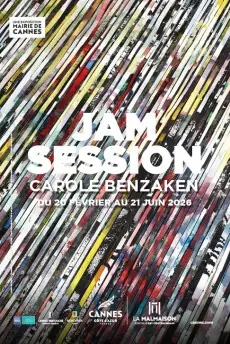
There is a particular quality of light on the Croisette on a Saturday afternoon in June. The palms cast thin shadows across the pavement, the sea sits flat and silver beyond the traffic, and the Grand Hôtel's awnings ripple in a thermal barely strong enough to be called a breeze. At number 47, set back just far enough from the boulevard's showier preoccupations, the Centre d'art contemporain La Malmaison offers a different kind of attention — cooler, quieter, more demanding.
This is where, on 13 June 2026 at 4 p.m., a one-hour guided visit will lead a small group through Jam Session, the current exhibition by French painter Carole Benzaken. The visit is organised by the centre itself; payment is made on arrival at the reception desk, and the total cost amounts to the €2 guided-visit supplement added to the standard admission — €6.50 full price, €2.50 reduced (for visitors aged 18 to 25, groups of ten adults or more, and holders of the Cannes Pass Culture). Under-18s, students, job-seekers, people with disabilities and their companions, and teachers bringing a class all enter free of charge, as do ICOM cardholders.
A Canvas in Perpetual Motion
Benzaken's practice resists easy categorisation, which is precisely the point. The title Jam Session is borrowed from jazz — that tradition of structured improvisation in which musicians follow a shared harmonic logic while simultaneously departing from it. On her canvases, something analogous is at work: forms that read as recognisable — a face, a fragment of landscape, a gesture — dissolve at their edges into passages of pure colour and mark-making, then reconstitute themselves elsewhere on the surface. The exhibition's organising principle, as described by the centre, is 'an incessant back-and-forth between figuration and abstraction.' The movement is never resolved; resolution, one suspects, is not the intention.
This tension has a long history in French painting — from the late Cézanne, who taught a generation to see the geometric scaffold beneath the sensory world, through to the lyrical abstraction of the post-war École de Paris. Benzaken works in full knowledge of that inheritance, though her visual language is distinctly contemporary: dense, layered, occasionally abrupt.
'L'œuvre joue sur la toile d'un incessant va-et-vient entre figuration et abstraction.' — Centre d'art contemporain La Malmaison
The Building Itself
La Malmaison occupies a Belle Époque pavilion that once served as the winter garden of the Grand Hôtel. Its ornate ironwork and generous ceiling height make it an unusual container for contemporary work — the architecture insists on a certain ceremony, which contemporary painting sometimes needs and sometimes subverts. In Benzaken's case, the grandeur of the space seems to suit canvases that are themselves theatrical in scale and ambition.
The guided visit format — one hour, a single guide, a work that rewards slow looking — is well suited to painting of this kind. Abstract or semi-abstract work tends to open up under sustained attention in ways that reproductions cannot anticipate. A guide who knows the exhibition's logic can point to the moments where the image tips from one register to the other, and those inflection points are where Benzaken's thinking becomes most legible.
For visitors spending a weekend in Cannes, the timing sits comfortably within a Saturday afternoon: the visit ends around 5 p.m., leaving the early evening free. The address — 47 boulevard de la Croisette — places La Malmaison within easy walking distance of the Palais des Festivals and the old port, two landmarks that anchor the city's geography and its self-image. Cannes is accustomed to spectacle; what La Malmaison offers, on a quieter register, is concentration.
The afternoon of 13 June will not be warm in any uncomfortable sense — June on the Riviera is still before the full press of summer — and the light through the centre's windows will have that particular Mediterranean clarity that painters have been chasing along this coastline for well over a century. It is a good day to stand in front of a canvas and let it take its time.