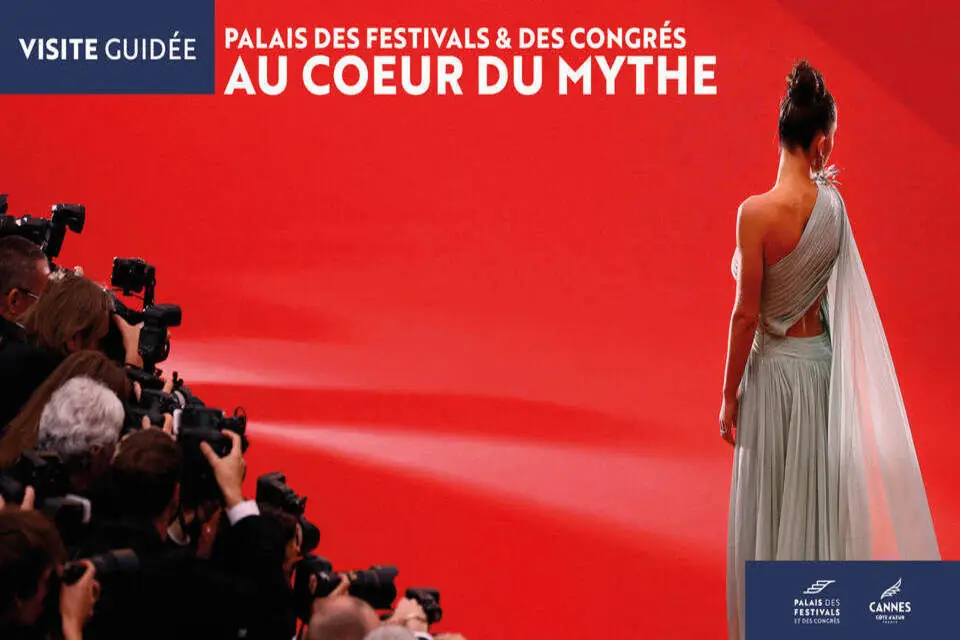
There is a particular quality of light on the Croisette in July — white and flat off the Mediterranean, softened by the plane trees that line the promenade. Walk it on any given summer afternoon and you will pass tourists photographing the same building from every angle: the Palais des Festivals et des Congrès, that low, grey-concrete monolith at the western end of the boulevard. It is not a beautiful structure in any conventional sense. And yet something about it holds the gaze.
On Monday, 20 July 2026 at 3 p.m., the Palais opens for a 90-minute guided tour under the title 'Au cœur du mythe' — a phrase that translates, with some licence, as 'at the heart of the myth.' The visit is led by a guide and costs €6 for adults; children under 12 enter free, and those holding a Carte Mobilité Inclusion pay €3. The address is 1 Boulevard de la Croisette, 06400 Cannes.
A Building That Earned Its Mythology
The Palais is routinely cited as one of the most photographed buildings in the world, which is a strange distinction for something built primarily as a congress centre. Its current incarnation — the fourth structure to occupy this stretch of the Croisette — opened in 1982 and was designed by the architects Hubert Bennett and Sir Hubert Bennett's team. It is functional, even blunt. But every May, when the Festival de Cannes arrives, the building undergoes a kind of transfiguration: the red-carpeted steps become the most scrutinised 24 metres of staircase on the planet. The rest of the year, those same steps are walked by conference delegates, trade-fair visitors, and the occasional curious tourist who pauses to place a hand in one of the celebrity handprints embedded in the pavement outside.
The tour follows that layered identity. Visitors walk the same routes taken by the actors, directors, and jury members who have passed through since the Festival's postwar renaissance — Cannes has hosted the competition since 1946, interrupted only by the extraordinary edition of 1968, when filmmakers including Godard and Truffaut shut the festival down in solidarity with the student uprising in Paris. The guide draws on the building's archive of 'insolites' — the odd, the ceremonial, the quietly extraordinary moments that accumulate over eight decades of cinema history.
'Les participants sont invités à marcher sur les pas des stars et à s'imprégner des moments les plus insolites de l'histoire du Festival de Cannes.'
More Than a Festival Venue
What the tour also makes visible is the building's parallel life. The Palais is the second-largest congress centre in France — a fact that surprises most visitors who associate it solely with the Palme d'Or. Throughout the year it hosts trade fairs, property conventions, music industry summits, and medical conferences, filling the hotels of Cannes during the quieter months between film seasons. The guided visit moves through spaces that serve both functions: the grand auditorium, the exhibition halls, the areas where the mechanics of a major international event become briefly legible.
For anyone spending time on the Côte d'Azur this summer, the tour offers something that the exterior photographs cannot: a sense of scale and sequence, of how a building that looks compact from the boulevard actually unfolds inward. Ninety minutes is enough to cover the ground without fatigue, and the €6 admission places it among the more accessible cultural experiences on a stretch of coast that can be, frankly, expensive.
Cannes in July is warm, crowded, and unapologetically itself. The Croisette fills with visitors from across Europe and beyond; the terraces of the Martinez and the Carlton are animated from noon until midnight. Against that backdrop, an hour and a half spent inside the Palais — learning what the building actually contains, and what it has witnessed — feels like a useful counterweight to the spectacle outside. The myth, it turns out, is more interesting when you can see the rooms it was made in.