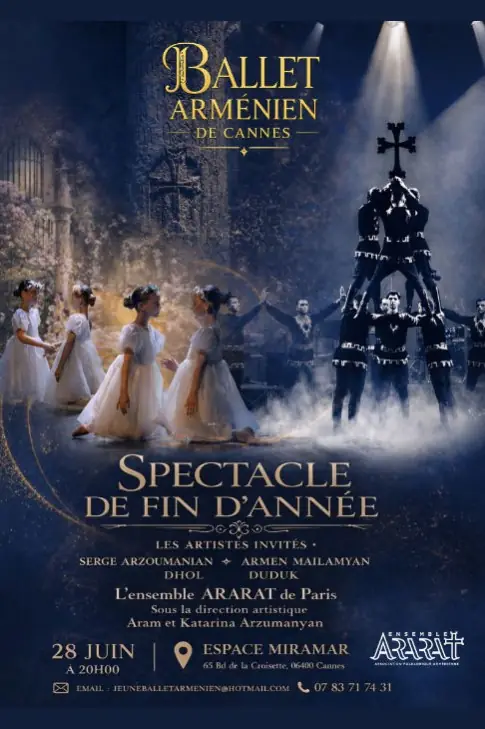
There is a particular quality to Sunday evenings in Cannes in late June — the light off the bay has softened, the Croisette crowd has thinned just enough, and the city remembers it is a place where people actually live, not merely pass through. It is precisely this hour, the 8 p.m. slot on 28 June 2026, that the Ballet Arménien de Cannes has chosen for its end-of-year performance at the Espace Miramar.
The venue sits at 35 rue Pasteur, a short walk from the seafront, in a building that hosts some of the city's more considered cultural programming. It is not a grand opera house — and that is rather the point. The scale is intimate enough that the sound of a duduk will carry without amplification becoming an obstacle between the instrument and the ear.
The Ensemble, the Instruments, the Artistic Hand
The evening centres on a collaboration between the Ballet Arménien de Cannes and Ensemble Ararat de Paris, a guest ensemble brought in specifically for this occasion. Together they will present a programme built around traditional Armenian music — the oud, the dhol, and the duduk forming the instrumental core — under the artistic direction of Lika Hakobyan.
Each of those three instruments carries considerable weight. The duduk, a double-reed woodwind carved from apricot wood, is among the oldest instruments still in active use anywhere in the world; UNESCO inscribed Armenian duduk music on its list of Intangible Cultural Heritage in 2005. Its tone sits somewhere between a human voice and a low clarinet — mournful in one phrase, luminous in the next. The dhol, a double-headed drum, provides the rhythmic architecture that Armenian folk and ceremonial dance has been built on for centuries. The oud, while associated across a broad arc of the Middle East and Mediterranean, arrived in Armenian musical culture through deep historical contact with neighbouring traditions and has long since become fully its own.
'The soirée promises a rich and moving musical moment' — from the official programme note.
Against this live sound, the dancers of the Ballet Arménien de Cannes will perform what is described as the company's end-of-year show — a format that typically represents the culmination of a full season's work, the choreography refined over months of rehearsal rather than assembled quickly for a single occasion.
What the Evening Holds
For those unfamiliar with Armenian dance as a theatrical form, it is worth arriving without strong preconceptions. The repertoire of Armenian folk dance is extraordinarily varied — from the slow, arching gestures of the highland traditions to the percussive footwork of more celebratory forms — and a company based on the Côte d'Azur, drawing on a diaspora community with deep roots in the region, will bring its own particular interpretation of that inheritance.
The French Riviera has had a significant Armenian community since the early twentieth century, when survivors of the 1915 genocide settled across Provence and the coast. Cannes, Marseille, Nice — these cities have been shaped, quietly and persistently, by that presence. A performance like this one is not a novelty or an import; it is a community presenting its own culture on its own terms, in a city that has been home to that culture for more than a hundred years.
Tickets are priced at 35 € for first-category adult seats, 30 € for second category, and 25 € for children aged six to thirteen. The performance begins at 20h. Full details are available through the official Cannes cultural agenda at cannes.com.
If you are spending that particular Sunday on the Riviera — whether as a resident or a visitor — this is an evening that will leave you with something more than a pleasant memory of the bay at dusk. The Espace Miramar will be lit, the duduk will begin, and for a little over an hour, Cannes will be somewhere else entirely.