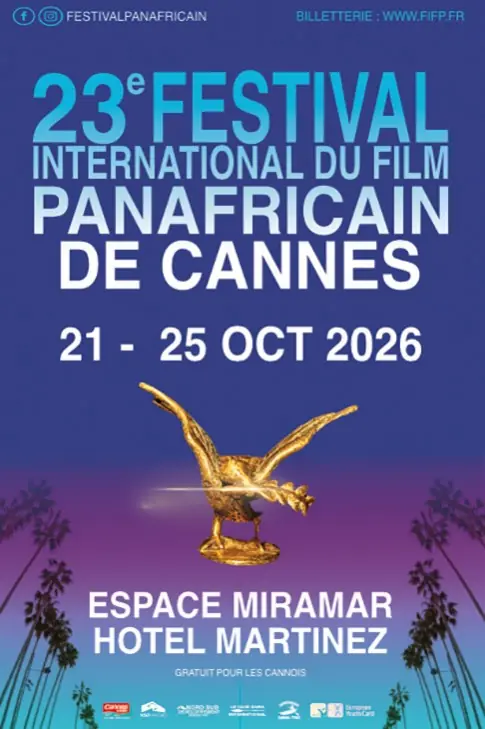
There is a particular quality to Cannes in late October. The summer crowds have gone, the palms along the Croisette sway in a cooler mistral, and the light — that Mediterranean light which cinematographers travel thousands of miles to find — turns amber by four in the afternoon. It is, in other words, exactly the right moment to sit in a darkened room and watch African cinema.
From 21 to 25 October 2026, the International Pan-African Film Festival returns to Cannes for its 23rd edition. Organised by the association Nord Sud Développement, the festival runs across two addresses that together form one of the more interesting pairings on the Riviera: the Espace Miramar, a civic cultural venue steps from the seafront, and the Hôtel Martinez — the Art Deco landmark on the Croisette whose façade has witnessed every iteration of Cannes glamour since the 1930s. Between these two spaces, and across a programme that stretches each day from 9:30 in the morning until midnight, the festival presents more than fifty films alongside conferences, debates, concerts and exhibitions.
A Platform, Not a Showcase
The distinction matters. The festival describes itself explicitly as a platform — for cinema and its crafts, for arts and traditional knowledge, for innovation and culture. That framing reflects something about how Pan-African film culture has evolved over the past three decades: it is no longer content simply to be seen. It wants to be discussed, contextualised, argued over. The conference and debate strand runs in parallel with the screenings, which means a visitor can move in a single afternoon from a film to the conversation it provokes, without leaving the building.
'A platform for cinema and its crafts, for arts and traditional knowledge, for innovation and culture' — the festival's own description of its ambition.
For context: Pan-African cinema as a movement has its roots in the post-independence decades of the 1960s and 70s, when filmmakers from Senegal, Mali, Burkina Faso, Algeria and elsewhere began building a visual language that owed nothing to Hollywood or to French commercial cinema. The Cannes festival, which predates many of its peers, has tracked that tradition through its subsequent transformations — the rise of Nollywood, the emergence of North African auteurs, the new wave of diaspora directors working between Paris, London and Lagos. Fifty-plus films across five days suggests a programme broad enough to hold several of those conversations at once.
What to Expect
The practical arithmetic is straightforward. Individual screenings and conference sessions are priced at 5 €, with free admission for residents of Cannes. The opening ceremony — which takes place at one of the two venues on the evening of 21 October — is ticketed at 10 €. For anyone planning to attend across multiple days, a festival pass is available at 30 €, which given the density of the programme represents reasonable arithmetic.
The exhibitions and concerts woven through the schedule give the festival a texture that goes beyond cinema alone. Walking between the Espace Miramar and the Martinez — a distance of perhaps five minutes along the seafront — becomes part of the rhythm of the week. The Croisette in October has a different atmosphere from its May incarnation: less performance, more city. Locals use the promenade for their evening walk. The cafés are quieter. It is easier, in that atmosphere, to actually talk about what you have just watched.
Cannes has hosted international film culture for the better part of a century, but its relationship with African cinema is not simply a footnote to the May festival. The Pan-African event has its own continuity — twenty-three editions represent a serious institutional history — and its own audience, drawn from the regional African diaspora, from film professionals, and from the simply curious.
Five days, fifty films, two venues, one city that knows how to hold a festival. October on the Riviera offers something the summer cannot: the chance to watch cinema without the noise.