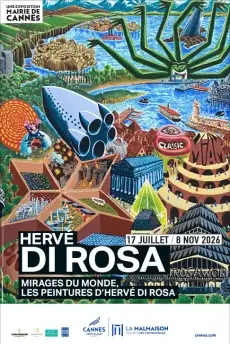
There is a building on the Croisette that most visitors walk past without slowing down. Sandwiched between the grand hotels and the shimmer of the bay, La Malmaison is easy to overlook — a Belle Époque pavilion that once served as a winter casino annex, now quietly housing some of the most considered contemporary exhibitions on the Côte d'Azur. On a November morning, with the summer crowds long gone and the light turning that particular pale gold it finds in autumn, the place becomes something else entirely: a room to think in.
On Saturday 7 November 2026 at 11:15, the Centre d'art contemporain La Malmaison at 47 boulevard de la Croisette hosts a one-hour guided visit dedicated to the work of Hervé Di Rosa. The visit forms part of the exhibition Mirages du monde, les peintures d'Hervé Di Rosa, which runs from 17 July to 8 November 2026 — making this guided tour one of the final opportunities to see the show before it closes.
The Man and the Movement
Di Rosa belongs to a generation that refused the distinction between high and low. Born in Sète in 1959, he was among the founders of la figuration libre — a French movement that emerged in the early 1980s as a deliberate counterpoint to the cool abstraction that had dominated European galleries for decades. Where abstraction turned inward, figuration libre looked outward: at American comics, at graffiti, at the visual noise of popular culture. The figures were flat, the colours loud, the lines cartoonish in the best sense of the word. Critics at the time were not always kind. History has been considerably more generous.
What sets Di Rosa apart from his contemporaries is restlessness — not the anxious kind, but the curious kind. Over four decades, he has travelled to workshops and artisan communities across the world, absorbing local techniques and materials and folding them into his own visual language. The result is a body of work that is simultaneously personal and global, instantly recognisable yet perpetually in motion.
'Di Rosa part à l'aventure dans les mirages du monde et explore toutes les techniques qui s'offrent à lui.' — La Malmaison, on the exhibition
What the Visit Offers
The guided tour lasts one hour. A dedicated guide will lead visitors through the exhibition, providing the kind of contextual thread that transforms a collection of canvases into a coherent conversation. For those encountering Di Rosa for the first time, this framing matters: the work can feel exuberant to the point of overwhelming, and knowing where to look — at the line, the palette, the borrowed technique — focuses the eye considerably.
Admission is structured accessibly:
- Full price: 8,50 €
- Reduced rate (18–25 years, Cannes Pass Culture, Cannes Seniors Le Club): 5,50 €
- Further reduced rate (under 18, students, job-seekers, holders of a disability card and one companion): 2 €
The Croisette address deserves a word. Most people associate that boulevard with the Film Festival, with photographers and velvet ropes and the particular theatre of celebrity. But the Croisette in November is a different proposition: quieter, saltier, the palm trees holding their ground against the mistral. Walking to La Malmaison along the seafront promenade on a cool morning, with the Esterel hills visible to the west, is its own kind of preparation for looking at art — it settles the mind in a way that a taxi ride simply does not.
Cannes has invested steadily in its cultural infrastructure beyond the festival calendar, and La Malmaison is central to that effort. The programme consistently brings serious contemporary work to a building whose proportions — intimate rather than monumental — suit painting particularly well. There is no grand atrium to cross, no sense of institutional weight to navigate. You arrive, and the work is simply there.
The 7 November tour coincides with the exhibition's final days. For anyone who has been meaning to see the Di Rosa show since July — and there are always people who have been meaning to — this guided visit is the natural occasion to finally do so, and to leave with more than a memory of bright colours on white walls.