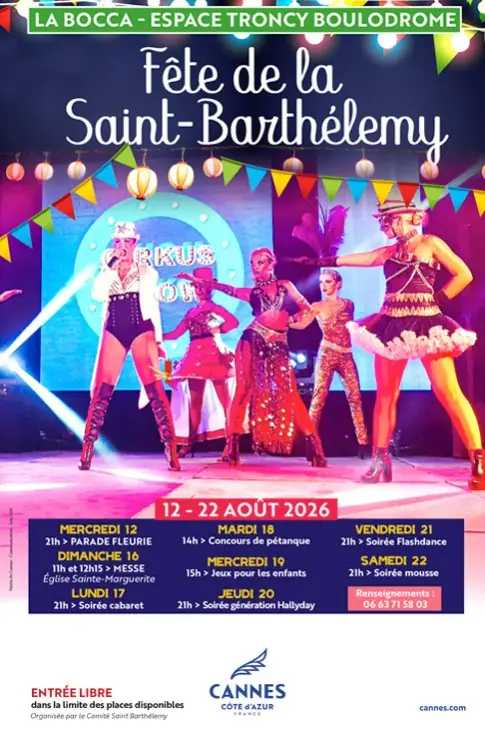
There is a version of Cannes that has nothing to do with film premieres or yacht berths. It lies a few kilometres west of the Palais, in the working-class quarter of La Bocca, where avenue Francis Tonner runs between low-slung apartment blocks and the kind of boulodrome that smells of compacted earth and pastis. Every August, this part of the city holds its own celebration — older, quieter in ambition, and considerably more local in character.
The Fête de la Saint-Barthélemy runs from Sunday 16 to Saturday 22 August 2026, spread across three addresses in La Bocca: the Espace Troncy — Boulodrome Jean Béraudo on avenue Michel Jourdan, the Église Sainte-Marguerite at 27 avenue Francis Tonner, and the Square Joseph Barthélemy on rue du Bosquet. The week is organised around a figure most visitors to Cannes have never heard of, but whose name is carved into the neighbourhood's identity: Joseph Barthélemy, founder of the Verrerie de La Bocca — the glassworks that once gave this quarter its industrial purpose and its people their livelihood.
The Man Behind the Festival
To understand why a glassworks founder still commands a Sunday mass and a wreath-laying in 2026 is to understand something about how French provincial towns remember their benefactors. Barthélemy was not a politician or a soldier; he was an industrialist who created work, and in La Bocca — a neighbourhood that grew up around that work — his memory has been tended carefully. The festival that bears his name is, at its core, an act of civic remembrance dressed in the clothes of a street party.
The week opens on Sunday 16 August with a mass at the Église Sainte-Marguerite, followed by a formal dépôt de gerbes — the laying of wreaths — at the Square Joseph Barthélemy. It is the kind of ritual that takes perhaps twenty minutes and carries the weight of decades. The rest of the week moves at a different tempo entirely.
Seven Evenings, One Quarter
What follows is a programme that makes no attempt at cultural sophistication and is better for it. A soirée cabaret billed as 'Special Women' sets the tone early in the week. The Boulodrome Jean Béraudo — named, pointedly, for another local figure — hosts the Challenge Jean Béraudo, a pétanque competition that will draw serious players: in the south of France, pétanque is not a garden game but a discipline with its own etiquette, its own vocabulary, and its own feuds.
Midweek brings an après-midi récréatif for children, a pause in the adult programming that acknowledges this is a neighbourhood festival, not a ticketed event. Then the evenings accelerate: a 'Génération Hallyday' night pays tribute to Johnny Hallyday, the French rock icon who died in 2017 and whose music functions here less as nostalgia than as shared inheritance. A 'Flash Danse années 80/90' evening follows — the kind of night where the dancefloor fills before nine and the playlist runs from Mylène Farmer to C+C Music Factory. The week closes with a soirée mousse as part of the Summer DJ Tour, which requires no further explanation.
It is also worth noting that a floral parade organised by the Mairie de Cannes is scheduled for Wednesday 12 August — four days before the festival proper begins — along avenue Francis Tonner. The two events share a geography and, presumably, some of the same faces in the crowd.
'La Bocca has always been the part of Cannes that works,' a local historian once observed. The festival, in its own way, proves the point.
For the visitor who arrives in Cannes during the third week of August expecting only the seafront and the rosé bars of the Croisette, the Fête de la Saint-Barthélemy offers something harder to manufacture: an evening in a boulodrome where nobody is performing for anyone, where the pétanque is taken seriously and the cabaret is not ironic. Admission details are not listed — the Mairie's event page at cannes.com carries the current programme — but the addresses are public and the welcome, in the tradition of such fêtes, is assumed rather than withheld.
La Bocca is fifteen minutes by bus from the centre. The effort is modest. The sense of having found something unscripted is rather larger.