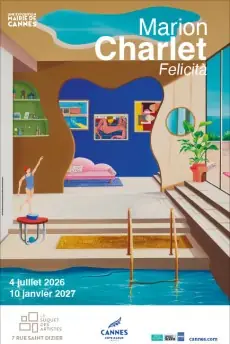
There is a particular quality of light in Cannes on a November morning — softer than summer, stripped of the crowd and the heat, honest in a way the Croisette rarely is. The old quarter of Le Suquet sits above it all, its lanes narrowing as you climb, the sea appearing in unexpected gaps between stone walls. At 7 rue Saint-Dizier, the Suquet des Artistes occupies a building that feels unhurried, removed from the festival machinery that defines the city in the world's imagination. It is the right kind of place for a conversation about painting.
On Saturday, 21 November 2026, at 11 in the morning, that conversation takes a specific and rare form: the curator of the exhibition Felicità — Marion Charlet herself — will lead a guided visit of her own show. The session lasts one hour. Admission runs from €2 to €6.50 depending on age and status, a price that makes the gesture feel genuinely civic rather than exclusive.
Colour, Light, and the Absent Figure
Marion Charlet is a French painter whose canvases refuse the figure. There are no people in her interiors, no faces at the window, no silhouettes caught mid-movement. What remains is the room itself — or rather, the feeling a room leaves behind. Colour pools in corners; light arrives from sources you cannot quite locate. The effect is not emptiness but suspension, as if the scene is held between two moments: the one just passed and the one not yet arrived. Her work has been described, and the exhibition title confirms it, in terms of felicità — the Italian word for happiness, though a happiness that is quiet, almost archaeological, more remembered than felt in the present tense.
Contemporary painting in France has long wrestled with the legacy of figuration — from the post-war intimism of Bonnard's heirs to the cooler spatial investigations that followed. Charlet's position in that lineage is her own: she takes the domestic interior, that most loaded of Western pictorial subjects, and empties it of its protagonist. What the visitor is left with is architecture as emotion, colour as memory.
'La couleur, la lumière et l'absence de la figure humaine donnent naissance à des lieux suspendus, entre mémoire et bonheur.'
What the Hour Offers
A guided visit led by an exhibition's curator is already something. A visit led by the artist who is also the curator — who built the show around her own body of work and made the decisions about sequence, spacing, and light — is a different proposition. Charlet will share the keys to reading her paintings: the logic of colour choice, the way the eye is directed through a canvas, the relationship between absence and presence that structures the whole. Visitors leave not simply having looked, but having been shown how to look.
The practical details are straightforward:
- Date and time:** Saturday, 21 November 2026, 11:00
- Duration:** One hour
- Venue:** Suquet des Artistes, 7 rue Saint-Dizier, Cannes
- Full price:** €6.50 / Reduced (18–25, Cannes Pass Culture, Cannes Seniors Le Club): €4.50 / Further reduced (under 18, students, job-seekers, disability card holders and their companion): €2
The Suquet des Artistes is a short walk from the lower town — up through Le Suquet's cobbled lanes, past the church of Notre-Dame d'Espérance, with the bay opening out behind you as you climb. Allow time for the ascent. The neighbourhood rewards it.
November in Cannes belongs to its residents in a way August never does. The terraces are quieter; the light on the water is long and lateral. To spend a Saturday morning in a hilltop gallery, listening to a painter explain what she was reaching for when she left the figure out of the frame — that is, in its modest and specific way, exactly what a city like this is for.