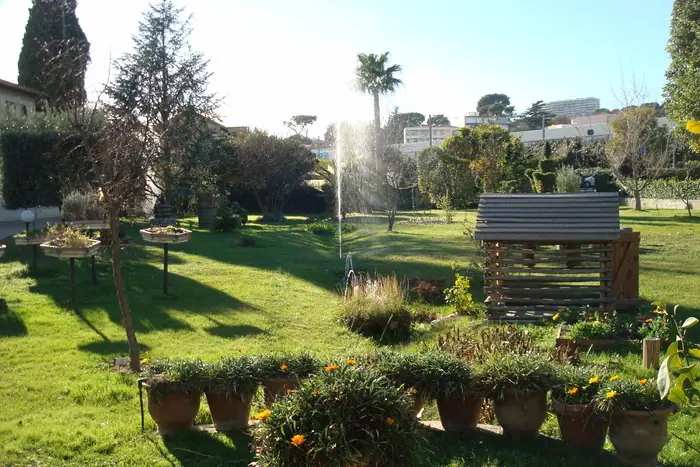
There is a particular quality of morning light on the Côte d'Azur in late June — dry, already warm by eight, the kind that makes old stone walls glow amber before the tourists have ordered their first coffee. On Avenue Germaine, a quiet residential street in Cagnes-sur-Mer, a gate opens onto something the neighbourhood has always known about but rarely seen: the Propriété Marro, a former market garden that has belonged to the same family for generations.
On 27 and 28 June 2026, the property invites visitors in — in small, deliberate groups of no more than 25 — for a guided tour that moves at the pace of the place itself. Entry costs four euros; children under 18 are admitted free. Reservations are required, which is less an administrative formality than a quiet statement of intent: this is not a spectacle, it is a conversation.
What the Slideshow Doesn't Show You
The visit begins indoors, with a short slideshow tracing the evolution of the garden over time. Then comes the eco-museum — a collection of tools that have not been retired to display cases but are still in active use. Visitors watch the shelling of corn and the beating of a scythe blade, gestures repeated here across several generations. These are not reconstructions. The worn handles and the particular angle at which someone swings a faux speak to actual, accumulated habit.
Cagnes-sur-Mer sits between Nice and Antibes, a town of three distinct layers — the medieval hilltop village of Haut-de-Cagnes, the seafront, and the inland residential quarter where this property stands. The coast here was market-garden country long before the villas arrived; the maraîchers who supplied the markets of Nice and Cannes left behind a network of irrigation channels, fruit trees trained against walls, and kitchen gardens laid out with a pragmatism that has nothing to do with fashion. The Propriété Marro is one of the rare surviving examples.
Topiary, Dry Fountains, and a System That Still Works
Moving through the grounds, the tour reveals topiary in several plant varieties and forms — shapes that require years of patient cutting to hold their geometry. More quietly remarkable is the ancestral irrigation system, which remains in functioning order. On the Côte d'Azur, where water has always been a serious matter — the region's lavoirs, canals, and fountains are testaments to centuries of careful husbandry — the survival of a working historic watering system is not a small thing.
Near the end of the visit, guests encounter the dry fountains: stone basins or channels designed to collect and direct water, now silent but structurally intact. They are the kind of detail that stops you, not because they are dramatic, but because they make you recalculate how old the thinking behind this garden really is.
'Nous vous raconterons quelques anecdotes et secrets de jardinage concernant cette ancienne propriété maraîchère appartenant à nos arrières grands parents.'
The hosts offer what no guidebook can: the specific anecdotes and gardening secrets of a family property. The great-grandparents who cultivated this land are present in the layout of the beds, in the choice of which tools were kept and which were discarded, in the particular varieties of vegetables that still grow here. Family memory and horticultural memory have become the same thing.
For the traveller who has seen the formal gardens of the Riviera — the Belle Époque extravagances of Menton, the exotic plantings of the Villa Ephrussi de Rothschild — the Propriété Marro offers something different in register entirely. No landscape architect, no imported palms, no theatrical cascade. Instead: a working inheritance, tended by people who learned from people who learned from people. That continuity is the visit.
The group limit of 25 is worth taking seriously. Book early, arrive on time, and bring the kind of attention you would give a good meal — unhurried, curious, willing to ask questions. The garden will do the rest.