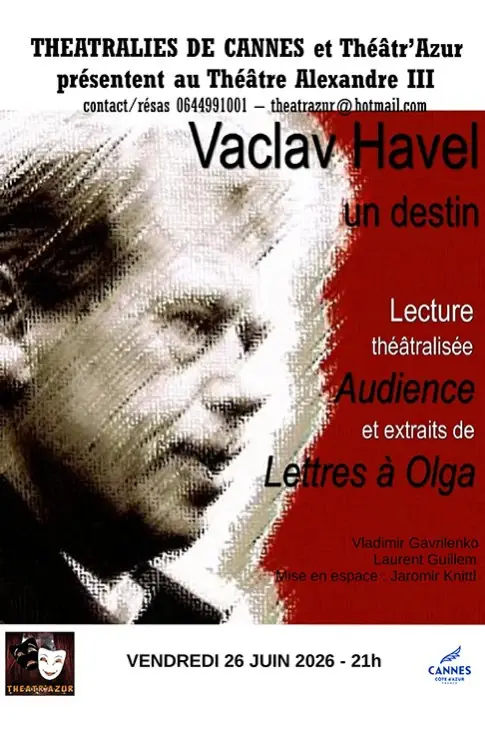
There is something fitting about staging Václav Havel under the Mediterranean sky. Cannes is a city accustomed to spectacle, to the theatre of appearances — red carpets, press junkets, the careful choreography of fame. But on the evening of 26 June 2026, the Théâtre Alexandre III on boulevard Alexandre III will host something of a different register entirely: a theatrical reading that strips performance back to its essentials — a voice, a text, and the weight of history.
The event is part of Les Théâtralies de Cannes, the annual showcase dedicated to new productions by Théâtr'Azur, presented with the support of the Mairie de Cannes. The programme for this evening centres on two works: Audience, a play by Havel, and selected passages from Letters to Olga, written during his imprisonment. Entry is set at 5 €.
The Man Behind the Text
Václav Havel (1936–2011) occupies a singular place in twentieth-century history — not merely as a dissident, nor solely as a statesman, but as someone who insisted, under considerable personal cost, that the two were inseparable. A playwright by training and vocation, he spent years writing absurdist theatre in Czechoslovakia during the normalisation period that followed the crushing of the Prague Spring in 1968. The authorities responded by banning his work, restricting his movements, and eventually imprisoning him. He was held for nearly four years between 1979 and 1983 — the period during which the Letters to Olga were composed, addressed to his wife and smuggled out under the watchful eye of prison censors.
The Velvet Revolution of November 1989 brought an end to communist rule in Czechoslovakia without a single shot fired — a transformation so swift and so complete that it still reads, decades later, like the third act of one of Havel's own plays. Within weeks, he was elected President of Czechoslovakia, and later of the Czech Republic. He remained in office until 2003.
What the Stage Holds
Audience is a short, sharp piece: a face-to-face between an intellectual who refuses to comply and his superior, a man who serves the totalitarian machinery of 1970s Czechoslovakia. The dynamic is recognisable to anyone who has read Kafka — the bureaucratic absurdity, the soft coercion, the way power operates not through violence alone but through the slow erosion of dignity. Havel knew this territory from the inside.
The Letters to Olga add a different texture. Written under censorship, they could not say everything directly, and so they speak obliquely — about identity, conscience, and what it means to remain oneself when the state has decided you should not exist as a public figure. Together, the two works form a portrait of resistance that is neither triumphant nor despairing, but precise and human.
A theatrical reading — lecture théâtralisée — is a form that suits this material well. Without sets or costumes, the language carries everything. The listener is left with the words themselves, and with the question they quietly pose: what would you have done?
'Even a purely moral act that has no hope of any immediate and visible political effect can gradually and indirectly, over time, gain in political significance.' — Václav Havel
The Théâtre Alexandre III is a intimate venue by Cannes standards — the kind of space where the distance between performer and audience collapses, and where a single voice can fill the room without amplification. It sits in the heart of the city, a short walk from the Croisette and the palm-lined boulevard that the world associates with cinema and glamour.
That contrast is not incidental. Havel spent much of his later life reflecting on the relationship between culture and civic life — on what theatre, literature, and art owe to the societies that produce them. An evening dedicated to his work, in a city that hosts one of the world's most watched cultural events, feels less like a coincidence than a conversation.
The performance begins at 21h. For those in Cannes at the end of June — a moment when the festival season has quieted and the city returns to something closer to itself — this is an evening that asks for attention rather than entertainment, and offers something more durable in return.