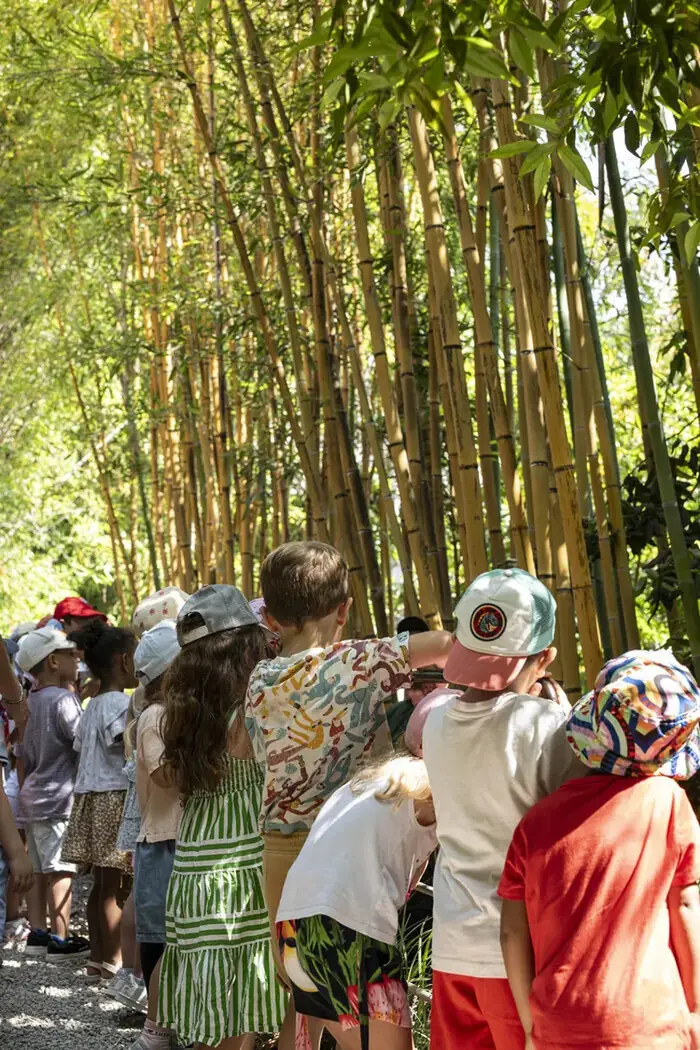
There is a particular quality of light in Menton that painters and botanists have both long understood. It arrives early, filtered through citrus leaves and the white limestone of the Maritime Alps, and it lands on things — on bark, on broad tropical fronds, on the skin of an unfamiliar fruit — with an unusual gentleness. The town sits at the far eastern edge of the French Riviera, pressed against the Italian border, and the mountains behind it create a natural shelter that traps warmth the way a cupped hand holds water. It is this geography, more than any human decision, that made Val Rahmeh possible.
On the morning of Friday, 5 June 2026, the Jardin botanique du Val Rahmeh opens its gates from 10h00 on Avenue Saint-Jacques, offering visitors access to one of the most botanically serious — and quietly spectacular — gardens on the Côte d'Azur. The garden belongs to the Muséum national d'Histoire naturelle, which places it in a different category from decorative civic parks: this is a working scientific institution, a place of collection and conservation, and the distinction shows in how it is tended.
A Microclimate That Exists Nowhere Else in France
The Val Rahmeh sits in a shallow valley between the sea and the mountains, and that position produces something meteorologists classify as a subtropical microclimate — the only one of its kind in the country. Winters here are mild enough, and summers long and warm enough, that species from the Mediterranean basin, sub-Saharan Africa, South America and Southeast Asia can all coexist within a few hectares. More than 1,800 species and varieties grow here: palms, bamboos, citrus in extraordinary variety, and tropical fruit trees that would struggle to survive anywhere else in metropolitan France. Walking through the garden in early June, when the light is long and the heat not yet oppressive, the transitions between botanical zones carry a faint quality of disorientation — the pleasant kind, where the landscape keeps refusing to confirm what country you are in.
The garden's palms alone constitute a serious collection. So do its citrus — Menton has been synonymous with the lemon since at least the 19th century, when the town's mild winters made it the preferred wintering ground for European aristocracy and its groves supplied fruit to much of the continent. That history is embedded in Val Rahmeh's collections in ways that reward the attentive visitor.
Conservation and the Study of Plants and People
Beyond the pleasure of the grounds, Val Rahmeh operates with two formal scientific missions. The first is the conservation of threatened, rare, or wild-extinct plant species — the garden functions, in part, as a living seed bank and refuge for plants that have disappeared or are disappearing from their native habitats. The second mission is ethnobotany: the study of relationships between plants and human cultures, the long entangled history of how people have used, named, feared, worshipped and cultivated the plant world.
"L'ethnobotanique, ou l'étude des liens entre les plantes et les humains" — the garden's own framing of its second mission, and perhaps its most quietly ambitious one.
This dual purpose gives Val Rahmeh a seriousness that distinguishes it from gardens that exist primarily as landscapes. The plants here are not merely ornamental; many carry stories of human dependence, of near-disappearance, of the long negotiation between cultivation and wildness. A visitor who arrives simply for the beauty will find it. A visitor who arrives with curiosity about what the garden is actually doing will find something more.
The practical details are straightforward: the garden is located at Avenue Saint-Jacques, 06500 Menton, and opens at 10h00 on 5 June. Menton itself is easily reached by train from Nice in under an hour, and from the station the old town and its lemon-yellow façades are a short walk toward the sea. Val Rahmeh lies on the eastern edge of the town, close enough to the coast that the salt air is present even among the bamboo groves.
June is a considered moment to visit. The garden is in full growth, the temperatures have not yet reached the intensity of July and August, and the morning hours — before the Riviera sun reaches its midday authority — offer the garden at its most composed. Bring comfortable shoes; the terrain is gentle but uneven in places, and the garden rewards a slow circuit rather than a direct route.