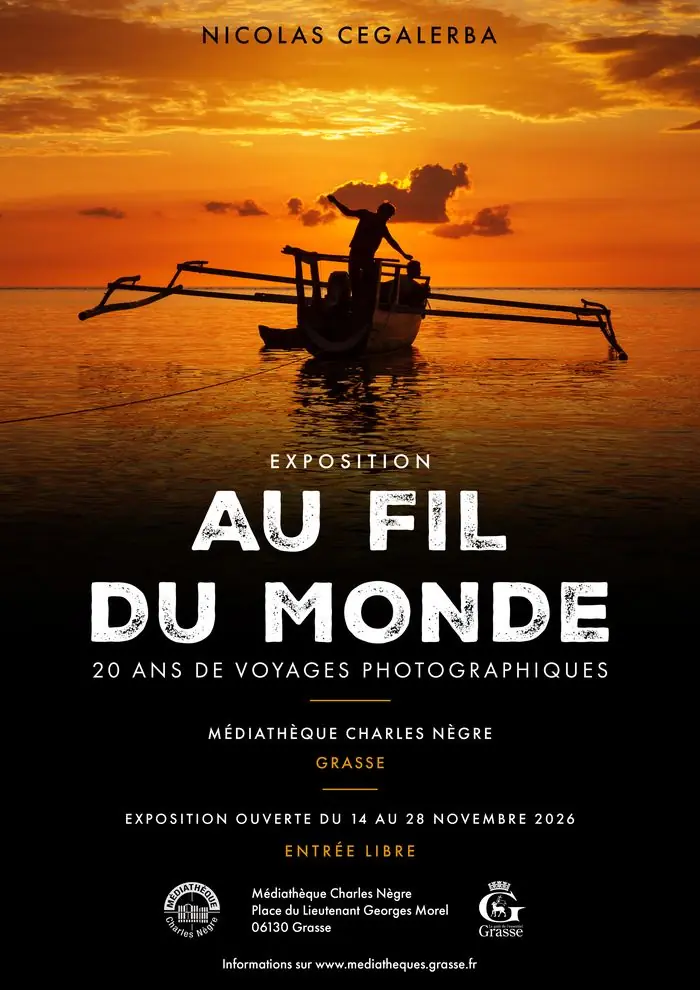
There is a particular quality of attention that settles over a room when someone speaks honestly about another artist's work — not to praise it, but to reckon with it. On Saturday, 14 November 2026, that kind of conversation is scheduled to take place in the basement of a library named after a man who, in the nineteenth century, helped invent the very medium under discussion.
The Médiathèque Charles Nègre sits on Place du Lieutenant Georges Maurel in Grasse — a town most visitors know for its perfume industry and its hillside geography, the old streets stacked above the Provençal plain like a cabinet of drawers left half-open. The library takes its name from Charles Nègre, a Grasse-born photographer and painter who worked in the 1840s and 1850s, at a moment when the photograph was still a novelty with uncertain ambitions. The institution honours that lineage seriously: its artothèque offers original works — engravings, silkscreens, lithographs, photographs — available not only to view but to borrow, a civic generosity that is rarer than it sounds.
The Film at the Centre of the Conversation
The event is part of the 'Échanges bord de scène' series run by L'Atelier NJ Photo Grasse, and it revolves around a documentary that has lost none of its weight since its release: Le sel de la terre, directed by Juliano Ribeiro Salgado and Wim Wenders, following the Brazilian photographer Sebastião Salgado across decades of work in some of the world's most damaged and most astonishing landscapes. The film is not comfortable viewing. It asks what it means to spend a life looking at suffering and beauty with the same disciplined eye, and whether that act of looking changes anything — in the world, or in the person holding the camera.
Nicolas Cegalerba, a photographer working within L'Atelier NJ Photo Grasse, will lead the discussion. The format is an exchange — the French word échange carries a mutuality that 'talk' or 'lecture' does not — built around his own practice and the questions the Salgado documentary raises. What draws a photographer to certain subjects? How does one work within a collective or workshop structure? Where does documentary intention end and something more personal begin?
'Le sel de la terre' follows Salgado not as a monument but as a man — someone who returned to his exhausted family farm in Brazil and, over years, helped replant two million trees. The film is as much about restoration as it is about bearing witness.
What to Expect on the Day
The session takes place at 16h00 in le PIXEL, the dedicated space on level -3 of the Médiathèque Charles Nègre. Entry is free, and places are limited to 90 — a number that keeps the room intimate enough for real back-and-forth without reducing it to a seminar. No registration details are listed in the programme, so arriving with some margin before four o'clock is advisable.
For anyone who has spent time with Salgado's photographs — the silver-grey panoramas of the Serra Pelada gold mine, the portraits from the Sahel, the later Genesis series with its almost unbearable tenderness toward the natural world — the conversation will offer a working photographer's close reading of that legacy. For those who haven't, the documentary itself serves as a sufficient and affecting introduction.
Grasse in November is a different proposition from Grasse in July. The tourist infrastructure has quietened, the light comes in at a lower angle across the limestone hills, and the town returns to something closer to its working self. An afternoon in a basement named after a nineteenth-century pioneer of photography, talking about a twenty-first-century master of it, feels exactly right for the season — unhurried, specific, and worth the drive up from the coast.