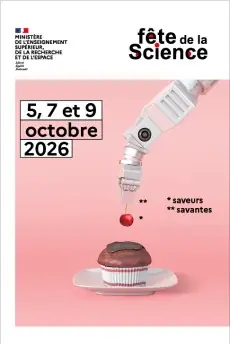
There is a moment in any good kitchen when chemistry takes over from instinct — when sugar darkens past golden into something irreversible, when oil and water decide, against all logic, to hold together. Most of us accept that moment as magic. On Friday, 9 October 2026, the Faculté des métiers and École hôtelière de Cannes invite you to understand it instead.
The Parcours scientifique 'Saveurs Savantes' runs from 9 h to 17 h at the school's campus on 54/56 rue de Cannes in Cannes La Bocca — the working-class western quarter that sits at a deliberate remove from the Croisette's theatre of glamour. Entry is free. The day is organised in partnership with the direction des Médiathèques, the Agglomération Cannes Lérins and the Maison de l'IA, a coalition that signals something more than a cooking demonstration: this is a conversation about where food, science and technology meet.
The Science on the Table
The programme moves through the fundamentals of kitchen chemistry with the kind of rigour you might expect from a professional hospitality school. Caramelisation, emulsions, fermentation, the manipulation of textures — each station is designed to make visible the reactions that cooks rely on daily without necessarily naming them. Blind tastings and quizzes punctuate the itinerary, sharpening attention in the way that only the removal of visual cues can.
'Saveurs Savantes' is, at its core, an argument that understanding why something works in a recipe does not diminish the pleasure of eating it — it deepens it.
The Mediterranean kitchen provides the afternoon's practical anchoring: a workshop on cuisine méditerranéenne draws on a pantry that the Côte d'Azur has refined over centuries — olive oil, aromatics, preserved citrus, the slow legumes of the arrière-pays. Alongside it, an atelier antigaspi addresses food waste with the same methodical attention, framing frugality not as compromise but as craft.
Intelligence, Artificial and Otherwise
Perhaps the most pointed item on the programme is the conference on artificial intelligence in the kitchen. The Maison de l'IA's involvement here is not incidental: Cannes, a city whose identity has long been shaped by the industries of image and spectacle, is quietly building infrastructure for a different kind of creative economy. What does it mean when an algorithm can suggest flavour pairings, optimise fermentation cycles or model the behaviour of a new emulsifier? The conference does not promise answers, but the question itself is worth a seat.
Screenings and a photographic exhibition on sustainable food systems round out the day, lending it a reflective quality that distinguishes it from a trade fair or a school open day. The images — the subject of which is alimentation durable — ask visitors to consider the full arc of what they eat, from cultivation to plate to compost.
The venue is, in its own right, worth noting. The École hôtelière de Cannes is one of the region's serious training grounds for the hospitality professions — the kind of institution whose graduates end up in the brigades of restaurants along the bay and beyond. Spending a day inside its walls offers a perspective on the Côte d'Azur that no beach club or palace hotel can provide: the working knowledge behind the region's celebrated art of living well.
For families, students, food professionals and anyone who has ever wondered why a hollandaise breaks or a soufflé falls, the itinerary offers something at each level of curiosity. The day asks nothing of you except attention — and the willingness to taste something you cannot yet identify.