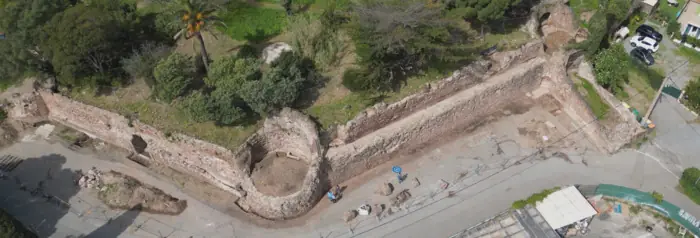
There is a particular quality to the light on the Butte Saint-Antoine in the early morning — the kind that arrives low and flat from the direction of the Var plain, catching the rough stone and the scrub in equal measure. The hill sits at the edge of modern Fréjus, unhurried and largely unannounced, while the town below gets on with its summer. But the ground here is older than almost anything the Côte d'Azur puts on display, and on Sunday 14 June 2026, an archaeologist will walk visitors across it at 09:00 and again at 13:00, explaining precisely what it contains.
The visit, conducted along the Chemin de la Lanterne d'Auguste, centres on the enclosure that once defined the summit of the butte — and on the latest research that has been reshaping what scholars understand about it. It concludes at the Lanterne d'Auguste, the ancient tower that still punctuates the skyline above the old harbour basin.
The First City Forum Julii Ever Built
The history beneath this hill is not merely old — it is foundational. Archaeological excavations have established that the earliest traces of Roman occupation on the Butte Saint-Antoine date to the late 40s BC, with organised domestic structures dated to 45–44 BC. This coincides precisely with the founding of Forum Julii, the Roman colony that would eventually become Fréjus. What the digs revealed, in other words, is not a later suburb or a military outpost, but the original urban nucleus: the forum and the first civic structures of the colony were here, on this hill, set apart from what would later become the town centre.
The remains speak to a society still finding its footing. Most of the housing from this earliest phase was modest — practical structures for settlers making a new place habitable. One exception: a more substantial house built in an Italian domestic style, its presence suggesting that wealthier colonists, or perhaps administrators, arrived alongside the ordinary inhabitants.
The transformation came quickly. By 27–25 BC, the character of the site changed entirely. A formal enclosure wall was constructed, and significant earthworks were laid in to support a monumental administrative complex — most likely a praetorium, the kind of building used to govern a region and coordinate military operations. Forum Julii was, from its earliest decades, a naval base of consequence, and the butte overlooked the port. The complex here would have been the point from which Rome administered this stretch of coastline and supervised the movement of its fleet.
'Cette visite menée par une archéologue vous révélera les dernières recherches sur l'enceinte de la Butte Saint-Antoine et se poursuivra en direction de la Lanterne d'Auguste.'
What the Walk Covers
The visit is led by an archaeologist — not a guide working from a script, but someone directly involved in the research — which means the conversation on the ground reflects current findings rather than settled consensus. The Butte Saint-Antoine is a site where interpretation is still evolving, and that makes the guided format more than a formality.
The route moves through the enclosure itself before continuing toward the Lanterne d'Auguste, the Roman tower at the entrance to what was once the harbour. The lanterne — its name a later, romantic reading of its silhouette — is one of the few Roman structures in Fréjus that has remained continuously visible above ground. Standing beside it, with the étang and the distant Maritime Alps in view, the geography of the ancient port becomes legible in a way that no plan or photograph quite manages.
Fréjus holds one of the densest concentrations of Roman remains in France: an amphitheatre, aqueduct, theatre, and city walls, most of them still standing to a degree that surprises first-time visitors. The Butte Saint-Antoine is less visited than those monuments, which is partly what makes this morning worthwhile. The site is not yet fully excavated; the research is not finished; the archaeologist leading the walk will say so.
Two time slots — 09:00 and 13:00 — are available on the day. The morning session, before the June sun reaches full height, is the easier choice for anyone planning to spend the afternoon elsewhere along the coast. Arrive at the Chemin de la Lanterne d'Auguste, 83600 Fréjus, and allow the hill to do the rest.