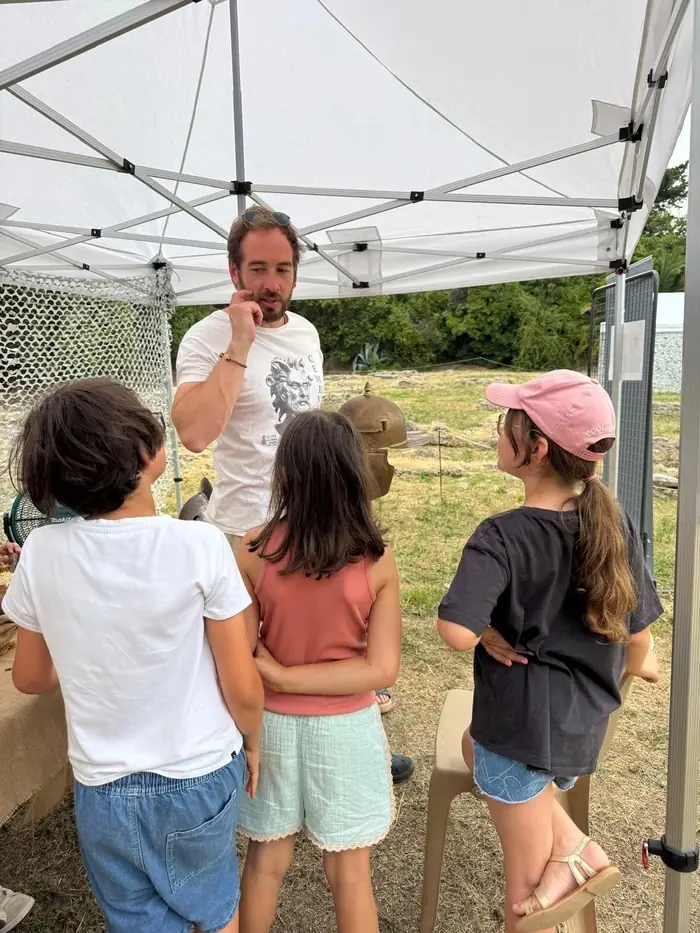
There is a particular quality to the light on the Cimiez hill in early summer — softer than the blaze of the Promenade below, filtered through the canopy of century-old olive trees that line the avenue des Arènes. Up here, the noise of Nice retreats. The traffic, the sea, the espresso machines — all of it falls away, and what remains is a quieter city, older by some two thousand years.
This is Cemenelum. Not a name most travellers carry with them when they arrive on the Côte d'Azur, but one worth learning. It was the Roman capital of the province of Alpes Maritimae, established on the same limestone ridge that today holds the Cimiez neighbourhood, its rose gardens, and the ochre-walled museum that guards what the earth gave back.
On 13 and 14 June 2026, the Musée Archéologique de Nice–Cimiez opens its permanent collections to guided visits — free of charge, no reservation required, subject to available places. The event, held under the title Cemenelum côté musée, runs from noon on both days, at 160 avenue des Arènes de Cimiez. It is a modest proposition on paper. In practice, it is something rather more considered.
What the Collections Hold
The objects on display were largely recovered during archaeological excavations carried out between 1950 and 1969, after the city of Nice acquired the site. Coins, ceramic vessels, bronze instruments, official inscriptions, private documents — the texture of a provincial Roman town, rendered in fragments. But the collections extend beyond Cemenelum itself. Artefacts from across the broader region are included, among them objects recovered from the wreck of the Fourmigue C, discovered off the coast of Golfe-Juan. A Roman shipwreck on the floor of the Mediterranean, its cargo now arranged in a hillside museum above the Riviera: there is a certain poetry in that journey.
The guided visit covers these permanent collections — the daily life of Cemenelum and the province of Alpes Maritimae, seen through the objects that administrators, merchants, soldiers, and ordinary inhabitants left behind. A guide will lead visitors through the rooms, providing the kind of contextual reading that transforms a display case of ancient glassware into a legible world.
«Les collections concernent la vie de Cemenelum et de la province des Alpes Maritimae, à travers les nombreux objets et documents officiels ou privés découverts lors des fouilles archéologiques.»
The Hill Above the City
Cimiez has always attracted those who preferred elevation — literal and otherwise. Queen Victoria wintered here in the 1890s, staying at the Hôtel Excelsior Regina, whose facade still presides over the neighbourhood. Henri Matisse lived and worked nearby for much of his later life, and is buried in the monastery cemetery a short walk from the museum. The Franciscan church beside the monastery holds altarpieces of quiet, startling beauty.
The Roman arena — the amphitheatre that gives the avenue its name — stands adjacent to the museum, open to the sky. In summer it hosts the Nice Jazz Festival; in June, before the crowds arrive, it is simply a ruin in a garden, which is its best form.
For the visitor who arrives on one of these two afternoons, the experience is layered without being laborious. The museum is not large, which works in its favour: the collections are focused, the rooms navigable, and the guided format means there is someone to ask about the things that resist explanation — the half-legible inscriptions, the purpose of a particular tool, the geography of a province that no longer exists by that name.
No ticket purchase is needed. No itinerary to book in advance. Simply arrive at the museum on 13 or 14 June, at noon or thereafter, and join the visit while places remain. Then, afterwards, walk out into the olive-shaded garden, look south toward the bay, and consider that the people who once administered this hilltop could see the same water.