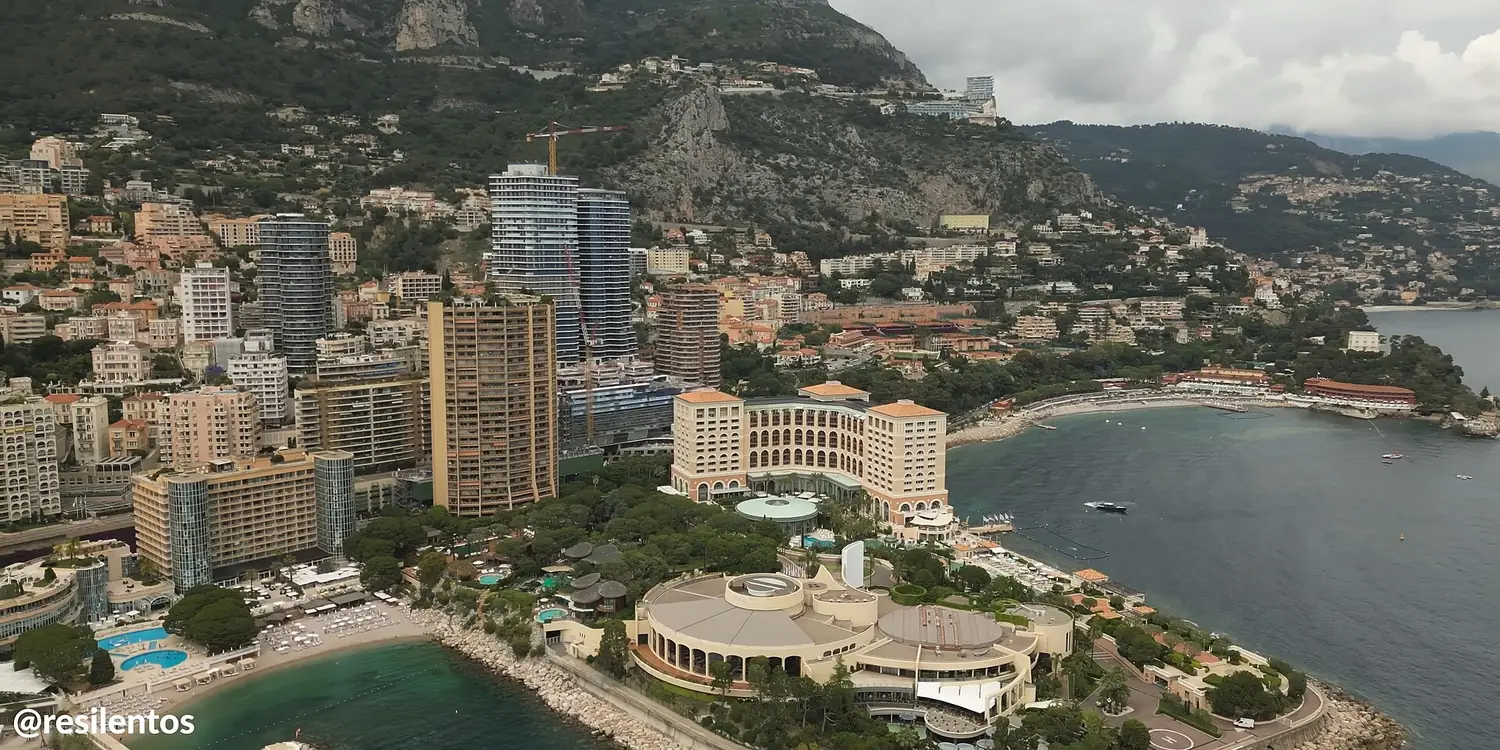
There is a moment, sometime after the sun has dropped behind the headland and the last light has gone from the water, when the roof of the Salle des Étoiles begins to move. Slowly, mechanically, without ceremony, the ceiling parts — and suddenly the concert hall has no ceiling at all. Above the stage: the full Mediterranean night, stars unobstructed, the faint salt smell of the sea carried in on whatever breeze the Principality allows in summer. It is a piece of theatre that no lighting designer could have conceived. The venue does it every fine evening, and it never loses its effect.
This is the setting for the Monte-Carlo Summer Festival 2026, which runs from 3 July to 15 August at the Salle des Étoiles, Sporting Monte-Carlo, 26 avenue Princesse Grace. Tickets are sold concert by concert — there is no season pass — which means each evening stands alone as its own occasion, with its own crowd, its own dress code negotiated privately between the guest and the Monégasque heat.
A Programme That Moves Between Registers
The festival opens not at the Salle des Étoiles but at the Opéra Garnier, where Sébastien Tellier performs on 3 July — an apt choice for a venue whose gilded Belle Époque interior was designed by Charles Garnier, the same architect responsible for the Paris Opéra. Tellier's particular brand of melancholic French pop sits comfortably in that gilded room. The Opéra Garnier reappears in the programme on 31 July, when Vanessa Paradis takes the stage — an artist whose career has moved, over four decades, between pop, cinema and something closer to chanson, and who remains one of the more quietly compelling live performers in French music.
The main sequence at the Salle des Étoiles begins in earnest on 7 and 8 July with Jon Batiste and Jason Derulo — two American artists who represent, between them, a considerable range of what popular music currently does with rhythm and spectacle. Then the programme pivots: 21 July brings The Last Dinner Party, the British rock group whose debut attracted unusual critical attention; 22 July, Aya Nakamura, whose French-language Afropop has made her one of the most-streamed artists in the world; 23 July, Juanes, the Colombian singer-songwriter who has spent twenty years making Latin rock that travels; and 26 July, John Legend, whose voice and piano remain a reliable constant in contemporary soul.
August brings LP — the American singer-songwriter known for a falsetto and a ukulele that have, improbably, become a signature — and Lisa Stansfield, the Rochdale-born soul singer whose 1989 debut remains a touchstone of British blue-eyed soul. The festival closes with Laura Pausini, the Italian pop singer whose career spans more than thirty years and whose following in southern Europe and Latin America is, by any measure, extraordinary.
The Room Itself
The Salle des Étoiles — the Hall of Stars, and the name is literal — was built facing the sea, which means that on clear evenings, with the roof open, the horizon is somewhere out there in the darkness beyond the stage. Dinner is served at tables set below the performance space, so the experience is closer to a supper club at scale than to a conventional concert hall. The formality is real but not stiff; Monaco has always understood that luxury and ease are not opposites.
Sporting Monte-Carlo, the complex that houses the venue, sits at the eastern edge of the Principality, a short distance from the border with France. The avenue Princesse Grace runs along the waterfront here, and on summer evenings the road fills with the particular slow traffic of people who are in no hurry to be anywhere else.
'Aux beaux soirs, il s'efface et le concert se poursuit sous les étoiles, dîner servi en contrebas de la scène.' — Sporting Monte-Carlo, on the Salle des Étoiles
For a visitor arriving from elsewhere on the Côte d'Azur — Nice is twenty minutes by road, Cannes perhaps forty — the festival offers something that the larger summer events along the coast do not always provide: intimacy at scale. The Salle des Étoiles is not a stadium. The distances between the audience and the performer are human. The sound, when the roof is open, goes up into the night rather than bouncing back from a ceiling, which changes the acoustic quality of everything — makes it feel less contained, more provisional, more alive to the moment.
Practical details are straightforward: tickets are available per concert through the Sporting Monte-Carlo website at montecarlosbm.com. The programme runs across six weeks, with enough variety in genre and register that a thoughtful visitor might plan two or three evenings around different artists. The Principality's hotels fill quickly in July and August; those arriving for a single evening often find it easier to base themselves in nearby Beausoleil or Cap-d'Ail and take a taxi along the coast road.
What the Monte-Carlo Summer Festival offers, in the end, is a particular convergence: serious international artists, a venue with a genuinely unusual physical character, and the specific quality of a Mediterranean night in high summer — warm, unhurried, faintly cinematic. The roof opens. The stars appear. The music begins.