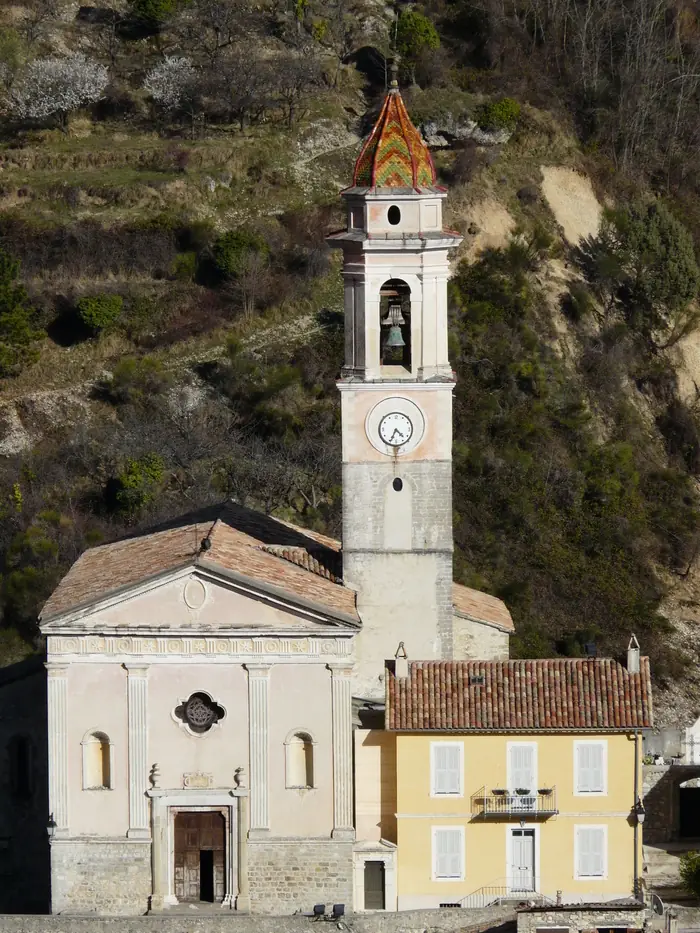
There is a moment, somewhere on the road up from Nice through the Paillon valley, when the landscape stops being merely pretty and starts being something older. The terraced slopes close in, the villages grow quieter, and eventually the road delivers you to Lucéram — a knot of medieval stone balanced on a ridge at roughly 650 metres, its bell tower visible long before the rest of the village resolves into focus. This is the arrière-pays niçois at its most unhurried, a place where the 21st century has arrived selectively and without much urgency.
On Sunday 28 June 2026 at 14h30, the Maison de Pays de Lucéram on place Adrien Barralis hosts a lecture titled 'Le patrimoine lucéramenc à travers l'histoire' — a structured, story-led account of how this village came to look and feel the way it does. Entry is free.
From Origins to the Present
The lecture traces Lucéram's arc from its medieval beginnings to the present day, drawing on historical records, local anecdotes, and architectural evidence. The focus moves across several interlocking themes: the physical fabric of the village — its narrow lanes, surviving ramparts, and religious buildings — and the agricultural and social traditions that gave the community its particular character. An olive mill, painters drawn to the light, a church whose altarpieces have been compared to the finest in the Alpes-Maritimes: these are among the threads the talk promises to pull together.
Lucéram belongs to a cluster of villages in the Comté de Nice that passed between Savoyard, French, and Piedmontese influence over the centuries before the region's final attachment to France in 1860. That layered political history left its mark on local architecture, dialect, and custom in ways that are still legible if you know where to look. The lecture is, in part, a guide to looking.
'C'est une invitation à comprendre comment ce patrimoine s'est construit au fil des siècles et continue de vivre dans le quotidien du village.'
What a Sunday Afternoon Here Actually Feels Like
The Maison de Pays is the natural hub for this kind of event — a community space in the heart of the village, the sort of place where local knowledge tends to pool. Arriving at half past two on a June afternoon, you will find the stone already warm from the morning sun and the lanes largely clear of the weekend crowds that gather lower in the valley. Lucéram in summer has the quality of a place that rewards patience: the more slowly you walk it, the more it gives back.
The programme is built around storytelling as much as scholarship — 'récits et anecdotes' alongside historical analysis — which means it should be accessible to visitors with no particular background in regional history. That said, those who have already wandered the village and found themselves curious about a carved lintel or a half-legible inscription on a wall will find the lecture a useful key.
What to do before or after is not complicated:
- The church of Sainte-Marguerite holds a collection of primitive altarpieces attributed to the Nice school of the 15th and 16th centuries — small panels, intense colour, worth the few minutes it takes to let your eyes adjust to the interior light.
- The lanes between the ramparts are short but layered; a circuit of the old perimeter takes under half an hour on foot.
- The surrounding countryside, terraced for olive cultivation for centuries, is walkable from the village centre.
Lucéram is roughly 26 kilometres from Nice by road and is served by public transport via the Paillon valley bus routes, which makes it a plausible afternoon destination without a car, though timings should be checked in advance.
The lecture costs nothing, lasts as long as the conversation does, and takes place in a village that has been asking the same questions about its own continuity for the better part of eight hundred years. That, in itself, is a reasonable reason to make the drive.