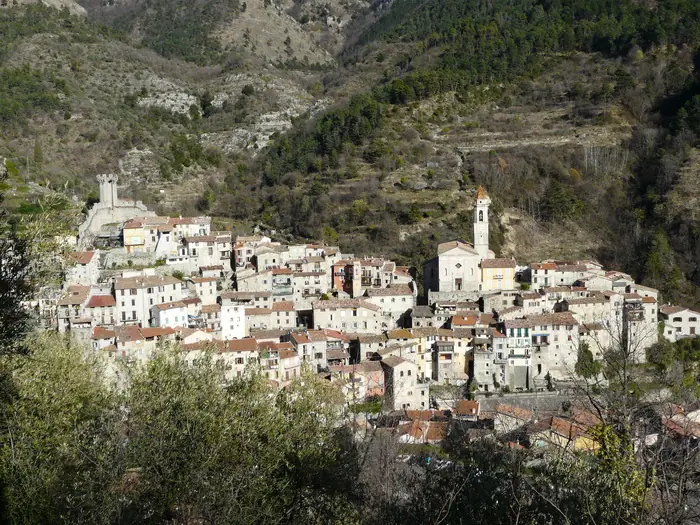
There is a particular quality to light in the Niçois hinterland in late June — not the flat, bleached glare of the coast, but something angled and specific, the kind that catches the edge of a stone archway and makes it look freshly cut. Lucéram sits at roughly 650 metres above sea level, folded into the valley of the Paillon de l'Escarène, and from certain angles the village seems less built than assembled — house stacked upon house, terracotta against pale render, the whole thing anchored by a bell tower that has been keeping time here since the medieval period. The air smells of warm limestone and, faintly, of the pine forests that close in on three sides.
On Saturday, 27 June 2026, at 14h30, the Maison de Pays de Lucéram — located on place Adrien Barralis — opens its doors to a free guided visit of the village. The walk is free of charge and leads through the cobbled lanes, vaulted passages, and old houses that define this particular corner of the arrière-pays niçois, with the surrounding mountains visible at almost every turn.
A Village Built on Layers
Lucéram is one of those places that rewards the slow walker. The street plan has not been rationalised; it follows the logic of medieval necessity rather than modern convenience, which means passages narrow unexpectedly, stairways appear mid-block, and a courtyard opens where you expected a wall. The guided format matters here — without it, a visitor might admire the surfaces and miss entirely what lies beneath them.
The village's baroque church is one of the stated focal points of the visit, and with good reason. This part of the pre-Alpine territory was, from the fourteenth century onward, a crossroads between the County of Nice and the Italian Piedmont — a position that left its mark on local religious art. The church at Lucéram is known for its collection of works attributed to the Niçois primitive painters, a group of artists active in the fifteenth and sixteenth centuries whose retables — altarpieces painted on wood with gold-leaf grounds and figures of precise, Byzantine-inflected intensity — are among the most significant examples of late-medieval painting in the region. Several of these works remain in situ in village churches throughout the arrière-pays, which is part of what makes guided visits like this one worth taking seriously rather than treating as a casual stroll.
The retables of the Niçois primitives were never meant to travel. They were made for specific altars, specific communities — and in Lucéram, that relationship remains intact.
The broader patrimoine of the village — its fortified layout, its ancient houses, its traditions — reflects a history shaped by altitude and relative isolation. For centuries, Lucéram was a staging post on the salt road, the route des sel, that connected the coast to the mountain valleys. Salt was currency, and the villages along this corridor accumulated both wealth and influence in ways that their modest scale today does not immediately suggest.
What the Afternoon Holds
The guided visit departs at 14h30 and is led through the framework that the Maison de Pays — a local heritage and welcome centre — has developed around the village's key sites. Expect to move through:
- The cobbled lanes and vaulted passages of the medieval centre
- The baroque church and its patrimony of religious art
- Viewpoints over the surrounding mountain landscape
- The broader architectural and historical context of the village
The pace of a guided walk in a village of this scale is, by nature, unhurried. Lucéram is not large; what makes the experience worthwhile is the density of what it contains relative to its size, and a guide's ability to make that density legible.
Admission is free. No booking details are specified in the available information, so arriving at the Maison de Pays de Lucéram, place Adrien Barralis, at or before 14h30 is the practical approach.
From Nice, Lucéram is reachable in under an hour by road, following the valley of the Paillon inland through Contes and L'Escarène. The drive itself is a reasonable argument for the visit — the coast recedes, the valley narrows, and the villages along the route each carry their own version of this same layered, mountain-Mediterranean character. Arriving in Lucéram on a June afternoon, with the light doing what it does at that hour and that altitude, is not a dramatic experience. It is a quiet one. Which, in the end, is rather the point.