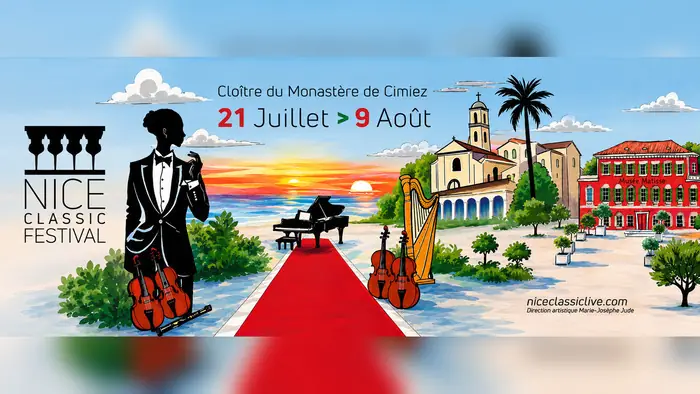
There is a particular quality to Sunday afternoons in Cimiez. The old Roman district sits above the city like a held breath — cooler than the seafront, quieter than the Vieille Ville, its umbrella pines casting long shadows across the ruins of an amphitheatre that predates the Riviera's entire mythology of glamour. On the 21st of June, that stillness will be interrupted, deliberately and beautifully, by the first chords of the Nice Classic Festival.
The concert takes place at four o'clock in the afternoon inside the Auditorium du musée Matisse, at 164 avenue des arènes de Cimiez — a venue whose address alone signals a certain seriousness of purpose. The Matisse Museum occupies a seventeenth-century Genoese villa, its ochre façade looking out over gardens where the painter himself once walked. To hear music here is to layer one sensory language over another.
A Programme Kept Secret
The festival has chosen to open with an act of restraint and intrigue: the programme is a surprise. What is confirmed is the cast. Marie-Josèphe Jude, one of France's most respected pianists, will perform alongside Charles Heisser, also at the piano, and Clarissa Severo de Borba on percussion. It is an unusual and suggestive combination — two keyboard voices and a percussionist, a triangle of rhythm and resonance that could take the afternoon in almost any direction.
'Première note' — the first note — carries the weight of everything that follows. A festival announces itself not just with a programme but with a tone.
Marie-Josèphe Jude has long been associated with the French piano repertoire, her playing characterised by clarity and a refusal of sentimentality. Clarissa Severo de Borba brings a different texture: percussion in a classical concert context is rarely decorative, and her presence here suggests the programme will have edges. Charles Heisser, a pianist with an affinity for chamber music, completes a trio whose chemistry, on paper, promises genuine conversation rather than parallel performance.
Cimiez as Setting
The neighbourhood itself is worth arriving early for. The Musée Matisse holds a permanent collection that traces the artist's relationship with Nice across several decades — from the early Fauvist oils to the luminous cut-outs of his final years. The gardens outside are open and unhurried, the kind of place where a half-hour before a concert feels like a gift rather than dead time. The Roman ruins of Cemenelum, the ancient capital of the province of Alpes-Maritimes, are visible nearby, a reminder that this hilltop has been drawing people for two thousand years.
June the 21st is also the date of the Fête de la Musique across France — a national day of music-making that fills streets, courtyards and parks from Dunkirk to Marseille with performances of every conceivable kind. To open a classical festival on this day is a statement of belonging: the Nice Classic Festival positions itself not as a rarefied alternative to the popular celebration but as part of the same broad impulse, the idea that music is a common inheritance rather than a specialist pleasure.
Attendance is limited — places are restricted and the intimacy of the auditorium is part of what the organisers are offering. This is not a festival that begins in a stadium. It begins in a room, with three musicians, and a programme that nobody knows yet. That combination of calibre and mystery is, in its way, a more compelling invitation than any printed running order.
The Riviera in June is already fully itself — the light sharp and long, the evenings warm enough to walk without a jacket, the city balanced between the end of spring and the full weight of summer. An afternoon of classical music in Cimiez, in a museum named for a painter who spent his life trying to capture exactly this quality of light, feels less like an event than a natural consequence of the place and the season.